
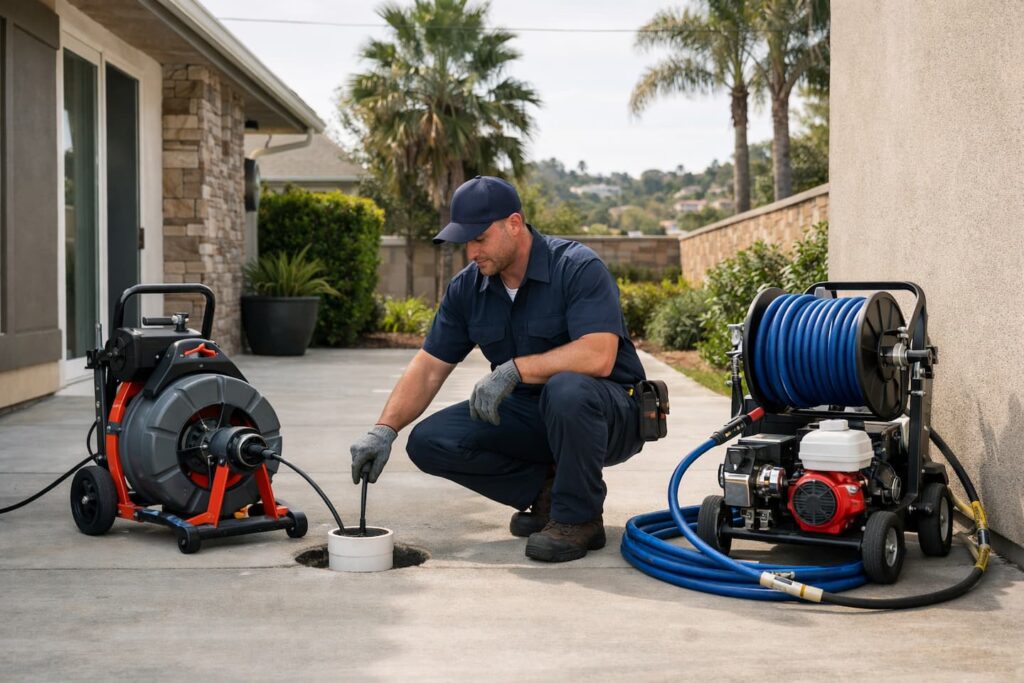
When a drain backs up once, most homeowners just want it open again. When it keeps happening, the real question changes.
At that point, the issue is no longer just how to get water moving today. It becomes a much more important question: why does this line keep falling back into the same problem? That is exactly where the difference between drain snaking and hydro jetting starts to matter.
Both methods are legitimate. Both are used by plumbers every day. Both can restore flow. But they are not interchangeable, and they are not trying to achieve the exact same result. Snaking is usually about getting through the blockage and reopening the line. Hydro jetting is usually about cleaning the inside of the pipe much more thoroughly so buildup is less likely to cause the same problem again.
That distinction is easy to miss when you are standing in front of a backed-up sink or shower and just want the immediate problem gone. But it matters a lot with recurring clogs, because recurring clogs are usually not random. They tend to come from grease that keeps coating the pipe wall, sludge that keeps narrowing the line, soft debris that keeps rebuilding after every temporary opening, or roots and pipe defects that keep creating the same obstruction pattern.
So which one actually solves recurring clogs? In many real-world cases, snaking is the faster way to reopen the drain, while hydro jetting is the better way to deal with the buildup that keeps making the drain clog again. That does not mean hydro jetting is always the answer. It means the right choice depends on whether the line needs a quick opening, a more complete cleaning, or a closer look at a deeper sewer problem.
This guide explains how each method really works, where each one is strongest, when snaking is enough, when hydro jetting is the better long-term play, and when recurring clogs are actually warning you that the issue may be bigger than cleaning alone.
Why recurring clogs are different from one-time clogs
A one-time clog is often just an event. A recurring clog is usually a condition.
That difference sounds small, but it changes everything about how the line should be approached. A one-time blockage may come from something obvious and isolated: hair, food waste, a heavy wad of paper, a small object, or a temporary buildup in one trap or branch line. In that kind of situation, restoring flow may genuinely solve the problem.
Recurring clogs are different because the line is usually not returning to a truly clean, normal state after service. It may be draining again, but it is still narrowed, rough, dirty, or structurally vulnerable. Grease may still be stuck to the pipe walls. Soap and sludge may still be coating the branch line. Roots may still be intruding through a weak point. Debris may still be catching in the same trouble spot every time water use gets heavy enough.
That is why homeowners often describe the same frustrating pattern: the drain is fixed, it works for a while, then it starts slowing down again, then the clog comes back. The important detail is that the line was restored to flow, but not necessarily restored to good condition. With recurring clogs, that difference matters more than the service name on the invoice.
So before comparing hydro jetting and snaking, it helps to frame the problem correctly. The real goal is not just to get the drain open. The goal is to figure out what kind of obstruction pattern is actually happening inside the pipe — and whether the line needs reopening, deep cleaning, or inspection for something more serious.
What drain snaking actually does
Drain snaking is often misunderstood as a simplistic “poke a hole through the clog” method. In reality, it is more capable than that — but it still has limits.
A snake, auger, or mechanical cable works by physically moving through the line and attacking the obstruction directly. Depending on the tool and the attachment being used, it can break through a blockage, cut through root intrusion, scrape material off part of the pipe wall, retrieve certain kinds of debris, or open a channel wide enough for water to pass again.
This is why snaking is so common. It is practical, versatile, and often the fastest way to restore basic use. If a toilet is backed up, a shower line is blocked by hair, or a kitchen drain has one localized stoppage, snaking is often the right first move because the immediate goal is simply to reopen the line safely and quickly.
Snaking also has real advantages beyond speed. It can be effective in smaller lines, isolated fixtures, and situations where access is limited. It can also be useful when the pipe condition is uncertain and the smartest first move is to restore flow before deciding whether deeper cleaning or camera inspection is appropriate.
But here is the key limitation: opening a line is not the same thing as fully cleaning a line. A snake may cut a path through grease, sludge, or soft debris and get the drain flowing again without actually removing most of the buildup that remains around the rest of the pipe interior. That is why snaking can solve the immediate stoppage and still leave the line vulnerable to another clog in the near future.
That does not make snaking the wrong method. It just means its strength is often immediate restoration, not necessarily the most complete pipe-wall cleaning possible.
What hydro jetting actually does
Hydro jetting approaches the problem differently. Instead of mechanically working through the obstruction with a cable, it uses high-pressure water to scour the inside of the pipe and wash debris down the line.
That difference is what makes hydro jetting so attractive for recurring clogs. The goal is not just to punch a usable opening through the blockage. The goal is to clean the pipe interior much more thoroughly so grease, sludge, soap film, loose scale-associated buildup, and soft debris are removed from the walls rather than left behind.
In practical terms, this means hydro jetting is often much better suited to lines that have become gradually narrowed over time. Think of kitchen drains with years of grease film, main lines with sticky buildup catching paper and solids, or branch drains that keep clogging because residue is coating the pipe instead of sitting in one isolated lump.
Hydro jetting can also be equipped for different conditions. With the right nozzle setup, it can cut through certain root intrusions, flush out accumulated debris, and clean line segments that a basic cable may only partially restore. That is why hydro jetting often comes up in conversations about repeat clogs rather than first-time blockages. It is usually less about emergency reopening and more about cleaning a line well enough to break the cycle.
That said, hydro jetting is not automatically the answer every time. It is not a magic fix, and it is not a substitute for repair if the line is structurally damaged. Its strength is thorough cleaning. If the real problem is a collapsed pipe, a bad offset, or recurring roots entering through a failed joint, cleaning alone — whether by water or cable — may not be the permanent solution.
The simplest way to understand the difference
If you want the shortest useful version, it looks like this:
- Snaking usually reopens the line.
- Hydro jetting more often cleans the line more completely.
That is a simplification, but it is a useful one. When the clog is caused by one localized blockage, reopening may be enough. When the problem is recurring because the pipe walls are loaded with grease, sludge, or other buildup, cleaning the line more completely is often what actually changes the long-term outcome.
This is why the “which one is better?” debate can be misleading. Better for what? Better for getting the drain open by this afternoon? Snaking often wins. Better for a line that has been partially clogged for months and keeps rebuilding the same problem? Hydro jetting often has the better logic.
Hydro jetting vs. drain snaking for grease buildup
This is one of the clearest cases where the difference really matters.
Grease-related clogs usually do not come from one perfect lump sitting in one perfect spot. More often, grease coats the interior of the line, traps food particles and sludge, and gradually narrows the pipe until normal kitchen use pushes it into a visible backup. That is why grease clogs often come back: the line may have been opened, but it was never truly cleaned.
A snake can absolutely help in a grease line. It can cut through hardened material, restore a usable passage, and get the kitchen working again. But if the pipe walls are still coated afterward, the line is still primed to trap more debris. That is why a kitchen sink can feel “fixed” and still start slowing again much sooner than expected.
This is where hydro jetting often becomes the better long-term answer. Because it uses high-pressure water to scour the line, it is usually better at removing the greasy film and soft buildup throughout the pipe rather than just creating one open path through it. If the real issue is that the line is dirty all the way around, not just blocked in one spot, hydro jetting is usually the stronger tool.
So for recurring kitchen clogs, greasy backups, and branch lines that never seem to stay clean for long, hydro jetting often makes more sense than repeating the same quick reopening approach again and again.
Hydro jetting vs. drain snaking for root intrusion
Roots make the comparison more nuanced, because both methods can help — but neither one automatically fixes the real reason roots keep coming back.
Snaking is often very effective at cutting through roots and reopening the line quickly. That is one reason it is such a common first response in root-related sewer stoppages. If the immediate problem is “the main line is blocked and we need flow restored,” snaking or rodding may be the fastest and most practical move.
Hydro jetting can also play an important role with roots, especially when the issue is not just the root itself but the mix of root mass, grease, sludge, paper, and other debris caught around it. With the right setup, jetting can provide a more thorough cleanup of the surrounding debris load.
But here is the part homeowners really need to understand: if roots are getting into the pipe, the line usually has a defect. A crack, a bad joint, an offset section, or an aging segment of pipe is giving the roots a place to enter. That means recurring root clogs are often not just cleaning problems. They are line-condition problems.
So the honest comparison for roots looks like this:
- snaking is often excellent for quickly reopening a root-blocked line,
- hydro jetting may do a better job cleaning root-related debris from the line,
- but if roots keep coming back through a defect, neither method is the permanent cure.
That is the point where cleaning may need to give way to inspection and possibly sewer line repair, because the real issue is no longer just what is in the pipe — it is the condition of the pipe itself.
Hydro jetting vs. drain snaking for sludge, soap, and soft buildup
This is the category where hydro jetting usually pulls ahead most clearly.
Many recurring clogs are not caused by one solid obstruction. They are caused by years of accumulation: soap film, soft sludge, residue, grease, paper fragments, and organic debris that gradually reduce the working diameter of the line. A snake can get through that kind of clog and restore function, but it may leave a surprising amount of buildup behind.
That is why some drains technically “work” after snaking but never feel fully healthy. The water goes down, but not the way it used to. The line clears, but not for long. The pipe is open enough to function, but not clean enough to resist rebuilding the same problem.
Hydro jetting is usually stronger here because it is designed to wash the pipe interior much more thoroughly. When the underlying issue is coating, narrowing, and accumulated residue, deep hydraulic cleaning is often much closer to the actual need than simple reopening.
Hydro jetting vs. drain snaking for scale and rough pipe walls
Scale and rough pipe interiors create a slightly different kind of recurring clog pattern. The issue is not always that one big blockage is forming. It is that the line has become easier to foul because the interior surface is no longer relatively smooth.
In a rough line, debris catches faster. Soap buildup clings more easily. Grease and sludge hang up sooner. A snake may restore flow for the moment, but it does not necessarily leave the pipe in a condition that resists new buildup particularly well.
Hydro jetting is often the stronger option here when the pipe is still suitable for aggressive cleaning, because it can remove soft buildup from rough surfaces more comprehensively. But this is also a situation where pipe condition matters. If the line is badly deteriorated, fragile, or structurally compromised, the smartest move may be inspection first rather than assuming deeper cleaning is automatically appropriate.
Why the cheaper option is not always the better value
One reason snaking remains the first choice so often is simple: it is usually less expensive upfront.
That makes sense. It often requires less setup, can solve straightforward stoppages quickly, and is a perfectly reasonable first step in many situations. If the problem is simple and isolated, paying for more than you need does not make sense.
But recurring clogs change the value calculation. If the line has already been opened once or twice and keeps failing again, the cheaper visit may not actually remain cheaper. Repeated temporary fixes add up. At some point, the better value is the service that is more likely to stop the cycle, not just the service that costs less today.
That is why homeowners should think carefully about the difference between price and outcome. Snaking may cost less upfront. But if hydro jetting is the service that finally removes the buildup driving the repeat clog, it may be the better value by a wide margin.
When snaking is usually enough
Snaking is often the right first move when the clog is simple, recent, and localized.
- the blockage is isolated to one fixture or one small branch line,
- this is the first clog or the first one in a long time,
- the goal is quick reopening,
- access is limited,
- the line does not have a known history of heavy buildup,
- or the pipe condition is unknown and should probably be evaluated before more aggressive cleaning.
That is why a basic drain cleaning approach often begins with mechanical clearing. It is efficient, practical, and often exactly right for local stoppages that do not yet show signs of being part of a bigger pattern.
Snaking also makes sense when the line may have structural issues and the smarter choice is to restore flow first, then decide whether a camera inspection or deeper cleaning is appropriate before going further.
When hydro jetting is usually the better answer
Hydro jetting usually becomes the better conversation when the problem is clearly recurring and the line likely needs more than a simple opening.
- the same drain or line keeps clogging,
- grease, sludge, or heavy residue is likely part of the problem,
- the line has already been opened before but keeps reclogging,
- multiple slow drains suggest a larger branch or main-line buildup issue,
- or the goal is to clean the line more thoroughly so the problem stays gone longer.
That is why hydro jetting is often the better fit for recurring kitchen line issues, buildup-heavy branches, and main lines that never seem to stay right after standard clearing. In these situations, the question is no longer just how to get through the blockage. It is how to remove enough of the underlying buildup that the line stops behaving like a repeat problem.
When neither method is the real fix
This is the uncomfortable but important part: sometimes recurring clogs are not primarily cleaning problems at all. They are pipe-condition problems.
If the line is broken, offset, collapsed, badly root-damaged, or otherwise structurally compromised, repeated cleaning may restore flow temporarily without changing the long-term outcome. In that case, the issue is not that the wrong cleaning method was chosen. The issue is that cleaning is no longer the real solution.
This is why recurring clogs sometimes need camera inspection more than they need another blind clearing attempt. If the same line keeps failing, the smartest next step may be understanding the actual condition of the pipe rather than repeating one more temporary service call.
A line that keeps clogging after proper cleaning is often telling you something important. Either the buildup is not being removed fully, or the line has a physical condition that keeps recreating the same problem. In the second case, repair becomes the conversation that matters.
Which one actually solves recurring clogs?
If the question is about true recurring clogs caused by buildup, hydro jetting is usually more likely to solve the real problem than snaking alone.
If the question is about opening a line quickly and getting water moving again, snaking may still be the better first tool.
If the question is about a damaged or root-compromised sewer line, neither method is the permanent cure by itself.
So the most accurate answer is not a blanket winner. It is a condition-based answer:
- Snaking is often better for quick access and immediate reopening.
- Hydro jetting is often better for recurring buildup and longer-lasting cleaning.
- Inspection or repair is necessary when recurring clogs are really symptoms of a structural sewer problem.
That is why homeowners with repeat kitchen clogs, grease-heavy lines, or main-line problems that keep coming back often move from basic snaking to deeper cleaning — and sometimes, when the line condition is poor, to repair instead.
A practical homeowner framework
If you want a simple way to think about it, use this framework:
Choose snaking first when the clog is recent, isolated, and clearly needs immediate reopening.
Choose hydro jetting when the same line keeps clogging, buildup is likely, and you want a more complete cleanout rather than another temporary opening.
Choose inspection and repair discussion when the line keeps failing even after proper cleaning, roots are recurring through a damaged section, or the symptoms suggest the problem is bigger than buildup alone.
That is the real answer most homeowners need. Not “which one is best in the abstract,” but “which one makes sense for the actual pattern this line is showing?”
Frequently Asked Questions
No. Snaking is often the better first move for a simple, isolated stoppage that just needs to be opened. Hydro jetting is usually stronger when the real issue is recurring buildup along the pipe walls.
Sometimes, yes. If the recurring problem is a localized obstruction that can be removed effectively, snaking may solve it. But if the line keeps reclogging because buildup remains inside the pipe, snaking may only provide temporary relief.
Yes. Hydro jetting is often the better option for grease-heavy lines because it cleans the pipe walls more thoroughly instead of just opening a path through the blockage.
It can be helpful, especially when root-related debris and buildup are part of the problem. But if roots keep returning, the line may have a defect that still needs inspection or repair.
That usually means the line may not be fully cleaned, or the real issue may be pipe condition rather than just blockage. At that point, hydro jetting or camera inspection often makes more sense than repeating the same temporary fix.
What actually solves the repeat problem
If the same line keeps clogging, the real issue is rarely just that one blockage. It is the condition inside the pipe that keeps making the next blockage easier.
That is why hydro jetting and drain snaking should not be treated like interchangeable services with different price tags. They overlap, but they do not solve the same type of problem in the same way. Snaking is excellent at opening many stoppages quickly. Hydro jetting is often better at removing the buildup that makes repeat clogs keep returning. And when the pipe itself is damaged, neither method is the final answer until the line condition is addressed.
If you are dealing with a recurring kitchen drain, a main line that has already been snaked more than once, or backups that keep returning after temporary relief, the smartest next step is usually not guessing. It is figuring out whether the line needs reopening, deeper cleaning, or a closer look at a bigger sewer issue.