
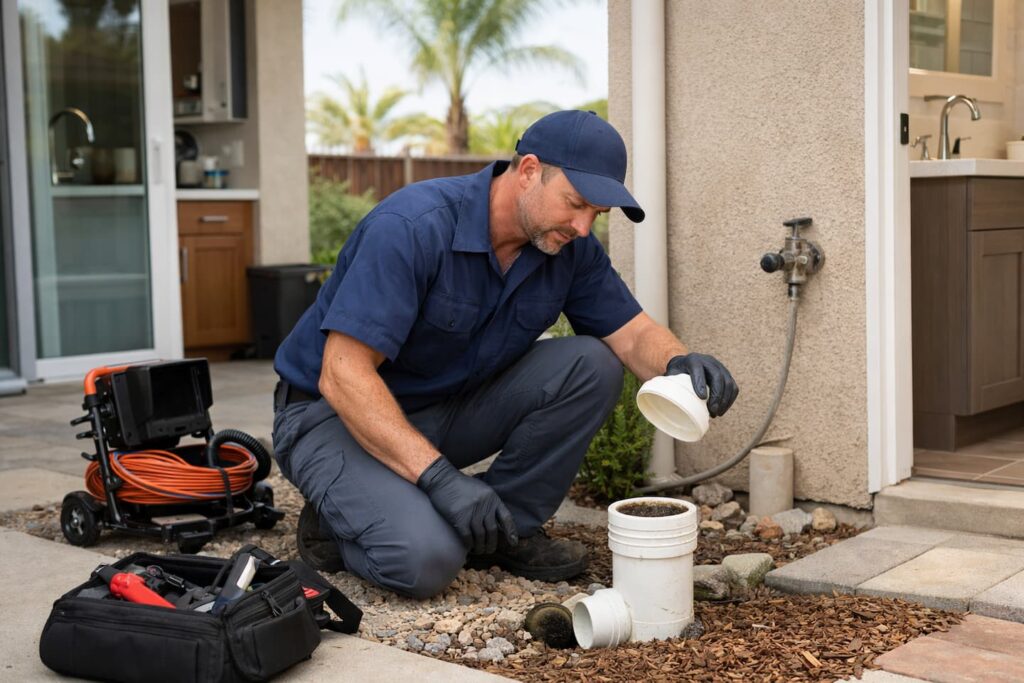
If your drains keep clogging, the problem is usually bigger than the clog you can see.
That is what makes recurring drain problems so frustrating. A one-time blockage is easy to explain. Hair builds up in a shower drain. Food scraps catch in a kitchen line. Something gets flushed that should not have been. You clear it, and life goes on. But when the same drain slows down again a few weeks later, or another fixture starts acting up too, the issue usually is not random. It is a sign that the line has become easy to clog for a reason.
In real homes, repeat clogs usually come from one of four things: grease coating the inside of the pipe, scale or rough interior pipe surfaces catching debris, roots entering the sewer line through a defect, or a broader drainage problem affecting more than one fixture. Sometimes it is one cause. Often it is a combination. A kitchen line may already be narrowed by grease. A root intrusion may catch wipes and paper. A rough older pipe may turn ordinary soap residue into a recurring problem.
The key is not just asking what clogged the drain today. The better question is why this line keeps turning into a clog again. Once you start looking at the pattern that way, the next step usually becomes much clearer.
This guide explains how to tell the difference between grease, scale, roots, and a bigger sewer issue, what the symptom patterns usually mean, and when a simple cleaning may be enough versus when the line likely needs a more complete solution.
Why recurring clogs matter more than one-time clogs
A one-time clog is usually an event. A recurring clog is usually a condition.
That distinction matters because homeowners often judge the result too early. If the sink drains after being snaked, it feels fixed. If the toilet flushes again, the problem seems over. But a line can be open and still be in poor condition. Grease may still be coating the walls. Scale may still be narrowing the passage. Roots may still be growing through a failed joint. Water may be getting through for now, but the reason the clog formed in the first place is still there.
That is why repeat clogs are more useful than they seem. They are feedback from the system. The line is telling you that something about its condition, not just its contents, is making normal drainage harder than it should be.
This is also why homeowners sometimes feel like plumbing work “didn’t last.” In many cases, the service restored flow, but the pipe was never returned to a truly clean or structurally sound condition. The next clog is not a brand-new problem. It is a continuation of the old one.
The four most common reasons drains keep clogging
Most recurring drain problems fall into a few recognizable categories.
- Grease and organic buildup: especially common in kitchen lines and older branch drains.
- Scale and rough interior pipe surfaces: often part of the story in older plumbing or homes with hard water.
- Tree roots in the sewer line: one of the most common reasons main line problems keep returning.
- A larger sewer-line or drainage-system issue: when multiple fixtures are affected and the problem is no longer local.
The challenge is that these issues can overlap. Grease can make it easier for wipes and food solids to catch. Scale can make small branch drains clog faster. Roots can turn an occasional slowdown into a whole-house drainage issue. That is why the best diagnosis usually comes from looking at the overall pattern, not just the nearest symptom.
Cause #1: Grease and sticky organic buildup
Grease is one of the biggest reasons a drain seems to improve for a while but never truly stay clear. This is especially true in kitchen plumbing.
The problem is that grease usually does not form one neat, removable plug. It tends to coat the pipe wall, especially after repeated exposure to cooking oils, fats, butter-heavy sauces, food solids, and disposal waste. Once that coating forms, it starts catching other debris. Food particles, soap residue, coffee grounds, and sludge begin sticking to it. The pipe gets narrower, rougher, and easier to clog.
This creates a very familiar pattern. The kitchen sink drains a little slower than it used to. It may smell slightly off after heavy cooking. The disposal seems to be working, but the line still backs up every few months. The sink may be fine most days, then suddenly clog after a big cleanup or holiday meal. That does not usually mean something dramatic happened that day. It usually means the line has been gradually narrowing and finally hit its limit.
Grease problems are also deceptive because hot water and soap make them look less serious than they are. The grease disappears from the pan, so people assume it is gone. In reality, it often just moves farther down the pipe before cooling and sticking again. That is why recurring kitchen clogs are rarely just about what is in the trap directly under the sink. The buildup may be deeper in the branch line or even farther down in the building drain.
Signs grease is probably the main issue
- the problem is mostly in the kitchen sink,
- the line slows down after cooking or dishwashing,
- the garbage disposal is used heavily,
- the clog returns after being cleared,
- and the sink sometimes smells sour, greasy, or stale.
If that pattern sounds familiar, a proper drain cleaning may be enough when the problem is still local. But if grease keeps coming back or the line never really feels restored, the conversation often shifts toward more complete pipe-wall cleaning rather than another quick opening.
Cause #2: Scale, mineral buildup, and rough pipe interiors
Scale is not always the first thing homeowners think of when a drain keeps clogging, but it plays a bigger role than many people realize.
As pipes age, their interior surfaces often become less smooth. In hard-water environments, mineral deposits can build up over time. In older piping, corrosion, pitting, and roughness may develop even if the pipe is still technically intact. Once the inside of the line becomes rough, normal debris stops washing through as easily. Hair catches faster. Soap scum builds up more stubbornly. Kitchen residue sticks more easily. Even a drain that has been cleared can start clogging again sooner because the pipe no longer has a clean, forgiving interior.
This is why some clogs feel less like sudden events and more like a drain that has slowly become high-maintenance. The shower never quite drains fast. The bathroom sink works, but it always seems a little sluggish. Soap and residue build up faster than expected. The line can still function, but it is no longer in a condition where everyday debris passes through easily.
Scale is often a contributing factor rather than the only cause of a major main line backup. But in branch drains, especially in bathrooms, it can absolutely be part of why a fixture keeps acting up despite repeated clearing.
When scale becomes more likely
- the problem is mostly in bathroom fixtures,
- the home has older piping,
- hard water has visibly affected faucets or showerheads,
- soap scum and residue seem to accumulate quickly,
- and the drain is more chronically slow than dramatically blocked.
On its own, scale does not explain every recurring clog. But when pipes are already rough, it gives hair, grease, soap, and organic material much more opportunity to stick and build up.
Cause #3: Tree roots in the sewer line
Roots are one of the most important causes of recurring clogs because they are usually a sign that the sewer line itself has a defect.
Roots do not usually smash their way into a perfect pipe. They find weak points: a crack, a loose joint, an offset section, or aging pipe material that is no longer watertight. Once they enter, they keep growing. And once roots are inside the line, they start catching paper, wipes, sludge, grease, and everything else moving through the pipe.
That is what makes root-related problems so persistent. Even if the roots are cut out and the line drains again, the entry point is still there unless the pipe itself is repaired. That is why root issues often feel like they come back no matter what. In a sense, they do. Clearing the blockage restores function, but it does not remove the reason the blockage keeps reforming.
Root intrusion becomes more likely in older homes, homes with mature trees, and properties with a history of sewer work, shifting soil, or older underground piping. It is especially suspicious when the problem affects toilets, tubs, and lower drains together rather than just one sink or shower.
Signs roots may be behind the repeat clogs
- the home has mature trees or large shrubs near the sewer route,
- multiple fixtures are affected,
- the line has been cleared before but the problem returns,
- toilets gurgle when other drains are used,
- and the issue feels more like a house-level drainage problem than one local clog.
When this pattern shows up, the issue often moves beyond routine cleaning and into the territory of sewer line repair, because the line is not just clogged — it may be letting roots in through a structural weak point.
Cause #4: A bigger sewer problem than one drain
Sometimes the reason drains keep clogging is not grease, scale, or roots acting alone. Sometimes the bigger problem is that the issue is no longer local at all.
The clearest clue is when multiple fixtures start showing symptoms at the same time. A slow bathroom sink by itself usually points to a local issue. But if toilets, tubs, showers, and sinks are all draining differently, especially in the same time period, the restriction is much more likely farther downstream in the building drain or sewer lateral.
This is where homeowners often lose time and money treating symptoms instead of causes. One drain gets cleared. Then another. Then another. But the real restriction is still in the shared line. The system may improve for a little while, then return to the same pattern because the main problem was never addressed.
A larger sewer issue becomes more likely when you notice things like toilets gurgling when another fixture drains, the lowest tub or shower showing the first backup, sewer odor around drains, or repeated backups that seem to migrate from one part of the house to another. Those are not the usual signs of one isolated clogged trap. They are signs that wastewater is having trouble moving through a shared part of the system.
How to tell whether the problem is one drain or the whole system
One of the most useful things a homeowner can do is stop looking only at the clogged fixture and start looking at the pattern.
If only one bathroom sink is slow, the odds still favor a local issue in that branch line. If only the kitchen sink clogs and the rest of the house is normal, grease or food-related buildup is more likely. But if toilets, tubs, showers, and lower drains are all involved — even if not all at once — the issue is probably farther downstream.
That distinction matters because it changes the right next step. Local problems are often handled with branch-line cleaning. System-wide symptoms usually call for a deeper look at the main drainage path. Treating a shared-line restriction like a simple fixture clog is one of the main reasons people end up paying for the same problem more than once.
How wipes, food waste, and “small habits” create repeat problems
Recurring clogs are not always caused by one major mistake. More often, they come from habits that seem harmless because they do not cause immediate trouble.
A few wipes flushed now and then. Grease rinsed from a skillet. Heavy garbage disposal use. Coffee grounds. Food scraps. Soap-heavy residue. None of these habits has to create an instant backup to still be part of the long-term problem. They build on each other. Wipes catch more easily in a pipe already narrowed by grease. Food solids hang up faster where roots are intruding. Soap residue sticks more easily to scaled interior walls. What seems like a small habit becomes significant when the line is already vulnerable.
This is one reason homeowners often underestimate their own role in recurring clogs. The question is not only what the pipe looks like. It is also what the pipe is being asked to handle every day.
Why a drain can seem fixed even when it really isn’t
This is the part that frustrates people most. A drain can be open and still not be solved.
That happens when the service restores enough flow to get water moving again, but does not remove enough buildup or identify the condition causing the restriction. A line can drain today and still have grease stuck to the walls. Roots can be cut back and still keep growing through the same defect. A rough, scaled pipe can be temporarily opened and still remain easy to clog again.
That is why recurring clog history matters so much. The first blockage may be an event. The second begins to suggest a pattern. By the third, it is usually worth asking not just for another clearing, but for a clearer explanation of why this line keeps becoming restricted.
In many repeat cases, the real issue is not whether the line can be opened. It is whether the line can be restored to a condition where it stops acting like a clog magnet.
What homeowners can check before calling a plumber
You cannot fully diagnose a recurring clog from the outside, but you can make the service call much more useful by paying attention to the right details first.
- Count how many fixtures are involved. One fixture points more toward a local problem. Multiple fixtures point more toward the shared drain or sewer line.
- Notice which fixture acts up first. Kitchen-only patterns often suggest grease. Lower drains or tubs showing the first symptoms often suggest a bigger sewer restriction.
- Pay attention to timing. Does the toilet gurgle when the shower drains? Does the tub back up during laundry? Does the odor appear after heavy use? These patterns often matter more than the clog itself.
- Be honest about what goes down the drain. Grease, wipes, food solids, and heavy disposal use are not side details. They are often central to the problem.
- Think about the property. Older home, mature trees, previous sewer trouble, hard water, or past repairs all make some causes more likely than others.
These observations do not replace inspection, but they often make it much easier to tell whether the issue is local, buildup-related, or likely tied to the sewer line itself.
When routine cleaning may still be enough
Not every repeat clog means the sewer line is failing. Sometimes the issue really is a branch line that has been building up residue for too long.
A bathroom sink full of soap scum and hair, or a kitchen drain narrowed by grease, may still respond well to straightforward cleaning when the issue is confined to one fixture or one branch. In those cases, the goal is to remove the buildup thoroughly enough that the line actually returns to normal function, not just temporary flow.
The important part is what happens after the service. If the fixture stays normal, the problem may have been local. If the same symptoms return quickly, that is when it stops looking like ordinary maintenance and starts looking like a deeper condition issue.
When a more thorough cleaning becomes the better next step
There is a point where the line does not just need to be opened. It needs to be cleaned much more completely.
That is often the case with heavy grease buildup, sludge-coated branch drains, and sewer lines that have already been cleared once or twice but still keep catching debris. In those situations, a more thorough approach like hydro jetting often makes more sense than another quick reopening, because the real goal is to clean the pipe interior well enough that new debris stops hanging up so easily.
This is especially true when the story is not “the drain clogged once,” but “this same line never stays right for long.”
When recurring clogs point beyond cleaning
At some point, repeat clogs stop being mainly a cleaning issue and start being a pipe-condition issue.
That point usually comes when roots keep returning through the same defect, when multiple fixtures keep acting up after previous service, or when the line clearly behaves like it has a structural weak point that keeps trapping debris. In those cases, continuing to pay for temporary reopening may cost more than diagnosing and addressing the actual defect.
The important mindset shift is this: if the same plumbing problem has already been treated multiple times, the goal should no longer be just relief. It should be clarity. What is the actual condition of the line, and what repair or cleaning strategy actually matches that condition?
A practical way to think about recurring drain problems
If you want a simple homeowner framework, use this:
- One fixture, first time: probably local.
- One fixture, keeps coming back: probably buildup or a branch-line condition issue.
- Kitchen drain repeating: think grease first.
- Bathroom fixture repeating: think hair, soap, scale, or rough branch piping.
- Multiple fixtures involved: think shared drain or sewer line.
- Trees plus repeat backups: think roots and a pipe defect, not just another clog.
- Same line reopened multiple times: stop guessing and start thinking about inspection or a condition-based repair plan.
That framework is not a full diagnosis, but it gets you closer to the right next step than treating every new clog like it appeared out of nowhere.
Frequently Asked Questions
That usually points to buildup still coating the line, not just one removable blockage. Grease is a common reason kitchen drains seem better for a while and then start backing up again.
Yes. Hard water and aging pipes can create rough interior surfaces and mineral buildup, which make it easier for hair, soap residue, and other debris to catch instead of washing through cleanly.
If only one fixture is slow, the issue is more likely local. If multiple fixtures are slow, gurgling, or backing up, the problem is much more likely in the shared drain or sewer line.
Sometimes, if the issue is local and the buildup is fully removed. But if roots, grease, scale, or pipe defects keep recreating the restriction, cleaning may only provide temporary relief.
If the same line has clogged more than once, if multiple fixtures are affected, or if the house shows signs of a shared drainage problem, it is usually time to move beyond temporary fixes and get the line properly evaluated.
What the pattern is really telling you
If your drains keep clogging, the repeated clog is not the whole problem. It is the visible symptom of a line that is no longer staying clean, open, or structurally dependable the way it should.
Sometimes that means grease buildup in a kitchen branch line. Sometimes it means scale and rough pipe interiors. Sometimes it means roots have found a weak point in the sewer line. And sometimes it means the issue is bigger than one fixture and has already become a shared drainage-system problem.
The best next step depends on the pattern. A local issue may respond well to proper cleaning. A heavily coated line may need deeper pipe-wall cleaning. A root-prone or damaged line may need a more structural solution. But whatever the cause turns out to be, repeat clogs are usually telling you the same thing: it is time to stop treating each backup like a separate surprise and start figuring out why the line keeps falling back into trouble.