
Tree roots rarely “break into” sewer lines the way people imagine — they find a weakness and quietly take advantage of it.
Most root intrusion problems don’t start with a dramatic pipe collapse. They start with a small defect: a hairline crack, a loose joint, an aging pipe that’s no longer watertight. Roots are naturally drawn to moisture and nutrients, and a sewer line provides both. Once they find a way in, they grow, expand, trap debris, and slowly turn a functioning pipe into a restricted one — and eventually into a recurring backup problem.
This is why root-related sewer issues tend to frustrate homeowners. The system may still “work” for a while. Toilets flush. Drains clear — most of the time. Then patterns start showing up: slow drainage, repeat clogs, odd gurgling, backups that seem to come back no matter what you do. The problem isn’t just the roots — it’s the condition of the pipe that let them in.
This guide breaks down the early warning signs of root intrusion, explains why it happens, and walks through the repair options that actually make sense depending on what stage the problem is at — from simple cleaning to long-term solutions.
Why tree roots grow into sewer lines
Roots don’t randomly attack pipes — they respond to opportunity.
Sewer lines carry water, nutrients, and organic matter. If a pipe has even a small defect — a crack, a separated joint, or material that’s begun to deteriorate — it can release tiny amounts of moisture and vapor into the surrounding soil. That’s enough to attract root growth.
Once a root finds that entry point, it doesn’t stop there. What starts as a fine, hairlike intrusion can quickly grow thicker. As wastewater flows past, the root begins catching debris: paper, grease, sludge, and other materials. Over time, this creates a dense mass inside the pipe, reducing flow and increasing the chance of a clog.
This is why root problems are rarely just about landscaping. They almost always involve two factors:
- a pipe that already has a defect or weakness,
- and roots taking advantage of that opening.
Older homes are especially vulnerable. Clay, concrete, and aging materials are more likely to develop joint gaps or cracks over time. If your home sits in an established neighborhood with mature trees, long sewer runs, and older piping, the conditions are almost ideal for root intrusion.
Why root problems are easy to miss at first
The early stage of root intrusion is subtle — and that’s exactly why it often gets ignored.
At first, everything still works. Maybe a drain is a little slower than it used to be. Maybe a toilet needs a second flush occasionally. Maybe there’s a slight delay after a shower. Nothing feels urgent.
That’s the trap. Root intrusion doesn’t usually create an immediate failure. It creates a gradually worsening restriction. And because the system still functions most of the time, homeowners tend to treat each symptom as a separate issue instead of recognizing the pattern.
A drain gets snaked. A clog clears. Things improve — temporarily. But the root structure is still there, and the pipe is still compromised. So the problem returns.
If you’ve ever had a line cleared and thought, “That fixed it,” only to see the issue come back weeks or months later — roots are one of the most common reasons why.
Early warning signs of roots in a sewer line
Root intrusion usually shows a pattern before it creates a full blockage. The key is recognizing that pattern early.
1. Drains are getting slower over time
Gradual slowdown is one of the earliest signs. Unlike a sudden clog, root-related issues tend to develop slowly. Toilets may flush a little weaker. Tubs may drain more slowly after use. The system still works — just not as well as it used to.
2. Recurring clogs that never fully go away
If you’ve had the same drain cleared more than once and the problem keeps coming back, that’s a strong signal. Roots create a structure inside the pipe that continues catching debris even after cleaning.
3. Gurgling toilets or strange behavior between fixtures
When one fixture affects another — for example, a toilet gurgles when a shower drains — it often means there’s a restriction in a shared line. Roots in the sewer lateral can disrupt normal flow and air movement.
4. Sewer odors that come and go
A partially blocked line can cause wastewater to move more slowly or sit in the pipe longer. That can lead to intermittent sewer smells, especially after heavy water use.
5. Wet spots or unusual patches in the yard
This is a more serious sign. If you notice a consistently damp area, unusually green grass, or a slight depression above the sewer line, it may indicate a leak or structural issue in the pipe — not just roots inside it.
6. Multiple fixtures affected at once
When more than one drain is slow or backing up, the issue is likely in the main line rather than a single fixture. That’s where root intrusion becomes a much stronger possibility.
If you’re seeing several of these signs together, it’s usually time to stop treating it as a simple clog and consider a broader evaluation of the sewer line.
How root intrusion is confirmed
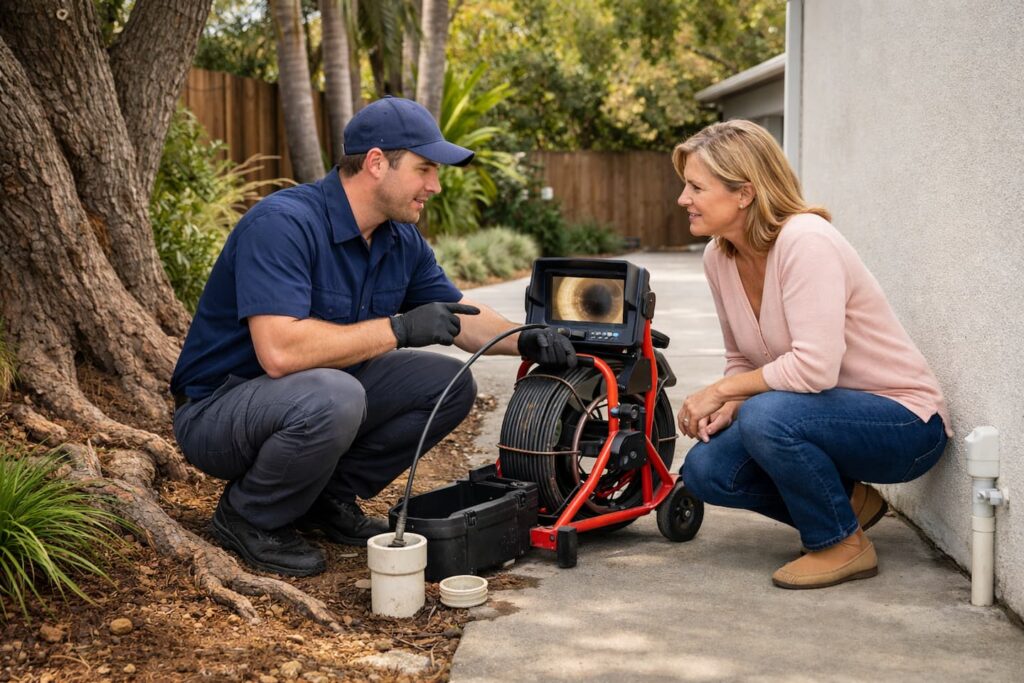
The most reliable way to confirm roots is a sewer camera inspection.
This allows you to see exactly what’s happening inside the pipe — not just that there’s a blockage, but why. Roots can appear in different stages, from minor intrusion to heavy blockage to full structural failure.
This step matters more than many homeowners realize. Without seeing the condition of the line, it’s easy to choose the wrong solution — either over-treating a minor issue or under-treating a serious one.
Best repair options for roots in a sewer line
The right solution depends on one thing: the condition of the pipe.
1. Root cutting (temporary or maintenance solution)
Mechanical root cutting clears the blockage and restores flow. It’s often the fastest way to get things working again. But it doesn’t fix the underlying issue — the point where roots entered the pipe.
This makes it a good short-term solution or part of a maintenance plan, but not always a permanent fix.
2. Hydro jetting (more thorough cleaning)
When roots are combined with grease and buildup, simple cutting isn’t always enough. Hydro jetting uses high-pressure water to clean the pipe walls more completely.
This is often the next step when clogs keep returning. It doesn’t repair structural damage, but it can significantly improve flow and delay the need for more invasive work.
3. Spot repair (targeted fix)
If inspection shows a specific damaged section, replacing that portion of the pipe can stop roots from re-entering. This is often the best balance when the rest of the line is still in good condition.
4. Trenchless lining
For pipes that are damaged but still structurally viable, lining creates a new interior surface without full excavation. This seals cracks and joints, preventing future root intrusion.
5. Full replacement
When the pipe is severely deteriorated or repeatedly failing, replacement is often the most reliable long-term solution. It’s more involved upfront, but it eliminates the cycle of recurring clogs and repairs.
If you’re already dealing with repeat backups or known root issues, it’s often worth evaluating whether sewer line repair is a better long-term investment than continued maintenance.
Which option is actually right?
There isn’t one “best” solution — only the right solution for your specific pipe.
A lightly affected line may only need periodic cleaning. A heavily obstructed but otherwise intact pipe may benefit from hydro jetting. A damaged section may need targeted repair. And a failing system may need replacement.
The key is matching the solution to the condition, not just the symptom.
Frequently Asked Questions
Most of the time, roots enter through existing cracks or weak joints. They usually make the problem worse rather than causing the original damage.
Yes. Even very small openings can allow roots to enter and expand over time.
It depends. Cleaning restores flow, but if the pipe is damaged, roots can return. Long-term solutions may require repair or lining.
Gradually slowing drains are often the first noticeable sign, especially when multiple fixtures are involved.
If you notice recurring clogs, multiple slow drains, gurgling toilets, or yard changes, it’s best to have the line inspected before the problem gets worse.
Final thoughts
Tree roots in a sewer line are rarely a one-time issue. They’re usually a sign that the pipe itself needs attention.
The earlier you catch the pattern — slow drains, recurring clogs, gurgling, or yard changes — the more options you have. Wait too long, and the solution becomes more complex and more expensive.
If your home is showing early warning signs or has a history of root problems, it’s worth getting a professional evaluation before the next backup. You can start here: contact Smart Plumbing USA.