
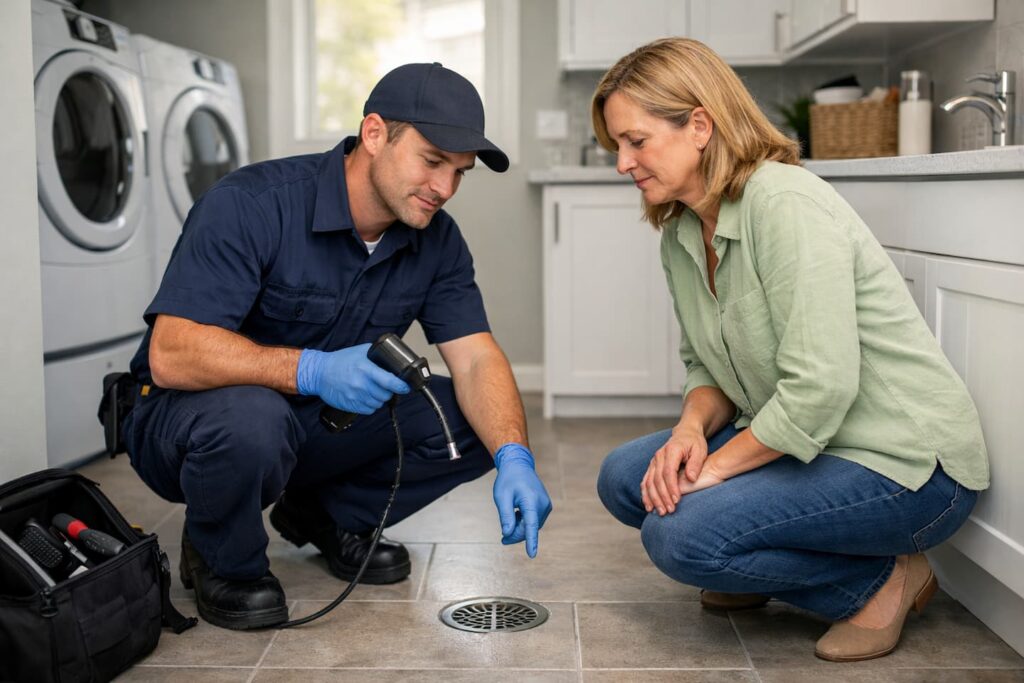
A sewer smell in the house is one of those issues that feels worse than it looks—and sometimes actually is.
You might notice it in a guest bathroom that rarely gets used, near a laundry drain, under a kitchen sink, or even in a hallway with no visible plumbing fixture. Sometimes it fades on its own. Other times it lingers or comes back in waves. And in many cases, homeowners are left guessing: is this something minor, or a sign of a bigger sewer problem?
The truth is that “sewer smell” is not one single diagnosis. It usually comes from one of three places: a dry trap, a venting issue, or a drain or sewer line problem. The challenge is that all three can produce a very similar odor, but the fix—and the urgency—can be completely different.
In many homes, the cause is simple. A rarely used drain dries out and loses its water seal, allowing sewer gas to enter the room. In other cases, the issue is more mechanical: a blocked or malfunctioning vent system creates pressure imbalances that pull water out of traps or push odor back into the house. And sometimes, the smell is an early warning sign of a larger issue—like a partially blocked main line, grease buildup, or a damaged sewer pipe.
The key is not to react to the smell alone, but to look at the pattern. One smelly drain behaves very differently from a house where multiple fixtures are slow, toilets gurgle, and odors get worse when water is used. Understanding that difference is what helps you avoid overreacting—or underreacting—to the problem.
This guide breaks down how traps and vents are supposed to work, how to tell whether the smell is coming from a dry trap, a vent issue, or a sewer line problem, what you can check yourself, and when it’s time to stop guessing and bring in a professional.
What a sewer smell in the house actually means
In a properly working plumbing system, sewer gas should never enter your living space. That’s not luck—it’s by design.
Every fixture in your home connects to a drainage system that relies on two key components: traps and vents. Together, they create a barrier that keeps sewer gases moving in the right direction—out of the home, not into it.
A trap (the curved pipe under a sink, tub, or drain) holds water. That water acts as a seal, blocking sewer gas from coming back up through the pipe. A vent system allows air to move in and out of the drainage system, preventing pressure buildup and making sure those traps stay intact.
When you smell sewer gas indoors, something in that system has failed. In most cases, it comes down to one of three issues:
- the trap is dry or compromised,
- the vent system is blocked or malfunctioning,
- or the drain/sewer line is restricted or damaged.
There are also smaller, localized causes—like a loose toilet seal or a leaking vent pipe—but those still fall into the same broader idea: somewhere, the system is no longer keeping sewer gas where it belongs.
How traps and vents protect your home
To understand sewer smells, you need a clear mental picture of how the system is supposed to behave.
Every time you use a sink, shower, or drain, water flows through the trap and leaves a small amount behind. That leftover water creates a seal that blocks sewer gas from rising back into the room. As long as that seal stays intact, odors stay out.
The vent system supports this by balancing pressure. When water flows through pipes, it creates both positive and negative pressure. Without proper venting, that pressure can push gases back through fixtures—or pull water out of traps entirely, breaking the seal.
So when a sewer smell appears, it usually means one of two things has happened:
- the water seal is gone, or
- the system is forcing gas past the seal.
From there, the diagnosis becomes about identifying why that happened.
When the smell is most likely a dry trap
This is by far the most common—and least serious—cause of sewer odor.
A dry trap happens when the water inside the trap evaporates or is never replenished. Once that happens, there is nothing blocking sewer gas from coming straight into the room.
This typically shows up in places like:
- guest bathrooms,
- laundry room floor drains,
- garage or utility drains,
- rarely used showers or tubs,
- older or secondary sinks.
The pattern is usually straightforward: one specific drain smells, and everything else in the house works normally. No slow drains, no gurgling, no backups—just a localized odor.
How to check it
Pour water into the suspected drain. If the smell fades within a short time and doesn’t return quickly, the issue was almost certainly a dry trap.
If the smell comes back quickly, though, something else may be happening—like a vent issue pulling water out of the trap repeatedly.
When the smell points to a vent problem
Vent issues are more subtle—and often more confusing—than dry traps.
The system may still drain, but not correctly. Pressure imbalances can cause air and gas to move the wrong way, which leads to odors appearing unpredictably.
This is where the smell is usually accompanied by behavior, not just odor.
Common signs of a vent issue
- gurgling or bubbling toilets,
- noisy drains,
- odor that appears when other fixtures are used,
- smell that comes and goes,
- traps that seem to dry out repeatedly.
For example, you might flush a toilet and suddenly smell sewer gas near a sink. Or run the washing machine and notice odor in another room. That’s a strong sign the system isn’t venting properly.
Common causes include blocked roof vents (from debris or nests), damaged vent pipes, or improper venting design. In some cases, the issue is hidden inside walls or attic spaces, which is why vent problems can feel inconsistent and hard to pinpoint.
Unlike a dry trap, this is not something that usually stays fixed after a simple water refill. The odor tends to return because the pressure issue hasn’t been resolved.
When the smell points to a sewer line problem
If sewer smell comes with drainage issues, it’s time to think bigger.
When multiple fixtures are affected, or the entire system feels slow or unstable, the problem is often not inside a single drain—it’s somewhere in the main line or building sewer.
Signs of a larger sewer issue
- multiple drains are slow,
- the whole house drains sluggishly,
- toilets gurgle or bubble,
- odor gets worse with heavy water use,
- lower drains show symptoms first,
- recurring backups or near-backups.
This is where sewer odor stops being just a smell problem. It becomes a symptom of restricted flow or poor system performance.
Common causes include grease buildup, wipes, debris, and tree roots. Over time, these materials narrow the pipe and disrupt both flow and airflow, allowing gas to behave unpredictably.
In these situations, basic fixes rarely last. The line usually needs professional drain cleaning or, in more stubborn cases, hydro jetting to remove buildup more completely.
If the issue keeps coming back, the next step may be inspecting the line for structural problems, including cracks, offsets, or root intrusion that may require sewer line repair.
How to quickly narrow down the cause
Instead of guessing, focus on patterns:
Dry trap is likely if:
- the smell is tied to one drain,
- that drain is rarely used,
- adding water fixes it.
Vent issue is likely if:
- you hear gurgling or bubbling,
- odors appear during water use,
- the smell comes and goes.
Sewer line issue is likely if:
- multiple drains are affected,
- the whole system feels slow,
- problems keep returning.
This kind of pattern-based thinking is the fastest way to avoid misdiagnosis.
When to stop troubleshooting
Some sewer smells are minor. Others are early warnings.
You should stop troubleshooting and call a professional if:
- multiple drains are slow,
- toilets are bubbling or backing up,
- the smell keeps returning,
- you see wastewater coming back up,
- or the problem is clearly recurring.
At that point, the risk is no longer just odor—it’s potential backup or sanitation issues. Waiting usually makes it worse, not better.
What the smell is really telling you
A sewer smell is not random. It’s a signal.
Sometimes that signal is simple: a dry trap that needs water. Sometimes it’s mechanical: a vent system that isn’t doing its job. And sometimes it’s structural: a sewer line that’s starting to struggle.
The important thing is not to treat all sewer smells the same. One smelly drain is not the same as a house with slow drains and gurgling toilets. One-time odor is not the same as a recurring pattern.
If the issue is persistent, involves multiple fixtures, or keeps coming back after simple fixes, it’s usually smarter to investigate early than deal with a full backup later.