
Faucet Repair and Replacement in Vista, CA
Smart Plumbing USA repairs and replaces leaking, dripping, loose, difficult-to-operate, and low-flow faucets in Vista homes. We inspect the faucet, mounting, water connections, supply lines, shutoff valves, and related components before recommending the appropriate repair or replacement.
- Kitchen, bathroom, bar, laundry, and utility sink faucets
- Cartridges, stems, seals, aerators, handles, and sprayer components
- Supply line, mounting, and shutoff valve problems evaluated
- Replacement faucets installed, connected, secured, and tested
A Dripping Spout Is Only One Type of Faucet Problem
A faucet includes internal water-control components, seals, handles, a spout or outlet, mounting hardware, supply connections, and often a sprayer or pull-down hose. A leak can develop inside the faucet body, beneath the handle, around the base, at the supply line, or at the shutoff valve below the sink.
That is why the visible water does not always identify the failed part. Moisture around the faucet base may come from an internal seal, water splashing above the sink, a loose mounting surface, or a connection underneath. Low flow may involve a clogged aerator, but it can also be caused by a cartridge, partially closed shutoff, restricted supply line, or wider pressure issue.
- Water-control components: cartridges, ceramic discs, valve stems, balls, seats, springs, and related seals.
- Outlet and flow components: aerators, flow regulators, spray heads, diverters, and internal passages.
- Mounting and movement: faucet bases, mounting nuts, handles, spouts, swivels, and countertop or sink connections.
- Water connections: hot and cold supply lines, integrated hoses, adapters, fittings, and angle-stop shutoff valves.
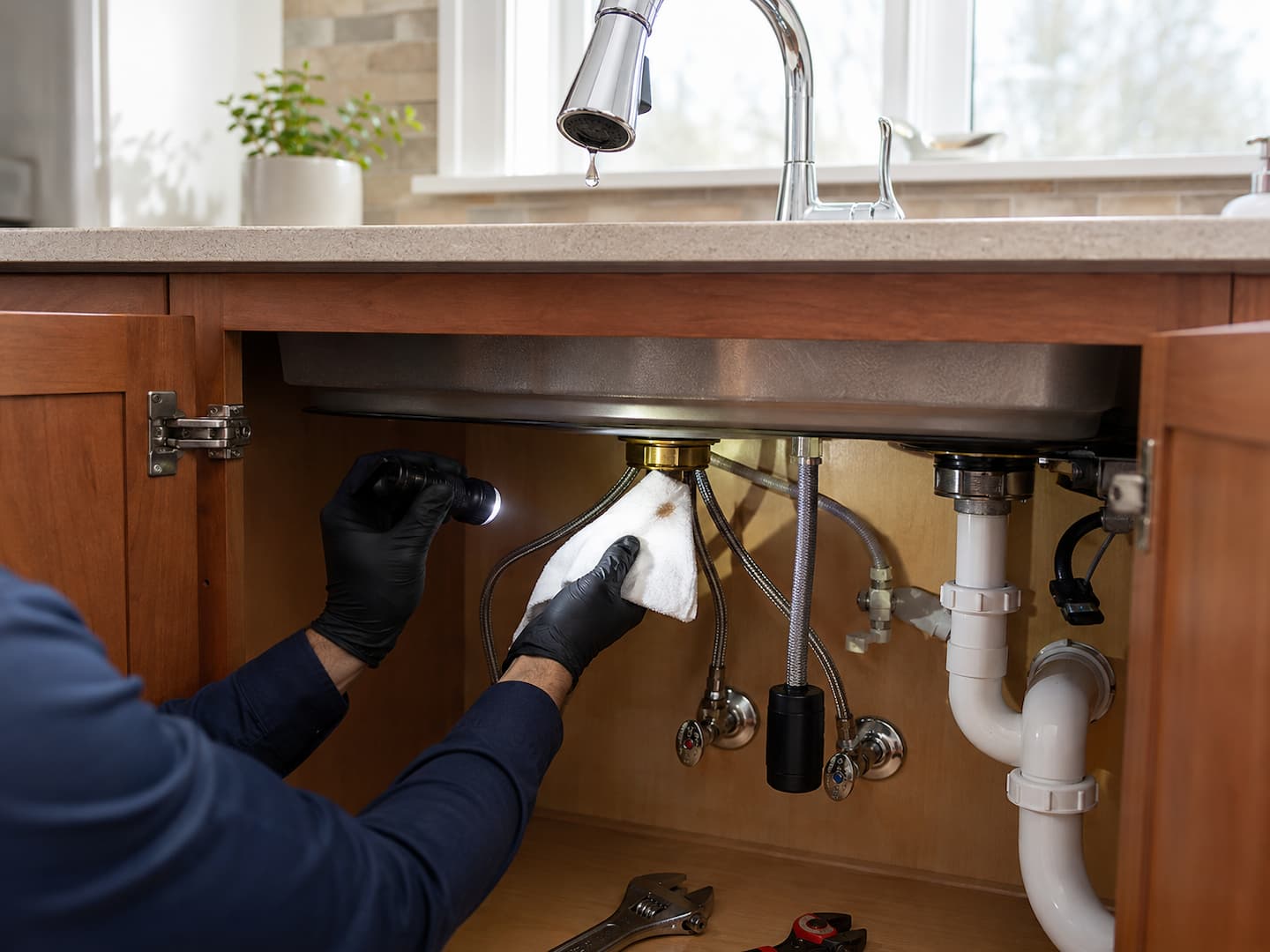
Faucet Problems We Diagnose and Repair
Pay attention to where the water appears, whether the symptom affects hot water, cold water, or both, and whether the problem occurs while the faucet is running or after it has been turned off.
Faucet drips after it is turned off
A worn cartridge, damaged valve stem, failed seal, scratched seat, debris, or internal wear may prevent the faucet from closing completely.
Internal valve diagnosisWater leaks around a handle
Handle-area moisture may involve cartridge seals, packing, O-rings, retaining hardware, internal pressure, or a damaged faucet component.
Handle and seal repairWater appears around the faucet base
Base leaks can originate inside the faucet, from a loose mounting connection, a spout seal, an integrated hose, or water traveling from above the sink.
Source confirmationLow or uneven water flow
Mineral buildup, debris in the aerator, a restricted cartridge, kinked hose, partially closed shutoff, or supply-side restriction can reduce flow.
Flow restriction diagnosisHandle is stiff, loose, or difficult to control
Internal wear, mineral deposits, loose hardware, a damaged cartridge, worn handle connection, or corrosion can affect movement and temperature control.
Handle and cartridge inspectionPull-down sprayer or hose is leaking
Spray heads, hose connections, docking mechanisms, diverters, check valves, and retractable hoses can leak, stick, lose pressure, or stop switching modes.
Sprayer and hose serviceHot and cold water do not respond normally
Incorrect temperature response may involve the cartridge, crossed or restricted supplies, partially closed shutoffs, debris, or another supply-side condition.
Temperature control checkFaucet is loose or moves on the sink
Loose mounting hardware, an unstable mounting surface, damaged supports, corrosion, or an incorrectly fitted faucet can allow movement and stress the connections below.
Mounting and stability repairRepairing the Faucet Component That Is Actually Failing
Some faucets can be restored with a compatible replacement component. Others have damage inside the body, unavailable parts, severe corrosion, or installation problems that make full replacement more practical. The recommendation depends on the faucet design and condition.
Cartridge and Valve Stem Replacement
Single-handle and two-handle faucets use different water-control components. A worn cartridge, stem, disc, ball, seat, or spring can cause dripping, stiffness, poor mixing, or incomplete shutoff.
Seal, O-Ring, and Packing Repair
Internal seals and O-rings help keep water inside moving or pressurized faucet components. Wear, mineral deposits, and damaged sealing surfaces can create leaks around handles, spouts, or bodies.
Aerator and Flow Restoration
Restricted or uneven flow may improve after the aerator, flow regulator, or outlet is cleaned or replaced. We also check whether the restriction continues upstream.
Handle, Spout, and Mounting Repair
Loose handles, worn adapters, unstable faucet bases, stiff swivels, and mounting hardware problems can affect control, alignment, and the connections beneath the fixture.
Pull-Down Sprayer and Hose Repair
Kitchen sprayer problems may involve the spray head, diverter, retractable hose, connection seals, weight, docking system, or integrated supply pathway.
Supply Line and Shutoff Connection Repair
Not every faucet-area leak comes from the faucet. Flexible supplies, adapters, integrated hoses, compression connections, and angle-stop valves can leak or restrict water flow.
A dripping faucet does not automatically need complete replacement. If the body, finish, mounting, and internal sealing surfaces remain serviceable—and compatible parts are available—a targeted repair may be the most practical option.
Request Faucet Repair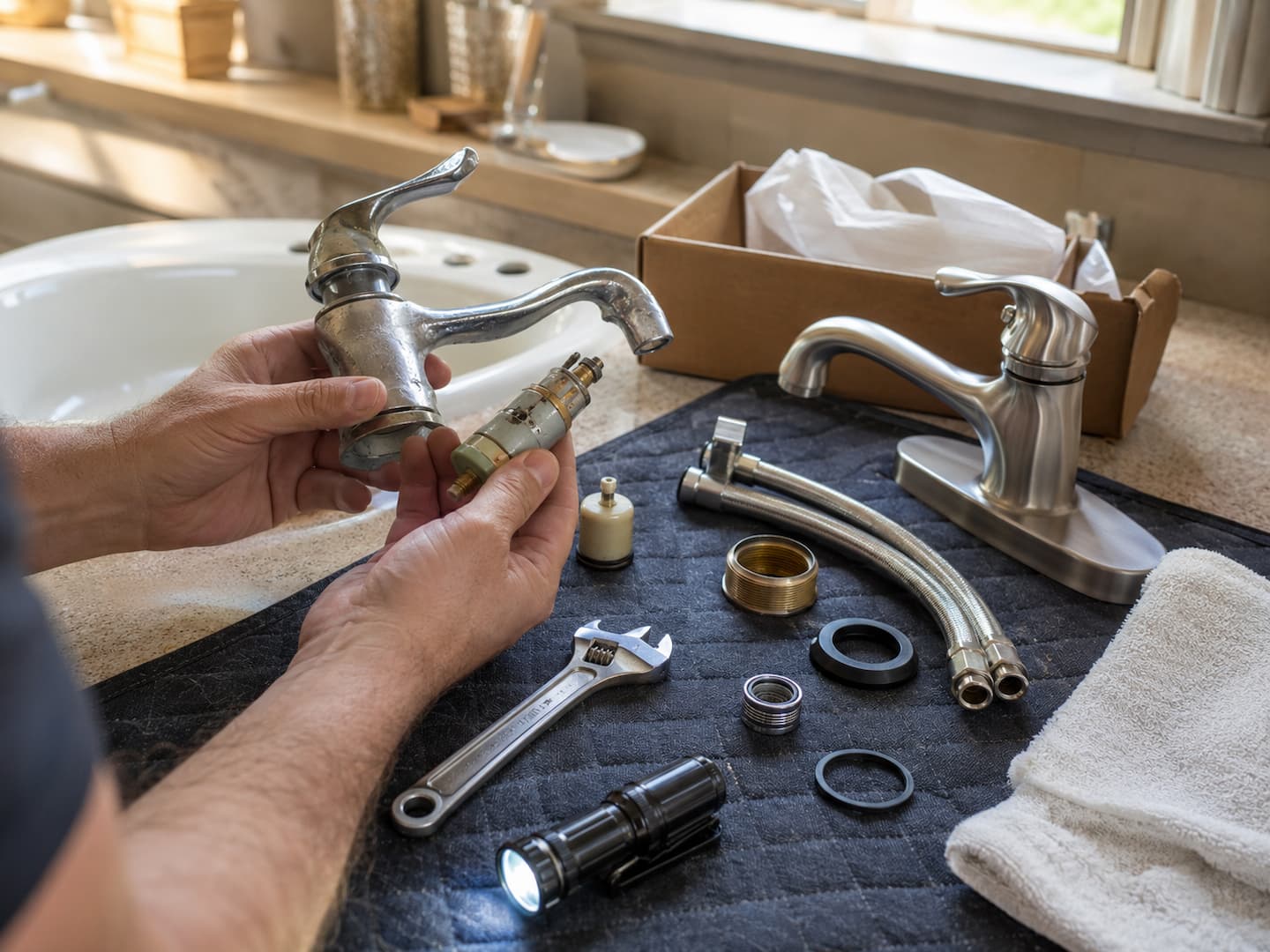
When Is Faucet Repair Worthwhile, and When Is Replacement More Practical?
Age is only one consideration. We also look at the failed component, part availability, body condition, mounting stability, finish deterioration, history of previous repairs, current performance, and whether the faucet still meets the household’s needs.
Repair may be the practical choice when:
- The leak comes from an identifiable replaceable cartridge, stem, seal, aerator, hose, or related component
- The faucet body is not cracked or badly corroded
- The mounting remains secure and the fixture fits the sink correctly
- Compatible replacement parts are reasonably available
- The finish and appearance remain acceptable
- The faucet otherwise provides suitable flow and control
Replacement may make more sense when:
- The faucet body, internal waterways, or integrated hoses are damaged
- Parts are obsolete, unavailable, or unreliable
- Leaks or control problems keep returning
- The fixture is severely corroded, loose, or difficult to service
- You want a different height, reach, handle arrangement, sprayer, or finish
- A sink, countertop, or bathroom update already requires faucet removal
A Replacement Faucet Must Fit the Sink, Countertop, and Existing Connections
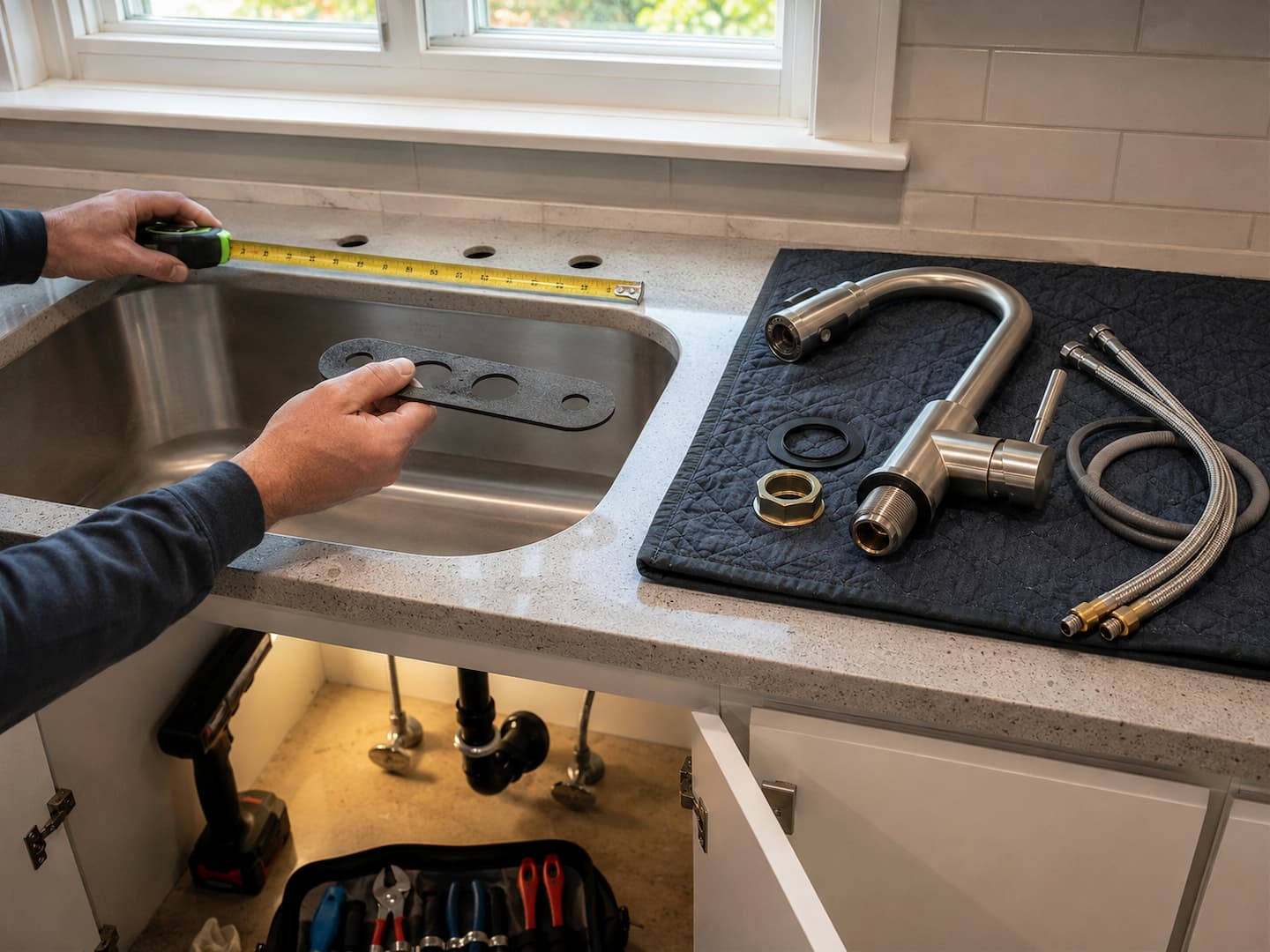
Faucet replacement is not only about matching the appearance of the room. The new fixture must work with the existing mounting holes, sink or countertop thickness, available space, supply connections, shutoff valves, accessories, and the way the faucet will be used.
We review the hole configuration, spacing, deck thickness, faucet reach, spout height, handle clearance, accessory layout, and under-sink working space.
Hot and cold water are isolated, the cabinet or surrounding finishes are protected, and the existing connections are checked before removal.
Old mounting hardware, sealant, supplies, and connections are removed as needed. Corrosion, damaged shutoffs, restricted lines, and mounting concerns are identified.
The faucet is aligned and mounted without unnecessary stress, then connected to suitable hot and cold supplies and any sprayer or accessory components.
We check flow, hot and cold operation, handle movement, spout rotation, spray functions, mounting stability, and all accessible connections.
Faucet Service for Kitchens, Bathrooms, Bars, and Utility Areas
Faucet designs differ in mounting, internal components, hose arrangements, handle configuration, flow requirements, and access beneath the sink. The service approach should match the specific fixture rather than treating every faucet as identical.
Kitchen Faucets
Service for single-handle, two-handle, high-arc, bridge-style, pull-down, pull-out, and side-sprayer kitchen faucets, including mounting and under-sink connections.
Bathroom Sink Faucets
Repair and replacement for centerset, widespread, single-hole, vessel-sink, and other lavatory faucet configurations, with attention to countertop clearance and drain controls.
Pull-Down and Pull-Out Faucets
Diagnosis of retractable hoses, spray heads, docking problems, weights, diverters, mode switches, hose leaks, and reduced spray performance.
Bar and Prep Faucets
Compact faucet service for wet bars, prep sinks, beverage areas, and secondary kitchens, including limited-clearance installation conditions.
Laundry and Utility Sink Faucets
Repair and replacement for utility fixtures exposed to frequent use, hose attachments, buckets, cleaning products, and heavier operating demands.
Touchless and Electronic Faucets
Installation and basic plumbing-side troubleshooting for compatible sensor faucets, including supplies, control boxes, solenoids, power arrangements, and manual override components.
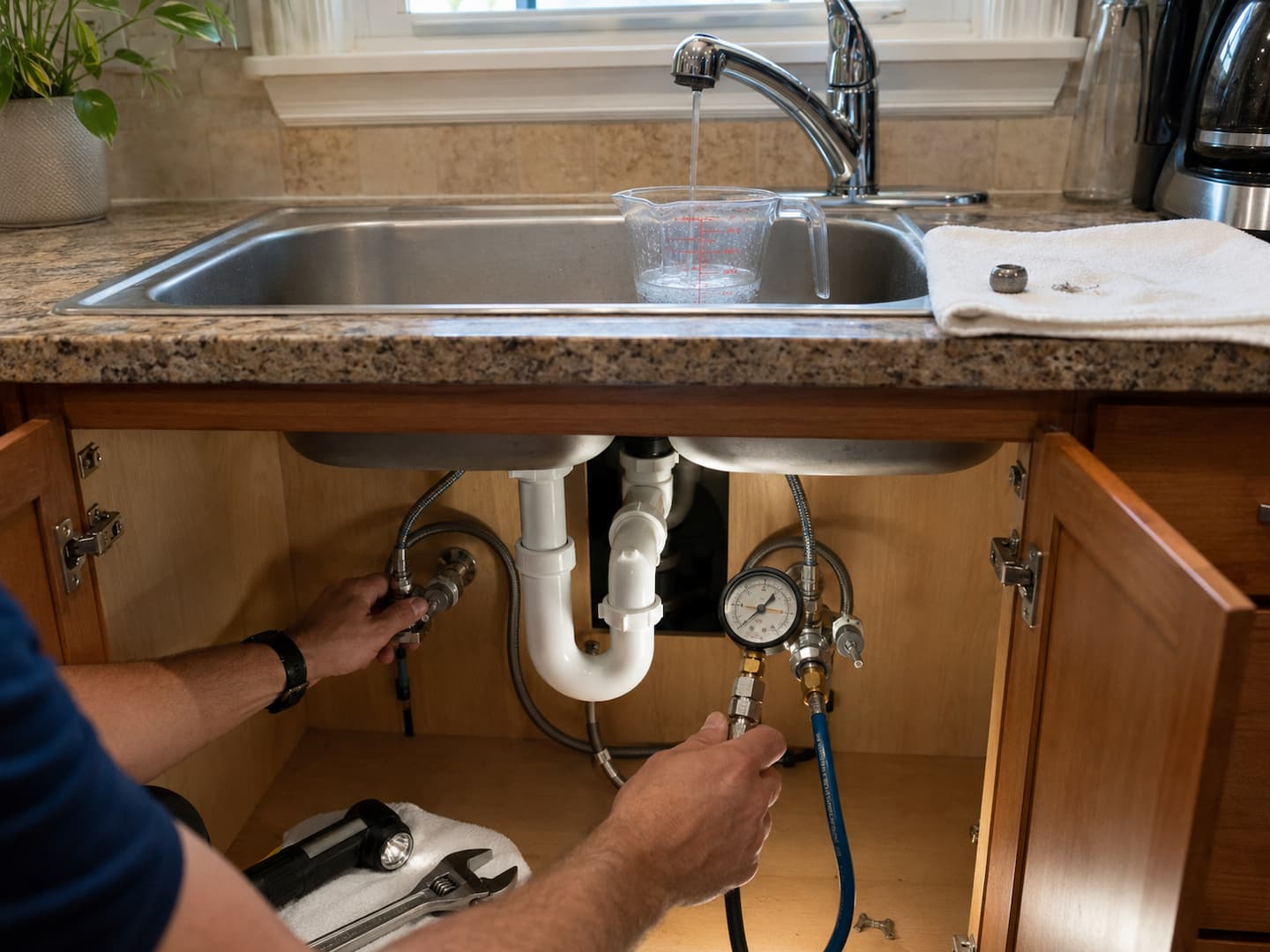
Is Low Water Flow Caused by the Faucet or the Plumbing System?
A faucet that suddenly loses flow may have a local restriction, but low pressure throughout several fixtures can indicate a broader supply issue. We compare the affected faucet with other fixtures before assuming that the faucet itself needs replacement.
Signs the restriction may be local to the faucet
- Only one faucet has weak flow
- The problem affects only hot water or only cold water
- Flow is uneven, spraying sideways, or stronger without the aerator
- The pull-down spray head has weaker flow than the main stream
- The handle has become stiff or difficult to position
- Nearby fixtures continue to operate normally
Signs the problem may extend beyond the faucet
- Several fixtures have weak or changing pressure
- Hot and cold flow are reduced throughout the home
- Pressure changes when another fixture or appliance runs
- There is evidence of a leak, pipe corrosion, or restricted supply piping
- The main shutoff or pressure regulator may not be operating correctly
- Low flow has gradually worsened in multiple parts of the home
Careful Faucet Work Above and Below the Sink
Faucet service affects the visible fixture, countertop or sink mounting, pressurized water connections, cabinet space, shutoff valves, and sometimes nearby drain components. Each part should be considered before the work is treated as complete.
Vista-based California C-36 plumbing contractor #1075429, providing residential faucet and plumbing service in Vista and nearby North County communities.
View license information →Source Confirmed Before Parts Are Replaced
We distinguish between a faucet-body problem, cartridge or seal failure, supply connection leak, shutoff issue, mounting concern, and water coming from another source.
Repair When Repair Is Reasonable
A serviceable faucet with an available replacement component should not automatically become a complete fixture replacement.
Under-Sink Connections Evaluated
Accessible supplies, adapters, integrated hoses, mounting hardware, and shutoff valves are checked for leakage, corrosion, restriction, and stability.
Compatibility Considered Before Installation
Mounting holes, deck thickness, clearance, faucet reach, accessory layout, connection type, and under-sink space are considered before replacement.
Clear Scope Before Work Moves Forward
The recommended repair or replacement scope is explained before authorized work begins, including related concerns found during removal.
Operation and Leak Testing
Hot and cold flow, handle control, spout movement, sprayer functions, mounting stability, supplies, and accessible connections are checked after service.
Faucet Repair and Replacement FAQ
These answers cover common residential faucet problems. Exact repair options depend on the faucet design, condition, part availability, mounting, and surrounding plumbing connections.
Can a dripping faucet usually be repaired?
Why does my faucet leak around the handle or base?
Why does only one faucet have low water pressure?
Should I repair my faucet or replace it?
Can you install a faucet that I already purchased?
Do you repair all faucet brands?
Can a leaking shutoff valve or supply line be replaced during faucet service?
Do you install touchless or electronic faucets?
Is the sink drain included with faucet replacement?
Is same-day faucet repair available in Vista?
Not sure whether the faucet, supply line, or shutoff valve is leaking? Describe where the water appears and whether it happens continuously, only while the faucet runs, or after it is turned off.
Call (858) 727-5522When the Problem Extends Beyond the Faucet
Some faucet-area symptoms originate in the water supply, shutoff valve, piping, sink drain, or wider plumbing system. These related services address conditions that cannot be corrected by replacing a faucet component alone.
Request Faucet Repair or Replacement in Vista, CA
Tell us where the faucet is located, what it is doing, and whether water is actively leaking into a cabinet or surrounding finish. We will use those details to help determine the appropriate service.
- Dripping spouts and faucets that do not shut off completely
- Leaks around handles, bases, hoses, supplies, and shutoff valves
- Low flow, uneven spray, restricted aerators, and temperature problems
- Loose faucets, stiff handles, damaged sprayers, and mounting concerns
- Kitchen, bathroom, bar, laundry, and utility faucet replacement
Quick Service Request
Complete the form and include any details you have. Photos and faucet model information can be useful.
- Faucet location: kitchen, bathroom, bar, laundry, or utility sink
- Where water appears: spout, handle, base, hose, supply, or shutoff
- Whether the issue affects hot water, cold water, or both
- Whether nearby fixtures have normal water pressure
- For replacement, the brand and model if already purchased