
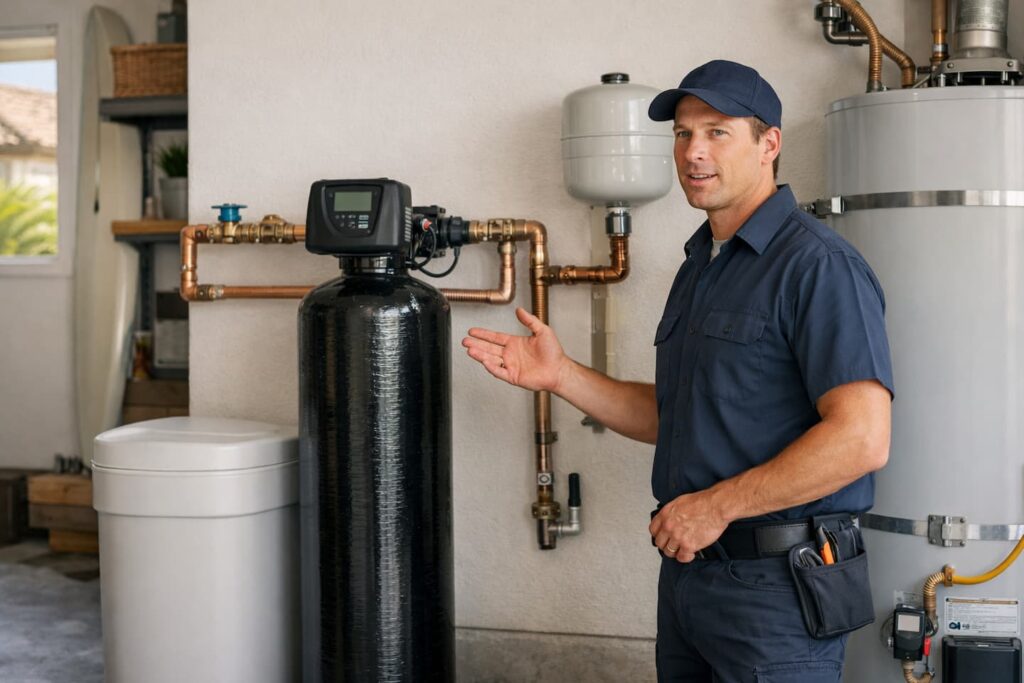
Hard water is one of those household problems that rarely feels urgent at first, which is exactly why homeowners live with it for years longer than they probably should.
It usually begins with little things: cloudy residue on shower glass, chalky buildup around faucets, spots on dishes, soap that never seems to lather the way it should. None of that feels like a plumbing issue in the serious sense of the word. It feels like a nuisance. Something cosmetic. Something to scrub off and move on from.
But hard water is not just a cleaning problem. Over time, those same minerals that leave marks on glass also leave deposits inside fixtures, valves, supply lines, water heaters, and water-using appliances. In other words, the part you can see is usually only the most harmless part of the story.
For Vista homeowners, this is not an abstract topic. Vista Irrigation District reported that in 2024, depending on source water and system flows, the district’s water hardness ranged from 60 to 310 mg/L, which is roughly 3.5 to 18.1 grains per gallon. On the U.S. Geological Survey scale, anything above 180 mg/L is considered very hard. That means some homes in Vista are not just dealing with moderately mineral-rich water. They are dealing with water that falls squarely into the hard-to-very-hard range.
That does not mean the water is unsafe. USGS states that hard water is generally not considered a health concern. EPA’s home treatment guidance makes the same basic point, while also noting the real household tradeoff: significant hardness can create scale on plumbing fixtures and appliances and can make soaps and detergents perform less effectively.
That is why this subject matters. The real question is not “Is hard water dangerous?” The real question is what that mineral load is doing to your house over time—and whether continuing to live with it is more expensive than dealing with it properly.
This guide explains what hard water actually is, how to recognize it in a Vista home, what it does to pipes and appliances, why water heaters often feel it first, and how to decide whether a water softener is actually worth the investment.
What hard water actually means
Hard water contains elevated levels of dissolved minerals, mainly calcium and magnesium. These minerals occur naturally as water moves through rock, soil, and source-water systems. So in one sense, hard water is not unusual at all. It is simply water with more dissolved mineral content than softer supplies.
The reason homeowners notice it so much is that those minerals do not stay dissolved forever in any practical sense. Once water is heated, evaporates, dries on a surface, or repeatedly flows through fixtures and appliances, the minerals begin leaving deposits behind. That is why hard water tends to announce itself through white spotting, chalky crust, cloudy shower doors, scale around faucet bases, and buildup on shower heads.
Vista Irrigation District makes this very practical in its own customer information: minerals in the water can leave white spots on glasses, coffeepots, shower heads, and shower doors. That is exactly how many homeowners first realize the water itself may be part of what they keep cleaning.
USGS classifies water hardness this way:
- Soft: 0 to 60 mg/L
- Moderately hard: 61 to 120 mg/L
- Hard: 121 to 180 mg/L
- Very hard: more than 180 mg/L
That scale is useful because it gives homeowners a way to interpret Vista’s reported range. At the low end, the district can be near the edge of soft to moderately hard. At the high end, it moves well into very hard water territory. That explains why some homeowners feel like hard water is just a mild nuisance while others feel like every fixture in the house is fighting them.
It also explains why local experience varies. Pipe age, plumbing material, water heater condition, fixture maintenance, and source-water variability all affect how aggressively hard water shows up in daily life. Two houses in the same city can technically have the same municipal provider and still experience mineral buildup very differently.
Common signs of hard water in a Vista home
The first signs are usually visible ones, which is why homeowners often think of hard water as a housekeeping problem long before they think of it as a plumbing problem.
You may notice white spotting on glasses after they dry, a chalky ring around faucet bases, a cloudy film on shower doors that reappears quickly after cleaning, or shower heads that seem to crust over faster than they should. Vista Irrigation District’s own customer guidance specifically points to these kinds of mineral spots as familiar hard-water effects.
Soap performance is another clue. If shampoo, body wash, hand soap, or dish soap never seems to lather properly, hardness may be part of the reason. CDC notes that water with too much calcium or magnesium can leave scaly buildup and prevent soap from lathering correctly. EPA similarly notes that significant water hardness can make it harder to get sufficient lather from soaps and detergents.
Laundry often reflects the same pattern. Towels may feel rougher than expected, whites may not stay as bright, and fabrics can lose that “clean-rinsed” feel faster over time. DOE notes that softened water can brighten and soften clothes, which indirectly highlights what hard water often works against.
Then there are the signs homeowners do not always connect to hardness right away:
- shower heads that begin spraying unevenly,
- faucet aerators that clog more often than expected,
- toilet fill valves that seem fussier over time,
- dishwashers and washing machines that feel more maintenance-heavy,
- water heaters that become noisier or seem less efficient.
EPA explicitly links water hardness with mineral or scale formation on plumbing fixtures and appliances. That means if scale is showing up everywhere you can see it, it is reasonable to assume it is also building up in some places you cannot.
Still, this is where a little caution matters. Hard water explains a lot, but not everything. If the home is experiencing unexplained water loss, hidden moisture, or broader plumbing symptoms that go beyond mineral residue, that is when it makes sense to separate a true plumbing problem from a hardness problem instead of assuming everything comes back to scale.
How hard water affects pipes and plumbing fixtures over time
Hard water usually does not damage plumbing in one dramatic event. It wears systems down by making them less efficient, less forgiving, and more maintenance-heavy over time.
Minerals accumulate where water repeatedly moves, sits, heats up, or evaporates. The smallest and most vulnerable openings tend to show the effects first: aerators, cartridges, shower heads, shutoff parts, supply lines, valve passages, and appliance connections. At the fixture level, that buildup can narrow openings, distort spray patterns, reduce flow, and make components feel older than they really are.
That is why a shower head may suddenly spray sideways, a bathroom faucet may feel weaker, or a fill valve may become unreliable even though nothing in the house has “broken” in the dramatic sense. Scale is often what quietly changes how components behave.
Hard water can also contribute to the broader feeling that plumbing is aging faster than expected. Even when mineral buildup is not the sole cause of a performance issue, it often makes an aging system feel less responsive and more maintenance-intensive. That is one reason homeowners sometimes keep replacing small fixture parts without feeling like the house is ever fully “back to normal.”
But this is where it helps to be precise. Hard water can absolutely reduce flow at a fixture or make scale-related performance issues worse. What it does not do is explain every plumbing problem by default. If the house has whole-home pressure loss, signs of hidden leakage, or pipe-related failures in multiple areas, those symptoms may point to different underlying issues. In that case, something like a proper leak evaluation may matter more than assuming minerals are the only problem in the system.
The same is true for older homes with repeated piping trouble. A softener can reduce future scale formation, but it cannot reverse decades of internal wear or rebuild plumbing that is already deteriorating. If the home has recurring pipe failures, a broader plumbing conversation may be more relevant than water treatment alone.
Why water heaters usually suffer first
If there is one part of the house that tends to feel hard water more clearly than the rest, it is the water heater.
That is because heat encourages dissolved minerals to come out of solution and settle where they should not. USGS specifically notes that hard water can lead to mineral buildup in water heaters. DOE’s maintenance guidance for storage water heaters reinforces the practical side of that by recommending routine flushing and periodic inspection steps that become even more relevant in mineral-heavy water conditions.
In tank-style heaters, sediment often collects at the bottom. As it builds up, the unit may become noisier, less efficient, and slower to recover. Some homeowners notice rumbling or popping sounds. Others notice that hot water seems to run out sooner than it used to or that recovery after a shower takes longer. In electric models, scale can also build up on heating elements, which further reduces efficiency.
That is one reason hard water often becomes a “real” problem in the homeowner’s mind through hot water performance first. A little spotting on shower glass is easy to live with. A water heater that seems tired, noisy, and slow is harder to ignore.
DOE also notes that water softeners can help prolong the life of faucets, pipes, and water-using appliances. Water heaters are usually where that benefit feels most concrete. If the heater is already underperforming, though, treatment is not a substitute for service. A softener can help protect the system going forward, but it does not reverse sediment problems that are already inside the unit. If that side of the house is already struggling, it may make sense to address the water heater itself before thinking only about future prevention.
Is hard water dangerous to your health?
For most homes on a municipal supply, hard water is mainly a nuisance and maintenance issue—not a direct health hazard.
USGS states that water hardness is generally not a health concern. EPA’s home treatment guidance says much the same. Vista Irrigation District’s water quality reporting also states that the district’s water met federal and state drinking water standards in the reporting year.
That distinction matters because people sometimes hear “hard water” and assume it means the water is unsafe. Usually, that is not what the term means at all. Hard water is mainly about calcium and magnesium content. CDC describes water softeners as systems designed to remove those minerals—primarily calcium and magnesium—from water.
So no, hard water does not usually create a household health emergency. But it can quietly create a maintenance burden, accelerate scale formation, reduce cleaning effectiveness, and make some plumbing and appliance components wear out sooner than they otherwise would. For many homeowners, the real cost is not medical. It is financial and practical.
What a water softener actually does
A standard whole-home water softener is designed to remove hardness minerals before the water moves through the rest of the house. Most conventional systems do this through ion exchange. DOE explains that hard water passes through resin beads that exchange calcium and magnesium ions for sodium or potassium ions. CDC describes the purpose more simply: water softeners remove minerals, primarily calcium and magnesium, from water.
That is what makes a true softener different from a simple point-of-use filter. A softener is not just improving water at one faucet. It is changing the hardness characteristics of the water feeding the plumbing system as a whole.
In practical terms, a well-selected softener can help reduce future scale formation, improve soap performance, make routine cleaning easier, and reduce some of the mineral-related strain on fixtures and appliances. EPA notes that water softeners can be used to remove excessive hardness, and DOE says softened water can reduce cleaning time and save money over the long term.
That is why, in a home where scale is showing up in multiple bathrooms, around fixtures, on shower doors, and in hot-water equipment, a whole-house softening strategy can make practical sense. In that kind of situation, adding a properly sized water softener is not really about convenience alone. It is about reducing a repeating pattern that keeps showing up across the house.
What a water softener does not do
This is just as important as the benefit side.
A water softener does not solve every water-quality concern. CDC notes that softeners remove minerals like calcium and magnesium, but they do not remove parasites, bacteria, or viruses. So if the concern is microbial safety, a softener is not the complete answer.
A softener also does not repair plumbing damage that already exists. It cannot fix a leaking pipe, rebuild a heavily scaled valve, reverse corrosion that has already happened, or restore a water heater that is already worn out internally. It helps reduce future hardness-related stress. It does not undo every effect of the past.
It is also not the same thing as a drinking-water filter. If your main goal is better taste or additional reduction of specific contaminants at one sink, a point-of-use system such as reverse osmosis may be more relevant than a whole-home softener.
Water softener vs. salt-free conditioner vs. reverse osmosis
These options often get lumped together, but they do different jobs.
A traditional salt-based softener is the classic whole-home solution for hard water because it removes hardness minerals through ion exchange. If the goal is to reduce scale throughout the plumbing system, this is usually the most direct category.
A salt-free conditioner works differently. EPA describes conditioners as products that can neutralize the scale-forming properties of water rather than removing hardness in the same way as a conventional softener. That may help with some scale behavior, but it does not necessarily create the same “soft water” result homeowners expect from ion exchange.
A reverse osmosis system is usually a point-of-use solution for drinking and cooking water. CDC notes that reverse osmosis systems can remove a range of contaminants and are best suited to water used for drinking and cooking. That is a different goal from whole-home hardness control.
So the better question is not “Which system is best?” in a general sense. It is “What problem am I trying to solve?” If the answer is widespread scale throughout the house, a true whole-home softener is usually the most relevant conversation.
Is a water softener worth it in Vista?
For many homes in Vista, yes—it can be a very reasonable long-term investment.
A softener usually makes the most sense when the mineral effects are showing up in multiple parts of daily life, not just one isolated place. It is easier to justify when most of the following feel familiar:
- You regularly see white spots or scale on glass, shower doors, and fixtures.
- Aerators and shower heads collect buildup faster than they should.
- Soap and detergents never seem to work as well as expected.
- The water heater seems more maintenance-heavy than it ought to be.
- You are tired of repeatedly cleaning and servicing the same mineral-related issues.
It also tends to make more sense when you plan to stay in the home for years. DOE’s guidance that softened water can save money over the long term is especially relevant in houses where hard-water symptoms are persistent and wide-ranging. The longer you live with the effects, the more the maintenance burden tends to matter.
For many Vista homeowners, the real question is not whether hard water exists—it clearly does in a meaningful part of the district’s reported range. The real question is whether the symptoms are minor enough to tolerate or repetitive enough that it makes sense to address the cause instead of constantly addressing the residue.
When a softener may not be the first thing to do
Not every home needs a whole-home softener immediately.
If your main concern is taste at one faucet, a point-of-use system may be more appropriate. If your hard-water symptoms are mild and mostly cosmetic, treatment may feel less urgent. Vista’s range is broad, and citywide numbers are useful context, but they are not a perfect substitute for what is happening at your specific property.
And if the home is dealing with leaks, major pressure problems, or aging plumbing issues, treatment may not be the best first step. In those situations, it often makes more sense to stabilize the plumbing system first and then decide whether adding treatment will help protect the repaired system going forward.
How to choose the right system for your home
Start by defining the actual goal.
If the goal is to reduce scale throughout the house, protect the water heater, and improve soap performance, a whole-home softener is usually the right category to evaluate. If the goal is better tasting drinking water at the kitchen sink, a point-of-use system may be more appropriate.
It also helps to test the water at your own property rather than relying only on citywide ranges. CDC recommends testing your water and choosing treatment based on the conditions you actually want to address. That matters in Vista because the reported hardness range varies depending on source water and flow conditions.
When comparing softeners, certification and efficiency matter. EPA recommends choosing certified systems and points to NSF/ANSI 44 for residential water softeners. NSF explains that NSF/ANSI 44 sets the minimum requirements for certifying residential cation exchange water softeners that reduce hardness caused by calcium and magnesium and are regenerated with sodium or potassium chloride.
Efficiency features matter too. Demand-initiated regeneration and better water and salt efficiency usually make more sense than choosing a system based on size alone. The right system is not just the one that softens water. It is the one that does it in a way that fits the household’s actual use pattern.
Frequently Asked Questions
Yes. Vista Irrigation District reported a 2024 hardness range of 60 to 310 mg/L, which means some homes may experience moderately hard water while others may receive water in the very hard range depending on source water and system conditions.
It can contribute to scale formation in fixtures, valves, water heaters, and water-using appliances over time. It may not be the sole cause of every plumbing problem, but it can increase maintenance and reduce performance in some components.
It helps reduce future scale formation by removing hardness minerals from incoming water, but it does not instantly undo every existing plumbing issue. Heavily scaled parts may still need cleaning, repair, or replacement.
It can help protect a repaired or replacement unit from future mineral buildup, but it will not reverse wear or sediment problems that are already affecting performance inside the heater.
Maybe, but for a different purpose. Reverse osmosis is usually a point-of-use option for drinking and cooking water, while a whole-home softener is designed to address hardness throughout the plumbing system.
What hard water in Vista really means for homeowners
Hard water in Vista is not just a cosmetic annoyance. In a service area where reported hardness can range from moderately hard to very hard depending on source conditions, the effects can show up across the home: white spotting, poorer soap performance, scale on fixtures, more water heater maintenance, and a general increase in the amount of attention plumbing equipment seems to demand.
For many homeowners, a water softener is worth serious consideration not because hard water is dangerous, but because it becomes expensive to keep ignoring. The right decision depends on context. If the issue is widespread mineral buildup, treatment may be the smart long-term answer. If the house is also dealing with leaks, pressure loss, or aging pipes, repair may need to come first.
The smartest approach is to match the solution to the real problem. Once you know whether you are mainly dealing with hardness, plumbing wear, or a combination of both, the next step becomes much clearer.