
When water pressure drops across the entire house, it rarely happens without a reason—and that reason is usually hiding somewhere between the street and your fixtures.
A weak shower, slow-filling appliances, underpowered faucets, and toilets that take longer than usual to refill all point to the same core issue: the system is not delivering water the way it used to. The challenge is figuring out where the restriction or pressure loss is happening. Is it inside a fixture? Somewhere in the piping? At the pressure regulator? On the main line? Or outside the house entirely?
This matters because not all “low pressure” problems are actually pressure problems. Sometimes the force behind the water is fine, but something is restricting how much can flow through the system. That distinction—between pressure and flow—is one of the most important parts of diagnosing the issue correctly.
If you understand how to read the signs, you can usually narrow things down before calling a plumber. This guide breaks down the most common causes, how to tell them apart, and when the issue points toward something simple—or something more serious like a hidden leak or main line problem.
Pressure vs flow: why the difference matters
Before diving into causes, it helps to clarify one key idea: low pressure and low flow are not always the same thing.
Pressure is the force pushing water through the pipes. Flow is how much water actually comes out of a fixture. You can have strong pressure but weak flow if something is restricting the path—like mineral buildup, a clogged aerator, or corrosion inside pipes.
This is why a house can feel like it has “low pressure” even when the incoming pressure is technically normal. If water cannot move freely, the result feels the same to the homeowner.
On the other hand, true pressure loss—when the entire system is underfed—usually points to something upstream: a regulator issue, a supply problem, or water being lost somewhere it should not be.
Step one: confirm it’s really a whole-house issue
This sounds obvious, but it’s one of the most important steps.
Check multiple fixtures across the house—kitchen, bathrooms, laundry, and at least one outdoor hose bib. Then compare hot vs cold.
- If only one fixture is weak → likely a local issue
- If only hot water is weak → likely water heater or hot-side restriction
- If everything (including outside) is weak → likely system-level problem
This simple comparison tells you whether you’re dealing with a small fix or something affecting the entire plumbing system.
The most common causes of whole-house low pressure
When the entire house is affected, the root cause usually falls into one of these categories:
- Partially closed valve
- Failing or misadjusted pressure regulator (PRV)
- Hidden leak
- Main water line issue
- Mineral buildup or corrosion
- Old piping (especially galvanized)
- Filter or treatment system restriction
- Temporary utility-side issue
The key is not memorizing the list—it’s recognizing how each one behaves.
Cause #1: a valve isn’t fully open
Start simple. If pressure dropped after plumbing work, a shutoff valve may not have been fully reopened.
This usually creates a consistent but mild reduction across the house. Everything still works, just not as strongly as before.
It’s an easy thing to overlook—and an easy thing to fix.
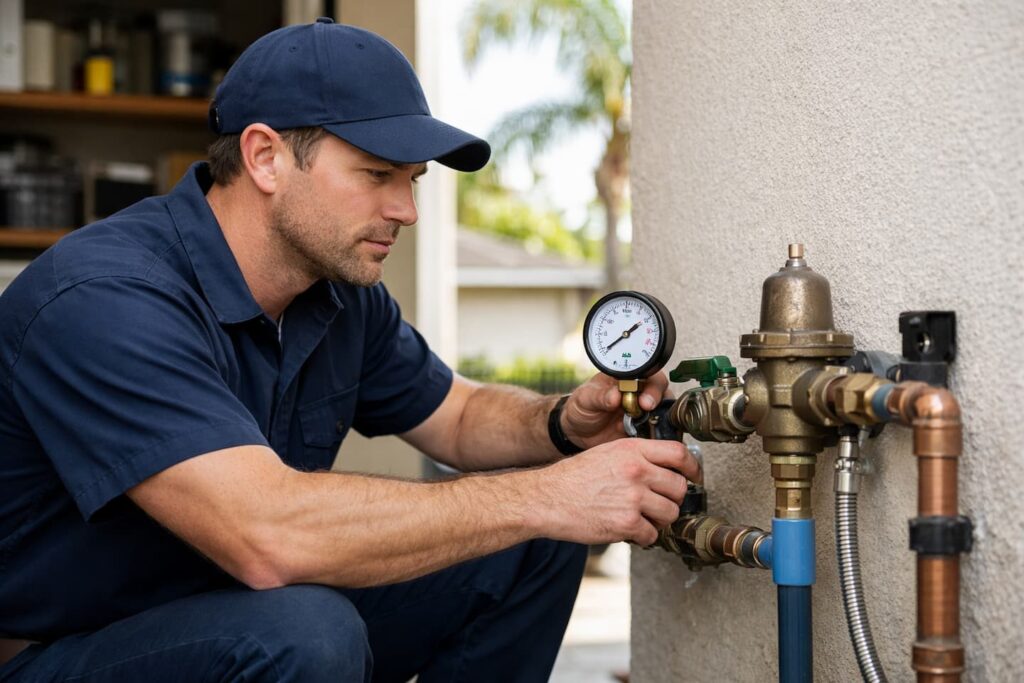
Cause #2: the pressure regulator (PRV)
The PRV controls how much pressure enters your home from the municipal supply.
When it starts failing, you may see:
- Consistently low pressure everywhere
- Pressure that fluctuates randomly
- Sudden drop without other clear cause
Because the PRV sits at the entry point, it can affect the entire house at once. It’s one of the most common causes of true whole-house pressure issues.
Cause #3: a hidden leak in the system
A leak doesn’t just waste water—it reduces how much reaches your fixtures.
This is especially important when pressure drops are combined with:
- Higher water bills
- Meter movement when nothing is running
- Damp spots or musty smells
- Water sounds when the house is quiet
At that point, the problem is no longer just about comfort. It’s about ongoing water loss and potential damage.
If those signs line up, it usually makes sense to stop guessing and move toward something like professional leak detection rather than trying to “adjust” the system.
Cause #4: the main water line
If everything is weak—including outdoor spigots—the issue may be happening before water even reaches the house.
Main line problems can include:
- Leaks underground
- Partial collapse or damage
- Restriction from debris or buildup
These issues often show up as steady, whole-house underperformance.
If the pattern suggests something upstream, it’s usually better to investigate the supply side directly—something like checking the main water line—instead of focusing on fixtures inside the house.
Cause #5: scale and buildup
In areas with hard water, mineral buildup slowly restricts flow over time.
This doesn’t usually cause a sudden drop—it’s more of a gradual decline:
- Shower pressure slowly weakens
- Faucets lose flow
- Hot water side becomes worse than cold
Technically, this is a flow problem—not a pressure problem—but the result feels the same.
Cause #6: old galvanized piping
If the home still has galvanized steel pipes, internal corrosion can significantly restrict flow.
This creates a long-term pattern:
- Pressure gets worse over time
- Flow becomes uneven between fixtures
- Fixes at fixtures don’t last
At that point, the issue is no longer local—it’s systemic.
In those cases, continuing to patch individual problems rarely solves the bigger issue, and something like repiping becomes a more durable solution.
Quick tests you can do at home
- Compare multiple fixtures (hot vs cold)
- Test pressure at a hose bib
- Run a no-use meter test
- Check for visible moisture or yard changes
- Think about timing (did something change recently?)
These simple checks often narrow the issue down faster than randomly inspecting parts of the system.
Final thoughts
Low water pressure across the whole house is rarely random. It’s usually the result of something specific—either restricting flow or reducing supply.
The key is not to jump straight to the most expensive explanation, but also not to ignore patterns that clearly point to something deeper than a clogged faucet. Once you separate fixture issues from system-wide problems, the answer usually becomes much clearer.
If the issue affects the entire house, doesn’t match a simple cause, or seems to involve hidden or underground components, that’s usually the point where a proper diagnosis saves more time than guessing.