
Backflow Testing & Prevention in Vista, CA
Need to answer an annual test notice, repair a failed assembly, or plan a compliant replacement? We help identify the requirement, coordinate the right testing credential, service the device, and close the loop with a passing retest when the scope allows.
- Annual compliance-test coordination
- Failed assembly diagnosis and repair
- Replacement and installation planning
- Reporting path checked before service
Keeping Private Water Use Out of the Public Supply
Water should move from the public main into a property. A pressure change can reverse that direction. If a hose, irrigation line, chemical feed, boiler, well or other connection exposes the plumbing to non-potable water, the return flow can create a cross-connection hazard.
Backsiphonage
Supply pressure drops below the pressure on the property. A main break, firefighting demand or other event can create suction that pulls water backward through an unprotected connection.
- Hoses left in tanks or pools
- Irrigation and auxiliary water
- Open-ended submerged outlets
Backpressure
Pressure inside a private system rises above the public supply pressure. Pumps, boilers, elevated piping and thermal expansion can push water toward the service connection.
- Booster or process pumps
- Heating and closed systems
- High-pressure equipment
Cross-connection control
The protection is selected for the hazard and the water provider’s rules. An air gap or approved assembly creates a tested barrier between the public supply and the potential source.
- Correct device for the hazard
- Accessible installation
- Testing and maintenance
- Records returned on time
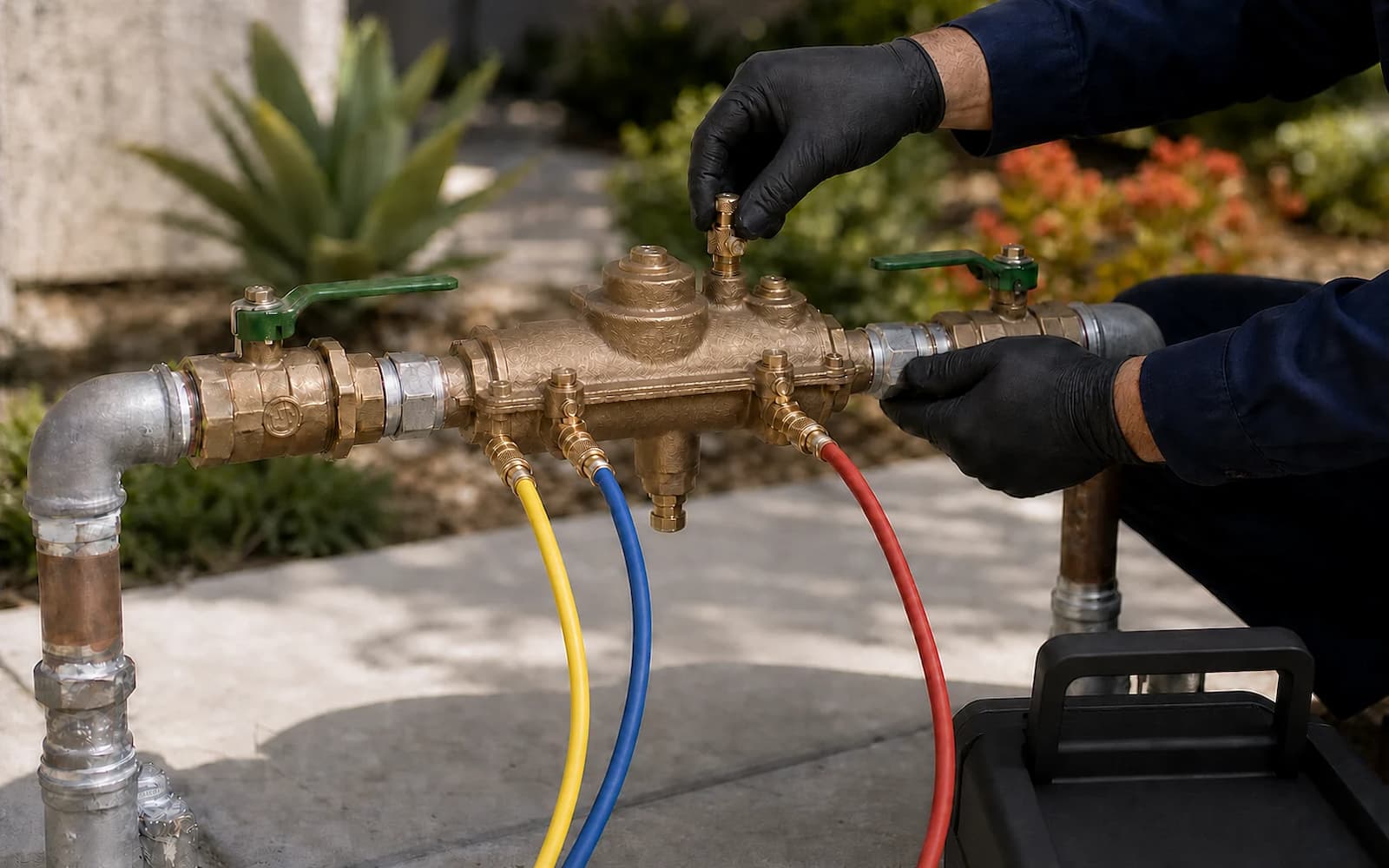
What Happens During a Backflow Test
The tester first identifies the assembly and checks whether it is accessible, installed in the expected orientation and free of obvious damage. A calibrated test kit is connected to the test cocks. The sequence then checks the internal checks and relief function required for that assembly type.
Water to the protected line may be interrupted while the shutoff valves are operated. That is usually brief, but a restaurant, multi-family building, irrigation controller or process line may need advance notice. Fire-service devices require their own coordination.
- Match the service address, assembly type, size and serial number to the notice
- Inspect shutoff valves, test cocks, body condition and visible leakage
- Connect the test kit and follow the procedure for the specific assembly
- Record measurements and a pass or fail result
- Submit the required report through the provider’s accepted process
- Repair and retest if the assembly does not meet the performance standard
A Compliance Visit Has More Than One Finish Line
A device can pass in the field and still miss the deadline if its paperwork goes to the wrong place. We confirm the reporting route before the appointment whenever possible.
Review notice
Water provider, due date, account reference and device details are checked.
Verify tester
Current certification and provider acceptance are confirmed for the compliance test.
Test assembly
The approved field procedure is completed and the measurements are recorded.
Correct a failure
Cleaning, parts, valve work or replacement is discussed before repair.
Retest and report
A passing result is documented and sent through the required channel.
The Device Must Match the Hazard
These terms are easy to confuse, and the units are not interchangeable. The applicable water provider or authority determines the protection required for the account and use.
Reduced-pressure assembly
Two check valves with a relief zone between them. Often used where a higher hazard requires protection against backsiphonage and backpressure.
Double-check assembly
Two independently acting checks. It may be permitted for certain lower-hazard applications, but it is not a substitute where an RP assembly is required.
Pressure vacuum breaker
Commonly associated with irrigation protection against backsiphonage. Installation height and the absence of downstream backpressure matter.
Air gap
A physical separation between a water outlet and the receiving vessel. When designed correctly, it provides protection without mechanical checks.
Backflow Requirements Are Account-Specific
Vista Irrigation District states that approved protection may be required where water use could contaminate the municipal supply. Its public guidance identifies commercial, industrial, agricultural and multi-family accounts, properties with wells, and certain high-risk uses. Ordinary single-family accounts are not automatically treated the same.
Commercial and industrial
Restaurants, manufacturing, vehicle service, laundries and other businesses may have chemicals, process equipment or plumbing arrangements that raise the hazard level.
Multi-family properties
A service protecting several units may have testing, access and tenant-notification needs that differ from one detached home.
Wells and auxiliary water
A private well, reclaimed water, pump or other auxiliary source creates a cross-connection concern even when the sources are not intentionally tied together.
Irrigation systems
Fertilizer injection, elevation, valves and how piping is arranged affect the required protection. A hose-bib vacuum breaker is not a universal solution.
Fire services
Fire lines can have separate device, reporting and outage coordination. Work should be planned with the water provider and fire-system contacts.
Higher-risk uses
Medical or dental facilities, chemical handling, flower growing and RV dump stations are examples the District identifies as potential high-risk accounts.
Why Assemblies Fail and What Comes Next
A failed result does not automatically mean the entire assembly is beyond repair. Debris can hold a check open. Rubber parts harden. A relief valve may drip because the first check no longer seals. Shutoff valves can also prevent the tester from completing a valid sequence.
The body, internal condition, approved parts, age and cost of a retest shape the decision. We explain whether a targeted service is reasonable or whether replacement is less uncertain.
Repair may be practical when
- The body is approved and in sound condition
- A known repair kit is available
- The checks or relief valve are serviceable
- Shutoff work can restore a valid test setup
- Access and downtime are manageable
Replacement may be the sounder path when
- The body is cracked, badly corroded or repeatedly failing
- The assembly is no longer accepted for the application
- Parts are obsolete or the repair cost approaches replacement
- The size, orientation or location does not meet the required plan
- Multiple internal and external components are deteriorated
- A different hazard now requires a different protection level
What Smart Plumbing Confirms Before the Appointment
Smart Plumbing USA operates under California C-36 plumbing contractor license #1075429. The CSLB classification includes maintenance and replacement of backflow preventers. An annual compliance test has an additional requirement: the tester’s current certification must be accepted by the water provider receiving the report.
We do not treat those credentials as interchangeable. Before a compliance appointment, we review the notice and verify the testing path. If an accepted tester is not available for the requested date, we can still discuss device repair, replacement or installation work and help coordinate the next step.
- Which water provider controls the account
- Whether the notice covers a domestic, irrigation or fire-service assembly
- Tester acceptance and report-submission method
- Access restrictions, tenant notices and planned water interruption
- Whether a failed device can be repaired and retested before the deadline
Questions About Testing, Repairs and Compliance
Who needs a backflow prevention device in Vista?
Vista Irrigation District states that approved protection is required where water use could contaminate the public supply, including commercial, industrial, agricultural and multi-family accounts, properties with wells, and certain high-risk uses. The water provider determines the requirement and device type for a specific account.
How often does a backflow assembly need to be tested?
Vista Irrigation District rules require customer backflow assemblies to be tested at least annually by a certified tester, with results sent to the District. Follow the due date and instructions on the notice for the account.
Does a C-36 plumbing license replace tester certification?
No. A California C-36 license covers plumbing work that includes backflow preventers. The annual compliance test must be performed and signed by a tester whose current certification is accepted by the applicable water provider. The credentials serve different purposes.
What happens if the assembly fails?
The tester records the failed performance. The assembly may need cleaning, an internal repair kit, shutoff work or replacement. After correction it must be retested, and the passing result is submitted according to the provider’s instructions.
Can any backflow preventer be installed as a replacement?
No. The assembly type, size, orientation, approval listing, location and installation details must match the provider’s requirements and the hazard. Confirm the accepted model and installation path before purchasing equipment.
Do all Vista homes need annual backflow testing?
No. Many ordinary residential accounts do not have a testable service backflow assembly. Properties with wells, irrigation or another cross-connection hazard may have requirements. Contact the water provider if the account status is unclear.
What information should I have when scheduling?
Have the notice, service address, due date, account or device reference, assembly type and size, serial number if visible, and a photo of the installation. Mention locked gates, tenants, fire service or a prior failed test.
Will the test interrupt water service?
Testing requires operating the assembly’s shutoff valves and normally creates a short interruption to the protected line. The impact depends on what the device serves, so tenants, businesses, irrigation controllers or fire-system contacts may need advance coordination.
Can you install or replace a backflow assembly?
Smart Plumbing USA can evaluate repair, replacement and installation work within the C-36 plumbing scope. The final plan depends on the water provider’s required assembly, approved model, site layout, permits, inspection and service-interruption needs.
Have the Notice and a Photo of the Assembly Ready
Send the service address, water provider, due date, device size and any previous failed result. We will confirm the testing or repair path before scheduling the visit; the photo can be shared when we reply.