
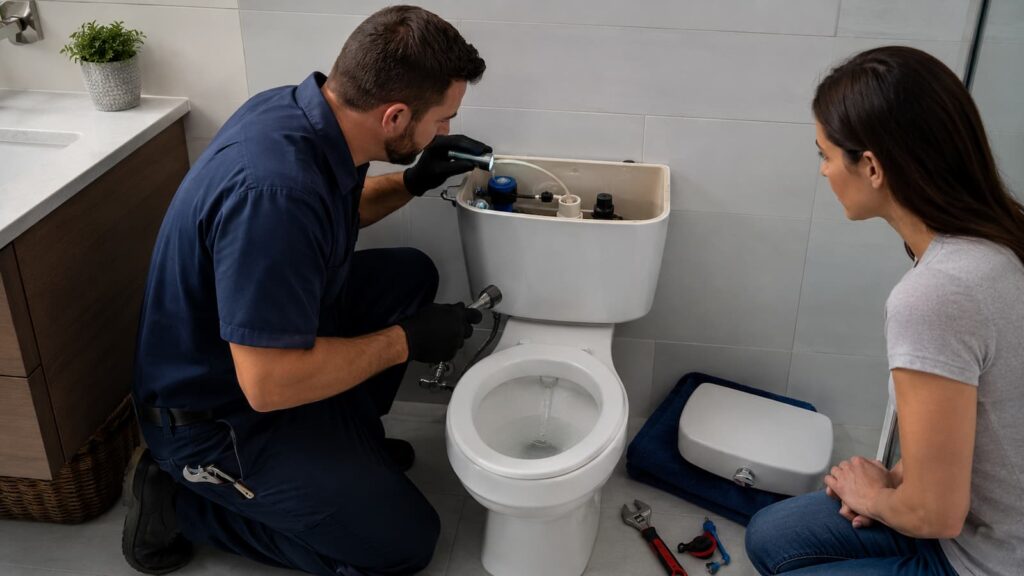
A toilet that keeps running may seem like a small annoyance, but it is often one of the most expensive “quiet” plumbing problems in a home.
At first, it may only sound like a faint hiss after flushing. Then the tank refills again even though no one touched the handle. Sometimes the toilet runs constantly. Sometimes it stops, then starts again minutes later. Sometimes there is no obvious sound at all, but the water meter keeps moving and the water bill slowly climbs. That is what makes running toilets so frustrating: the problem can be obvious, intermittent, or almost completely silent.
The good news is that many running toilet problems come from simple parts inside the tank. A worn flapper, loose chain, misadjusted float, leaking flush valve seal, faulty fill valve, high water level, or stuck handle can allow water to move from the tank into the bowl or into the overflow tube. When that happens, the toilet refills again and again. The fixture may still flush, so homeowners often delay the repair. Meanwhile, water continues flowing straight into the sewer line.
A running toilet should not be ignored. EPA WaterSense notes that household leaks can waste about 180 gallons per week, and toilets are often the culprit. Most toilet leaks are related to old or worn-out flappers, also called valve seals. A worn flapper can even create silent leaks that waste thousands of gallons per year.
This guide explains why toilets keep running, how to identify the most likely cause, how much water can be wasted, what homeowners can safely check, when replacing a part makes sense, and when the problem may need professional help. If you have a running toilet that keeps coming back after adjustments, or if the shutoff valve, supply line, toilet base, or surrounding plumbing also looks questionable, Smart Plumbing USA can help with professional pipe repair and general plumbing repair support.
What does it mean when a toilet keeps running?
A toilet “runs” when water continues moving after the flush cycle should be complete. In a normal flush, water leaves the tank, enters the bowl, clears waste through the trapway, and then the tank refills to a set level. Once the tank reaches that level, the fill valve shuts off. The toilet should then sit quietly until the next flush.
When a toilet keeps running, something in that cycle is not sealing, stopping, or adjusting correctly. Water may be leaking from the tank into the bowl. Water may be flowing into the overflow tube because the tank level is too high. The fill valve may not be shutting off. The flapper may not be seating properly. The handle may be sticking. The chain may be too tight or too loose. The float may be set incorrectly. The flush valve seat may be damaged. Or an internal crack or worn seal may be allowing water to escape slowly.
The sound can vary. A constantly running toilet may sound like steady water flow. A fill valve problem may sound like hissing. A slow tank-to-bowl leak may be silent until the tank refills suddenly. That refill sound may happen every few minutes or every few hours. Some homeowners describe this as the toilet “flushing by itself,” “cycling,” “ghost flushing,” or “randomly refilling.”
Those patterns matter because they help identify the likely cause. Constant running often points to a fill valve, float, overflow, or flapper that is badly failing. Intermittent refilling often points to a slow leak from the tank into the bowl. A toilet that only runs after flushing may have a flapper, chain, or handle problem. A toilet that runs only when the shutoff valve is fully open may have a weak fill valve or pressure-related issue.
The most important thing to remember is that a running toilet is not normal. It is not just background noise. It means water is being wasted, and the cause should be found before the problem becomes expensive.
How a toilet tank works
Understanding the main tank parts makes troubleshooting much easier. Most standard gravity toilets have a few key components that work together during every flush.
The handle or trip lever starts the flush. When you press it, the lever lifts a chain or lift wire attached to the flapper. The chain needs the right amount of slack. If it is too tight, the flapper may not seal. If it is too loose, the flapper may not lift properly.
The flapper is the rubber, silicone, or plastic seal at the bottom of the tank. During a flush, it lifts and allows water to rush through the flush valve opening into the bowl. After enough water leaves the tank, the flapper drops back down and seals the opening. If the flapper is warped, dirty, too old, misaligned, or incompatible with the toilet, water can leak past it.
The flush valve is the larger opening and assembly where the flapper sits. If the seat is rough, cracked, mineral-coated, or damaged, even a new flapper may not seal correctly. Some toilets use a canister-style flush valve instead of a traditional flapper, but the idea is similar: a seal has to close tightly after each flush.
The fill valve refills the tank after flushing. It turns on when the water level drops and shuts off when the tank reaches the proper level. Older toilets may use a ballcock with a float ball on an arm. Newer toilets often use a vertical float cup attached to the fill valve body. If the fill valve does not shut off, water may continue entering the tank.
The float controls when the fill valve shuts off. If it is set too high, the tank water level can rise above the correct mark and spill into the overflow tube. If it is set too low, the toilet may not flush strongly. If it sticks, the toilet may keep filling or refill unpredictably.
The overflow tube prevents the tank from overflowing onto the floor. If the water level rises too high, water goes into the overflow tube and down into the bowl. That protects the bathroom floor, but it also means the toilet can waste water continuously without visible flooding.
Once you understand these parts, a running toilet becomes less mysterious. Water is either leaking out of the tank when it should not, or water is entering the tank when it should have stopped.
Cause 1: a worn or warped flapper
The flapper is the most common cause of a running toilet. It is a small part, but it does a big job. Every time the toilet flushes, the flapper lifts and reseals. Over time, rubber can harden, warp, crack, swell, or develop a poor sealing surface. In-tank cleaning tablets, chlorine, minerals, age, and normal wear can all shorten flapper life.
When the flapper does not seal tightly, water slowly leaks from the tank into the bowl. As the tank level drops, the fill valve turns on to refill it. That is why the toilet may refill randomly even when no one flushed. This is often called ghost flushing. It is also why some toilet leaks are silent. Water can slip past the flapper quietly and flow into the bowl without making an obvious running sound.
A worn flapper may look distorted, slimy, brittle, cracked, faded, or misshapen. Sometimes it feels soft and gummy. Sometimes it looks normal but does not seal properly. If the flapper is old and the toilet is running, replacing it is often the first practical repair.
Compatibility matters. Not every flapper fits every toilet. Toilets have different flush volumes, flush valve sizes, and designs. Some use 2-inch flappers, some use 3-inch flappers, and some use special canister seals instead. Using the wrong flapper can cause weak flushing, double flushing, or continued leaking.
EPA WaterSense notes that old or worn-out flappers are a common cause of toilet leaks and says flappers should be checked periodically and replaced at least every five years to help ensure a good seal.
If replacing the flapper stops the leak, the repair is simple and inexpensive. If a new, correct flapper still leaks, the flush valve seat, chain adjustment, tank water level, or toilet design may need closer inspection.
Cause 2: the chain is too tight, too loose, or tangled
The chain connects the toilet handle to the flapper. It seems minor, but the chain position can make a toilet run after every flush.
If the chain is too tight, it can hold the flapper slightly open. Even a tiny gap allows water to leak from the tank into the bowl. The toilet may run constantly or refill every few minutes. This often happens after someone replaces a flapper or handle and clips the chain too short.
If the chain is too loose, the handle may not lift the flapper fully. The flush may be weak, incomplete, or inconsistent. A loose chain can also get caught under the flapper, preventing a proper seal. Sometimes the chain has too much extra length and tangles with itself or other parts in the tank.
The right chain adjustment usually allows a small amount of slack when the flapper is closed. The handle should lift the flapper cleanly when pressed, and the flapper should fall back into place without the chain pulling on it or getting trapped under it.
This is one of the easiest checks homeowners can do. Remove the tank lid, flush the toilet, and watch the chain. Does it lift smoothly? Does the flapper close fully? Is the chain catching? Is it holding the flapper open? If yes, adjust the clip position or remove excess chain length carefully.
If the chain keeps tangling because the handle arm is bent, corroded, or misaligned, the handle assembly may need replacement. That is usually a simple part, but it should still be matched correctly to the tank style.
Cause 3: the fill valve is failing
The fill valve controls water entering the tank after a flush. When it works correctly, it opens after the tank empties and shuts off when the tank reaches the proper level. When it fails, the toilet may hiss, run constantly, refill slowly, refill noisily, or never shut off completely.
A failing fill valve can be caused by worn internal seals, mineral buildup, debris, age, or water pressure issues. Sometimes sediment gets into the valve and prevents it from closing. Sometimes the float mechanism sticks. Sometimes the valve simply wears out after years of use.
One common sign of a fill valve issue is water flowing into the overflow tube. Remove the tank lid and look at the water level. If water is reaching the top of the overflow tube and spilling into it, the tank is filling too high or the fill valve is not shutting off. The overflow tube is preventing a floor flood, but the toilet is still wasting water.
Another sign is a persistent hissing sound after the tank is full. The toilet may not look like it is running into the bowl, but the fill valve may be allowing a small amount of water to keep entering. If the water level is stable below the overflow tube and the hissing continues, the fill valve itself may be leaking internally.
Fill valves are usually replaceable. In many cases, replacing an old fill valve is better than trying to adjust it repeatedly. Modern replacement fill valves are widely available and can improve refill performance, reduce noise, and stop water waste. However, the toilet shutoff valve under the tank must work properly before replacement can be done safely. If that shutoff valve is stuck, leaking, or corroded, the job becomes more than a simple toilet part replacement.
If a new fill valve does not solve the problem, water pressure, overflow height, incorrect installation, or another tank component may be involved.
Cause 4: the float is set too high
The float tells the fill valve when to stop filling the tank. If the float is set too high, the fill valve may allow water to rise above the correct level. Once water reaches the top of the overflow tube, it drains into the bowl. The toilet may run continuously because water is entering the tank and escaping through the overflow at the same time.
This problem can happen after a fill valve replacement, after someone adjusts the float, or as parts shift with age. It can also happen if the float sticks and does not rise freely.
Most toilet tanks have a water level mark printed or stamped inside the tank. If there is no mark, the water level is commonly set below the top of the overflow tube, often around one inch below, though the exact requirement depends on the toilet design. If water is at or above the overflow opening, the float needs adjustment or the fill valve may be failing.
Older ball floats are adjusted by gently bending the float arm or turning an adjustment screw, depending on the design. Newer float cup valves usually have a screw or clip that moves the float up or down on the valve body. The goal is to let the tank fill enough for a strong flush without letting water spill into the overflow tube.
If adjusting the float fixes the running toilet, continue monitoring it for a few days. If the water level rises again, the fill valve may not be shutting off reliably and may need replacement.
Cause 5: the flapper seat or flush valve is damaged
Sometimes the flapper is not the real problem. The surface it seals against may be damaged. This is the flush valve seat. If the seat is rough, cracked, warped, mineral-coated, or worn, a new flapper may still leak.
Mineral buildup can create an uneven sealing surface. Old flapper material can leave residue. Cleaning tablets can damage rubber and sometimes affect plastic parts. If the flush valve seat has a nick or deformation, water can escape even when the flapper looks closed.
To check this, turn off the water supply, flush the toilet, and inspect the flush valve opening once the tank is mostly empty. The surface should be smooth and clean. If there is mineral buildup, it may be possible to clean it gently. Avoid aggressive scraping that damages the plastic. If the seat is cracked or the flush valve assembly is failing, replacement may be needed.
Replacing a flush valve is more involved than replacing a flapper because the tank usually has to be removed from the bowl. The tank-to-bowl gasket and bolts may also need replacement. On older toilets, bolts can be rusted, and disturbing them can create leaks. This is often where a simple running toilet repair becomes a bigger job.
If the toilet is old, inefficient, or has multiple failing parts, replacing the entire toilet may sometimes make more sense than rebuilding the tank. But if the bowl and tank are in good condition, a flush valve replacement can restore proper sealing.
Cause 6: the handle is sticking
A toilet handle that does not return fully after flushing can keep the chain lifted and prevent the flapper from sealing. This can make the toilet run after every flush until someone jiggles the handle. If you have ever had to “jiggle the handle” to stop the toilet, the handle assembly, chain, or flapper movement needs attention.
Handles can stick because of corrosion, mineral buildup, a loose nut, a bent lever arm, poor alignment, or a chain that pulls at the wrong angle. The handle may feel loose, stiff, wobbly, or slow to return. Sometimes the handle looks normal from the outside but the lever inside the tank catches on another component.
Watch the handle and flapper during a flush. If the handle stays down, the flapper may stay open. If the lever arm rubs against the tank lid, overflow tube, or fill valve, it may not move freely. If the chain is connected too close or too far from the handle pivot, the pull may be awkward.
Handle assemblies are usually inexpensive and replaceable. Keep in mind that some toilet handles are side-mount, front-mount, angle-mount, or model-specific. Universal handles fit many toilets, but not all. If the toilet has a special design, matching the correct part matters.
If the handle sticks because other tank parts are misaligned, replacing the handle alone may not solve the problem. The tank components should work together smoothly.
Cause 7: the refill tube is positioned incorrectly
The refill tube is the small flexible tube that sends water from the fill valve into the overflow tube after a flush. Its job is to refill the toilet bowl to the proper level. If it is installed incorrectly, it can contribute to running or siphoning problems.
The refill tube should usually direct water into the overflow tube without being pushed too far down inside it. If the tube extends below the tank water level or is inserted too deeply, it can create a siphon effect in some setups, pulling water from the tank and causing the fill valve to turn on repeatedly.
Many fill valve kits include a clip that holds the refill tube at the correct position. If that clip is missing, loose, or incorrectly placed, the tube may shift. This can happen after DIY repairs or when parts are replaced quickly without checking the final position.
If the toilet runs after a fill valve replacement, check the refill tube position. Make sure it is clipped properly and not shoved down inside the overflow tube. This is a small detail, but it can make the difference between a normal refill and a toilet that cycles unexpectedly.
If adjusting the tube does not help, look again at the flapper, fill valve, water level, and flush valve seal. Running toilets often have more than one small issue at the same time.
Cause 8: water pressure is too high
High water pressure is not the most common cause of a running toilet, but it can make toilet fill valves noisier, more prone to wear, and harder to shut off cleanly. If several toilets in the home have noisy fill valves, frequent running, or short part life, water pressure should be considered.
Residential plumbing systems are designed to operate within a safe pressure range. When pressure is too high, valves, supply lines, faucets, washing machine hoses, water heaters, and toilet fill valves can experience extra stress. A toilet fill valve may hiss, chatter, slam, or fail prematurely. You may also notice water hammer, dripping faucets, or relief valve discharge at the water heater.
High pressure is usually checked with a pressure gauge attached to a hose bibb or laundry connection. If pressure is too high, a pressure reducing valve may be needed or may need adjustment or replacement. This is not just a toilet issue. It is a whole-house plumbing protection issue.
If one toilet is running, start with tank parts. If multiple fixtures show pressure-related symptoms, the problem may be broader. In that situation, a professional plumbing evaluation is more useful than repeatedly replacing toilet fill valves.
Because high pressure can also contribute to leaks and fixture wear, addressing it early can help prevent more expensive plumbing problems later.
How much water can a running toilet waste?
The amount of water wasted depends on how severe the leak is. A small flapper leak may waste water slowly and silently. A fill valve stuck open can waste much more. The worst leaks can move a surprising amount of water because the toilet is connected directly to the water supply and the wasted water usually goes straight into the bowl and down the drain.
EPA WaterSense says household leaks can waste about 180 gallons per week, and toilet leaks are often the cause. The agency also notes that old or worn flappers can silently leak thousands of gallons a year. That is why a running toilet can affect the water bill even if the bathroom floor stays dry.
The hidden nature of toilet leaks is what makes them costly. A sink leak usually drips where you can see or hear it. A toilet leak often sends clean water directly from the tank into the bowl and then into the sewer. There may be no puddle, no visible damage, and no dramatic failure. The only clue may be the sound of refilling or a higher bill.
Water waste also depends on whether the toilet runs constantly or cycles intermittently. A constantly running toilet can waste much more than one that refills for a few seconds every hour. But even intermittent leaks add up over days, weeks, and months. If the problem has been going on for a while, it may already have wasted far more water than expected.
This is why running toilets should be treated as a water bill issue, not just a noise issue. Fixing a flapper, fill valve, or float adjustment can pay for itself quickly if the toilet has been wasting water every day.
The dye test: how to check for a silent toilet leak
Some toilet leaks are easy to hear. Others are silent. The dye test is a simple way to check whether water is leaking from the tank into the bowl without flushing.
To do the test, remove the tank lid and add several drops of food coloring or a toilet leak detection tablet to the tank water. Do not flush. Wait about 10 to 20 minutes. Then look in the bowl. If colored water appears in the bowl, water is leaking from the tank into the bowl. The most likely causes are a worn flapper, a bad flush valve seal, a damaged flush valve seat, or another sealing issue at the bottom of the tank.
If no color appears in the bowl but the toilet still hisses or water is entering the overflow tube, the issue may be with the fill valve, float setting, or water level. The dye test is best for tank-to-bowl leaks, not every type of running toilet.
Run the test when the toilet has been sitting unused for a few minutes. If someone flushes during the test, the result is no longer useful. For intermittent leaks, you may need to repeat the test or watch the tank over a longer period.
The dye test is useful because it gives you evidence. Instead of guessing whether the toilet is leaking, you can see whether tank water is reaching the bowl. If it is, replacing the flapper or seal is usually the first step.
What homeowners can safely check first
Most toilet tank checks are safe and straightforward if you are careful. The tank contains clean water, and many parts can be observed without tools. Start with the basics before replacing parts.
- Remove the tank lid carefully. Place it flat on a towel so it does not fall or crack.
- Watch one full flush cycle. See whether the flapper lifts, closes, and seals properly.
- Check the chain. It should have slight slack and should not catch under the flapper.
- Look at the water level. If water is entering the overflow tube, adjust the float or inspect the fill valve.
- Listen to the fill valve. Hissing after the tank is full often points to a fill valve problem.
- Inspect the flapper. Look for warping, cracks, slime, mineral buildup, or poor alignment.
- Run a dye test. Colored water in the bowl means tank water is leaking past the seal.
- Check the handle. Make sure it returns freely after flushing.
- Look at the refill tube. It should be clipped properly and not inserted too far into the overflow tube.
- Check the shutoff valve. It should turn without leaking, but do not force it if it is stuck or corroded.
These checks can usually identify the common causes. If the toilet is older, has rusted bolts, a leaking supply line, a stuck shutoff valve, or water around the base, be more cautious. What starts as a tank part replacement can turn into a larger repair if old connections fail.
Which toilet parts should you replace first?
The best part to replace first depends on the symptom, but there is a practical order that works for many toilets.
If the toilet refills randomly or the dye test shows colored water in the bowl, start with the flapper or flush valve seal. This is usually inexpensive and is the most common cause of silent tank-to-bowl leaks. Make sure the replacement part matches the toilet model and flush valve size.
If water is flowing into the overflow tube, adjust the float first. If adjustment does not stop the problem, replace the fill valve. If the fill valve is old, noisy, slow, or unreliable, replacement is usually better than repeated adjustments.
If the handle sticks or the chain repeatedly tangles, replace or adjust the handle and chain. This is especially likely when the toilet stops running after someone jiggles the handle.
If a new flapper does not stop the leak, inspect the flush valve seat. A damaged flush valve may need replacement. Because this can require removing the tank, it is a bigger job than replacing a flapper or fill valve.
If several parts are old, it may make sense to rebuild the tank with a kit that includes a fill valve, flapper, flush valve, gasket, and bolts. However, tank rebuilds are not always the best option for very old toilets. Rusted tank bolts, cracked porcelain, inefficient flush design, or model-specific parts can make replacement more practical.
The goal is not to replace random parts. The goal is to match the repair to the symptom. A flapper will not fix a fill valve that will not shut off. A fill valve will not fix a cracked flush valve seat. Diagnosis first, parts second.
When replacing parts is better than adjusting them
Adjustments are useful when parts are in good condition but slightly mispositioned. Replacement is better when parts are worn, unreliable, old, or damaged.
A chain that is slightly too tight can be adjusted. A chain that is corroded, tangled, or attached to a sticking handle may need replacement. A float set too high can be adjusted. A fill valve that continues hissing after adjustment should usually be replaced. A flapper that is slightly misaligned can be reseated. A flapper that is warped, cracked, soft, or old should be replaced.
The age of the parts matters. Toilet tank parts are exposed to water, minerals, cleaning chemicals, chlorine, and repeated movement. Even if a part can be adjusted today, it may fail again soon if the material is already degraded. A flapper that is more than a few years old and already leaking is usually not worth trying to save.
Repeated adjustment is also a clue. If you have to adjust the same part every few weeks, the part is probably worn or the toilet has a larger issue. A properly working toilet should not need constant attention.
Replacement also makes sense when water waste is ongoing. The cost of a basic part is often small compared with the water it can waste if you delay. For many running toilets, replacing a flapper or fill valve is one of the simplest ways to stop unnecessary water loss.
When it may be better to replace the toilet
Most running toilets can be repaired by replacing internal tank parts. But sometimes replacing the entire toilet is the better choice, especially when the fixture is old, inefficient, damaged, or repeatedly failing.
Consider toilet replacement if the porcelain tank or bowl is cracked, the flush valve opening is damaged, parts are difficult to find, the toilet uses much more water than modern models, the toilet clogs frequently, the bowl has poor flushing performance, tank bolts are badly rusted, the toilet rocks at the floor, or multiple repairs keep failing.
Older toilets can use significantly more water per flush than modern high-efficiency models. If an older toilet also leaks or runs, water waste becomes even more costly. Replacing the fixture may improve reliability and reduce water use, especially if the existing toilet has weak flushing or recurring tank problems.
However, replacement should not be automatic. If the toilet is a good model in solid condition and only needs a flapper or fill valve, replacing the whole fixture would be unnecessary. The decision depends on condition, performance, age, part availability, and whether the toilet has other problems beyond running.
If replacement is being considered, the installation should include a proper wax ring or seal, secure flange connection, stable toilet base, working shutoff valve, and supply line in good condition. A new toilet installed over a bad flange, leaking angle stop, or uneven floor can create new problems.
When a running toilet needs a plumber
Many running toilet problems are simple, but not all of them are good DIY projects. A plumber should be called when the cause is not clear, the problem keeps returning, the shutoff valve leaks, the supply line is corroded, water appears around the toilet base, the toilet rocks, the tank bolts are rusted, the flush valve needs replacement, or multiple parts have already been changed without solving the problem.
A plumber should also be involved if the toilet is part of a broader plumbing issue. For example, if multiple toilets are acting strangely, if drains gurgle when the toilet refills or flushes, if water pressure seems too high, or if the toilet runs along with other leak symptoms, the problem may not be limited to the tank parts.
Professional help is especially useful when older shutoff valves are involved. To replace a fill valve or toilet, the water supply must be turned off. If the angle stop under the toilet does not shut off fully or starts leaking when touched, the repair becomes a plumbing job. Forcing a brittle valve can turn a running toilet into an active leak.
If the running toilet has contributed to a high water bill and you are not sure whether there are other leaks in the home, it may also be worth checking the larger plumbing system. Smart Plumbing USA provides leak detection and repair for homeowners dealing with unexplained water use, hidden leaks, or recurring plumbing concerns.
A running toilet may be a small part problem, but the water waste can be large. If you cannot confidently stop the leak, professional service is usually worth it.
How to prevent running toilet problems
Preventing running toilets is mostly about checking small parts before they fail completely. Toilets are used every day, and the parts inside the tank wear out gradually. A few simple habits can reduce water waste and surprise repairs.
Check the toilet tank a few times a year. Remove the lid, flush once, and watch the parts move. The flapper should close cleanly. The fill valve should shut off. Water should stop below the overflow tube. The handle should return freely. The chain should not be tangled or pulled tight.
Run a dye test if you suspect a silent leak or if your water bill increases without explanation. It is quick, inexpensive, and gives a clear result. If color appears in the bowl without flushing, replace the flapper or investigate the flush valve seal.
Avoid in-tank cleaning tablets that sit in the tank for long periods, especially harsh bleach-based products. They can damage rubber seals, flappers, gaskets, and other components. Bowl cleaning is important, but chemicals sitting in the tank can shorten part life.
Replace old flappers proactively. Since flappers are one of the most common leak sources, periodic replacement can prevent silent leaks. EPA WaterSense recommends checking flappers periodically and replacing them at least every five years to maintain a good seal.
Pay attention to sound. A toilet that hisses, refills randomly, runs after flushing, or needs handle-jiggling is asking for attention. Fixing it early is easier than waiting until the fill valve fails completely or the water bill shows a surprise increase.
Finally, keep the shutoff valve in good condition. A toilet repair is much easier when the angle stop works. If the valve is corroded, stuck, or leaking, have it replaced before an emergency.
A quick symptom guide for a toilet that keeps running
If you want to narrow the problem quickly, use this practical guide:
- Toilet runs constantly and water goes into the overflow tube: float set too high or fill valve not shutting off.
- Toilet refills every few minutes without flushing: flapper or flush valve seal likely leaking.
- Toilet stops running when you jiggle the handle: handle, chain, or flapper movement problem.
- Dye appears in the bowl without flushing: tank-to-bowl leak, usually flapper or flush valve seal.
- Hissing sound after the tank is full: fill valve may be leaking or not closing fully.
- Weak flush after adjusting water level lower: water level may now be too low or wrong flapper installed.
- New flapper does not stop leak: wrong flapper, damaged flush valve seat, chain issue, or canister seal problem.
- Toilet runs only after some flushes: flapper may be sticking, chain may tangle, or handle may not return fully.
- Several toilets have similar issues: high water pressure or water quality may be contributing.
- Toilet runs and water appears around the base: there may be a separate leak or toilet installation issue that needs prompt attention.
This does not replace diagnosis, but it helps you avoid guessing. The pattern usually points toward the part that needs attention.
Frequently Asked Questions
A toilet usually keeps running because the flapper is not sealing, the chain is too tight or tangled, the handle is sticking, the fill valve is failing, or the float is set too high and water is entering the overflow tube.
Yes. A running toilet can waste a significant amount of water because the water usually flows directly from the tank into the bowl and down the drain. EPA WaterSense notes that household leaks can waste about 180 gallons per week, and toilets are often the culprit.
Use a dye test. Put food coloring or a leak detection tablet into the toilet tank and do not flush. Wait 10 to 20 minutes. If color appears in the bowl, water is leaking from the tank into the bowl, usually past the flapper or flush valve seal.
If the toilet refills randomly or the dye test shows color in the bowl, start with the flapper or flush valve seal. If water is running into the overflow tube or the fill valve keeps hissing after the tank is full, adjust the float or replace the fill valve.
EPA WaterSense recommends checking toilet flappers periodically and replacing them at least every five years to help maintain a good seal and avoid leaks. Replace it sooner if it is warped, cracked, gummy, or leaking.
This usually means the handle, chain, or flapper is not returning properly. The handle may be sticking, the chain may be too tight or tangled, or the flapper may not be dropping fully onto the flush valve seat.
Consider replacing the toilet if the porcelain is cracked, parts are hard to find, the toilet is very old and inefficient, tank bolts are badly rusted, the flush valve area is damaged, the toilet clogs often, or multiple repairs keep failing.
Call a plumber if the running keeps returning, the shutoff valve leaks or will not turn, water appears around the base, the fill valve or flush valve replacement is not straightforward, tank bolts are rusted, or you suspect high water pressure or another plumbing issue.
Final thoughts
A toilet that keeps running is usually caused by a small part inside the tank, but the water waste can be anything but small. A worn flapper, faulty fill valve, incorrect float level, tangled chain, sticking handle, or damaged flush valve seal can send clean water straight into the bowl and down the drain day after day.
The best first step is to look inside the tank and watch what happens after a flush. Check the flapper, chain, fill valve, float, overflow tube, handle, and refill tube. If the problem is silent, run a dye test. If the toilet is old, has multiple worn parts, or the shutoff valve and surrounding plumbing look unreliable, a professional repair may be the safer option.
Most running toilet problems are easier and cheaper to fix early. The longer the toilet runs, the more water it wastes — and the more likely a small repair becomes a high water bill or a bigger plumbing headache.