
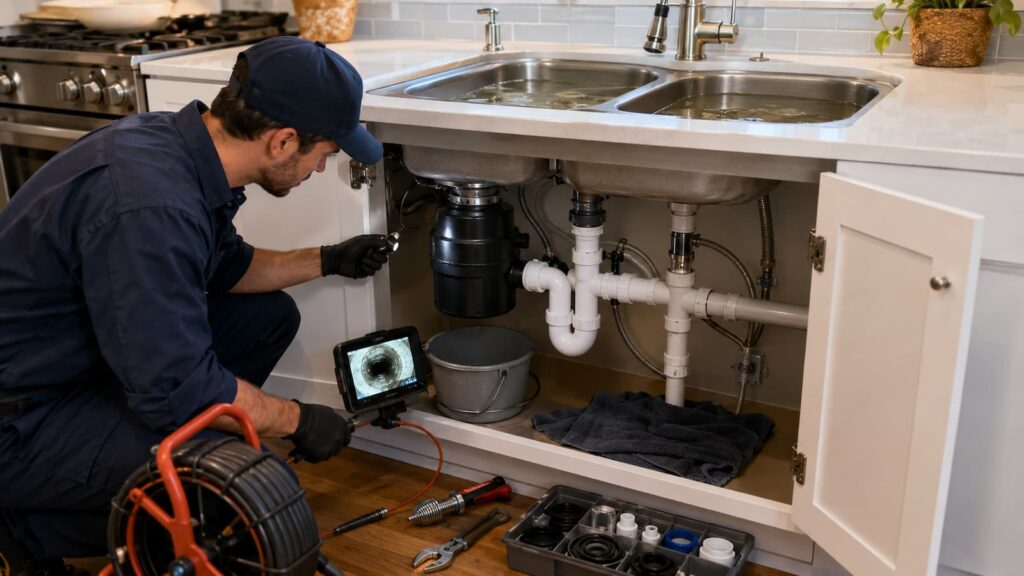
A kitchen sink backing up on both sides is more than a normal slow drain.
When one side of a double sink fills with dirty water, many homeowners assume that one basin is clogged. But when both sides are backing up, the issue is usually somewhere shared by both sides of the sink. That shared point might be the garbage disposal outlet, the tee between the bowls, the P-trap, the disposal discharge pipe, the dishwasher drain connection, or the kitchen branch drain inside the wall.
The details matter because the right fix depends on where the restriction is. A clog inside the disposal is different from a clog in the P-trap. A blocked dishwasher hose is different from a grease-coated branch line. A sink that backs up only during dishwasher use tells a different story than a sink that fills whenever either basin drains. A sink that backs up and gurgles when the washing machine runs may point to an even deeper drain problem.
Kitchen sinks are especially vulnerable because they handle a difficult mix of materials: food particles, grease, cooking oil, soap residue, coffee grounds, starches, vegetable peels, rice, pasta, eggshell fragments, sauces, and dishwasher discharge. A bathroom sink mostly deals with soap and toothpaste. A kitchen drain deals with everything from dinner cleanup to disposal waste. Over time, that combination can create stubborn buildup that does not behave like one simple clog.
This guide explains why a double kitchen sink backs up on both sides, how to tell whether the garbage disposal, P-trap, or deeper drain line is responsible, what homeowners can safely check, what not to pour down the drain, and when professional service is the smarter move. If your sink keeps backing up after basic cleaning, professional drain cleaning can help clear the line properly and determine whether the issue is local or deeper in the kitchen drain system.
What it means when both sides of the kitchen sink back up
A double kitchen sink usually has two bowls that connect to a shared drain assembly below the countertop. One side may drain through a garbage disposal. The other may connect through a basket strainer. The two sides then usually join through a tee or continuous waste pipe before draining through the P-trap and into the wall.
Because the two basins share piping, a backup in both sides usually means water cannot leave through the shared path. If the clog were only in one basket strainer, that side might be slow while the other side drained normally. But when both bowls fill, the restriction is often at or after the point where they connect.
That shared restriction may be close to the sink. Food debris can collect at the disposal outlet. Grease can build up in the horizontal pipe between the disposal and tee. The P-trap can fill with sludge. The trap arm leading into the wall can become restricted. Or the kitchen branch drain farther inside the wall can be coated with grease and food residue.
The direction of the backup can also tell you something. If water drains from one bowl and rises into the other, the clog is usually downstream of both basins. If the disposal side backs up into the non-disposal side, the shared piping or trap may be restricted. If dishwasher discharge sends dirty water into the sink, the issue may involve the disposal connection, air gap, high loop, dishwasher hose, or branch drain.
In simple terms, both sides backing up means the kitchen drain system has lost capacity. The question is whether that lost capacity is in the disposal, under-sink piping, P-trap, branch drain, or main line.
Cause 1: a garbage disposal clog
A garbage disposal can cause a double sink backup when waste gets stuck in the disposal chamber, outlet, or discharge pipe. The disposal may still hum or spin, but that does not mean the drain path is clear. A disposal grinds food into smaller pieces; it does not make those pieces disappear. They still have to move through the kitchen drain line.
Disposal clogs often happen after fibrous foods, starchy foods, grease-heavy cleanup, or too much waste at once. Celery, onion skins, corn husks, potato peels, rice, pasta, coffee grounds, eggshell fragments, and thick sauces can all contribute. Even if some of those materials pass through the disposal, they may collect farther down the pipe, especially when mixed with grease.
A disposal issue is more likely if the backup began right after heavy food waste was sent down the disposal. You may hear the disposal strain, hum, or stop. Water may sit in the disposal side first, then rise into the other basin. The disposal may drain slowly even after it sounds like it is running normally.
There is an important safety rule here: never put your hand inside a garbage disposal. If the disposal is jammed, turn off the switch and, if needed, power at the breaker before attempting any safe reset or external tool use. Many disposals have a reset button underneath and a hex key socket for freeing a jam from the bottom. Those features vary by model. If you are unsure, stop and call a professional.
A disposal clog can sometimes be resolved by clearing the jam and flushing the drain properly. But if the disposal works and the sink still backs up on both sides, the problem is likely downstream in the discharge pipe, P-trap, trap arm, or branch drain.
Cause 2: a clogged P-trap
The P-trap is the curved section of pipe under the sink. It holds water to block sewer gases from entering the home. It also catches debris. That makes it both useful and vulnerable. In a kitchen sink, the P-trap can collect grease, food particles, sludge, coffee grounds, small utensils, labels, and other debris that slips past the sink strainers or disposal.
A P-trap clog is common because the trap has a bend where heavier material can settle. Water slows as it turns through the curve. Grease and food residue can cling to the inside. Over time, the opening narrows until water can no longer pass fast enough.
A clogged P-trap can cause both sides of a double sink to back up because the trap is downstream of both basins. Water from either side must pass through the same trap. If the trap is blocked, both sides are affected.
Signs of a P-trap clog include standing water in both basins, a bad smell from the sink, slow drainage after food cleanup, gurgling from the drain, and a backup that seems limited to the kitchen sink. If all other fixtures in the home drain normally, the clog may be local to the kitchen assembly or nearby branch.
Some homeowners remove the P-trap themselves. This can be reasonable if the trap is plastic, accessible, not corroded, and the homeowner is comfortable with basic plumbing. Put a bucket underneath first because the trap will hold dirty water. However, if the trap is metal, corroded, old, glued, leaking, or connected to fragile piping, forcing it apart can create a bigger repair.
If cleaning the P-trap restores flow and the problem does not return, the issue may have been local. If the trap is clear but the sink still backs up, the restriction is farther downstream.
Cause 3: grease buildup in the kitchen branch drain
Grease is one of the most common reasons kitchen sink backups keep returning. It often starts as a thin film inside the pipe. Warm grease may go down the drain as a liquid, but it cools inside the plumbing. Once it cools, it sticks to pipe walls. Food particles, soap residue, starches, and disposal waste then attach to that sticky layer.
Kitchen branch drains are especially prone to grease buildup because they receive wastewater from dishwashing, cooking cleanup, garbage disposal use, and sometimes dishwasher discharge. The buildup may not happen all at once. Small amounts of grease and food residue can accumulate over months or years until the line becomes narrow enough to back up during normal use.
A grease-coated branch line can make both sides of the sink back up even if the disposal and P-trap are clear. This is because the restriction is farther inside the wall, beyond the under-sink parts. The sink may drain slowly after light use, then back up after a dishwasher cycle, large meal cleanup, or disposal use.
One clue is recurrence. If the P-trap has been cleaned and the sink improves for a short time, then backs up again, the branch line may still be coated. Another clue is water that drains slowly even after the visible under-sink piping has been cleared. Grease problems often need more than surface cleaning because the buildup clings to the pipe walls.
Hot water and dish soap are not a reliable fix for grease buildup. They may move grease farther down the line, but they do not remove the underlying coating. In some cases, they simply relocate the problem from the trap to a deeper section of pipe.
When grease buildup is heavy or recurring, more thorough cleaning may be needed. For stubborn kitchen line restrictions, hydro jetting may be appropriate because it can clean buildup from pipe walls more completely than a basic opening.
Cause 4: food debris and disposal waste stuck in the drain line
Garbage disposals can create a false sense of security. Because the food is ground smaller, it feels safe to send down the drain. But small food particles can still build up, especially when they are sticky, starchy, fibrous, or mixed with grease.
Rice and pasta swell with water and can become gummy. Potato peels and vegetable skins can clump. Coffee grounds behave like sediment. Eggshell fragments can mix with grease and sludge. Fibrous foods can wrap around disposal parts or collect in the piping. Even small amounts can create problems when repeated daily.
Food debris may collect in the disposal discharge pipe, the continuous waste pipe between basins, the P-trap, or the trap arm leading to the wall. If it reaches a grease-coated section of pipe, it may stick instead of washing away. Over time, the line becomes more restricted.
Food-related clogs often show up after cooking or cleanup. The sink may back up after rinsing dishes, running the disposal, or draining pasta water. If the dishwasher connects to the disposal, dishwasher discharge may push water into the sink because the kitchen drain cannot accept the added flow.
The best prevention is to treat the disposal as a helper, not a trash can. Scrape plates into the trash or compost first. Avoid large batches of food waste. Run plenty of cold water during and after disposal use. Keep grease, oil, coffee grounds, rice, pasta, and fibrous scraps out of the drain as much as possible.
Cause 5: dishwasher discharge backing into the sink
If the kitchen sink backs up mainly when the dishwasher drains, the dishwasher connection should be considered. Most dishwashers discharge into the garbage disposal or a branch tailpiece under the sink. If the disposal outlet, air gap, high loop, dishwasher hose, or sink drain line is restricted, dishwasher water can back up into the sink.
A dishwasher backup may appear as dirty or sudsy water rising into one or both sink basins during or after a dishwasher cycle. The water may smell like food residue. If there is an air gap on the countertop, water may spill from the air gap when the dishwasher drains. If there is no air gap, the dishwasher hose should typically be routed in a proper high loop according to local code and manufacturer requirements to help prevent backflow.
If a new garbage disposal was recently installed and the dishwasher suddenly will not drain, one common issue is the disposal dishwasher inlet knockout plug not being removed. That plug is present when the disposal is not used with a dishwasher. If the dishwasher hose is connected but the plug is still in place, dishwasher water has nowhere to go.
However, if the dishwasher worked normally before and now water backs into the sink, the issue is more likely a clogged hose, air gap, disposal inlet, or kitchen drain restriction. The dishwasher may be doing its job, but the sink drain cannot receive the water fast enough.
Dishwasher-related backups can also reveal grease buildup in the kitchen branch line. A dishwasher releases water in a burst. If the line is partially restricted, that sudden discharge may exceed the drain’s reduced capacity and send water into the sink.
Cause 6: a clogged trap arm or wall drain
If the P-trap is clear but the sink still backs up, the clog may be in the trap arm or wall drain. The trap arm is the horizontal pipe that leaves the P-trap and enters the wall. From there, the kitchen sink connects to a vertical or horizontal branch drain hidden inside the wall or cabinet area.
This section is a common place for grease and sludge to collect because it is downstream of the disposal and P-trap but still close enough to receive heavy kitchen waste. The pipe may have a long horizontal run, older rough interior, poor slope, or buildup from years of use. When it narrows, both sides of the sink can back up even though the under-sink parts look normal.
Wall drain clogs are often harder for homeowners to clear safely because the restriction is no longer in a removable trap. A hand snake may or may not reach it. Using the wrong tool can damage fittings, push the clog deeper, or get stuck. If the pipe is old, corroded, or improperly installed, aggressive DIY attempts can create leaks inside the wall.
A wall drain restriction is more likely if the sink drains slowly after the P-trap has been cleaned, if water backs up into both basins, if the disposal is working, and if the backup returns soon after basic cleaning. It may also cause gurgling as air struggles to move through the restricted pipe.
Professional drain cleaning can usually access this line through the trap arm, cleanout, or another appropriate access point. If the line repeatedly clogs, a deeper issue such as grease buildup, poor slope, or pipe condition may need to be addressed.
Cause 7: a venting problem
Kitchen drains need air as well as water flow. Plumbing vents allow air to enter the drain system so wastewater can move smoothly and traps do not siphon. If venting is blocked, restricted, or improperly installed, the kitchen sink may drain slowly, gurgle, or back up in unusual ways.
Vent problems are less common than grease or P-trap clogs, but they can create confusing symptoms. The sink may gurgle after draining. Water may hesitate before leaving. One basin may bubble when the other drains. The dishwasher may cause strange drain sounds. A nearby fixture may gurgle when the kitchen sink is used.
A vent issue can be caused by a blocked roof vent, debris, nesting material, improper remodeling, a failed air admittance valve where one is installed, or poor original plumbing layout. However, a drain clog can mimic a vent problem because a restricted line also disrupts air movement. That is why vent issues should not be assumed too quickly.
If the sink is backing up on both sides, a physical restriction is usually the first suspect. If the drain line is clear but gurgling and slow drainage continue, venting may need to be evaluated. Homeowners should avoid climbing onto the roof to clear vents unless they have proper equipment and experience. Roof work is dangerous, and the diagnosis may still be wrong.
A plumber can test whether the drain is restricted, whether the vent path is functioning, and whether the sink’s plumbing layout is contributing to the problem.
Cause 8: a deeper drain or main line issue
Most double kitchen sink backups are local to the kitchen drain system. However, a deeper drain or main line issue becomes possible when other fixtures are also affected. The kitchen sink may be the first place you notice the problem, but it may not be the only fixture involved.
A main line issue is more likely if multiple drains are slow, toilets gurgle when the kitchen sink drains, water backs up into a tub or shower, floor drains bubble, or lower-level fixtures react when the dishwasher or sink runs. These symptoms suggest wastewater is struggling to leave the home through shared piping.
Main line restrictions can be caused by tree roots, grease, wipes, sludge, scale, broken pipe, offset joints, bellied pipe, or collapsed sections. A kitchen line can also contribute to a main line problem when grease and food waste move beyond the kitchen branch and collect farther downstream.
If only the kitchen sink is affected, the issue is probably local. If several fixtures are affected, stop using large amounts of water and schedule service. Running the dishwasher, laundry, or multiple sinks can make a sewer backup worse if the main line is restricted.
For recurring or whole-house symptoms, a sewer camera inspection can help determine whether the problem is simple buildup, roots, pipe damage, or another condition inside the line.
How to tell whether it is the disposal, P-trap, or drain line
The symptom pattern usually gives the best clues. Start by asking what happened right before the backup. Did it happen after running the disposal? After the dishwasher drained? After rinsing greasy pans? After both basins were full of water? Did it happen suddenly, or has the sink been slowing for weeks?
A garbage disposal issue is more likely if the disposal hums, jams, drains poorly, or backed up immediately after food waste was sent through it. Water may collect first on the disposal side, then rise into the other basin. The disposal may sound different or stop entirely.
A P-trap clog is more likely if both sides are affected, the backup seems limited to the kitchen sink, the trap smells bad, and other fixtures in the home are normal. Cleaning the trap may restore flow if the clog is in the removable under-sink section.
A trap arm or branch drain clog is more likely if the P-trap is clear but water still backs up, if the problem returns quickly after cleaning, or if grease-heavy use has been common. The restriction may be inside the wall or farther down the kitchen line.
A dishwasher connection issue is more likely if the backup happens during dishwasher drain cycles, if water spills from the air gap, or if a new disposal was installed recently and the dishwasher no longer drains correctly.
A main line issue is more likely if other fixtures are involved. If toilets gurgle, tubs drain slowly, or lower drains back up when the kitchen sink or dishwasher runs, the problem may be deeper than the kitchen sink.
The more isolated the symptom, the more likely the issue is local. The more fixtures involved, the farther downstream the restriction is likely to be.
What homeowners can safely check first
If the sink is backing up on both sides, start with safe observations before taking anything apart. The goal is to identify the likely source without creating a leak under the cabinet or damaging the disposal.
- Stop running water. If both basins are filling, adding more water only increases the mess.
- Turn off the garbage disposal. Do not run the disposal while standing water is present unless you know it is safe and the unit is not jammed.
- Check whether the disposal is jammed. Listen for humming, clicking, or silence. Never put your hand inside the disposal.
- Look under the sink. Check for leaking slip joints, a loose trap, a sagging dishwasher hose, or water dripping from the disposal.
- Check when the backup happens. If it happens during dishwasher use, focus on the dishwasher drain path and sink drain capacity.
- Test other fixtures carefully. If bathroom drains or toilets are also affected, stop using water and suspect a deeper issue.
- Use a bucket before opening the trap. The P-trap will hold dirty water, and the sink basins may drain when it is removed.
- Avoid forcing old fittings. Corroded metal traps and old slip nuts can break or leak.
- Do not use chemical drain cleaner before service. It can sit in the standing water and create hazards.
If the under-sink piping is plastic and accessible, some homeowners can remove and clean the P-trap. But if the cabinet plumbing is old, corroded, leaking, glued, or confusing, calling a plumber is usually safer.
Should you plunge a double kitchen sink?
Plunging can sometimes help a kitchen sink clog, but it must be done carefully. In a double sink, pressure can escape through the other basin instead of pushing into the clog. That is why the other drain opening usually needs to be sealed with a stopper or wet rag before plunging.
If one side has a garbage disposal, plunging can push water and debris through the disposal side or into the dishwasher drain connection. If the dishwasher hose does not have a proper high loop or air gap, pressure can potentially force dirty water into places it should not go.
Never plunge after using chemical drain cleaner. If the drain cleaner has not cleared the clog, it may be sitting in the standing water. Plunging can splash it onto skin, eyes, clothing, or cabinet surfaces.
Plunging is more likely to help a soft clog in the trap or nearby pipe. It is less likely to solve a grease-coated branch line, vent problem, disposal outlet clog, or deeper drain restriction. It may create temporary movement without fully removing the cause.
If plunging works once and the sink drains normally afterward, monitor it. If the sink backs up again soon, the line likely still contains buildup. Repeated plunging is not a maintenance plan. It is a sign that the line needs proper cleaning.
What not to pour into a backed-up kitchen sink
A backed-up kitchen sink tempts people to pour something stronger down the drain. That is usually not the best move. Chemical drain cleaners may not clear grease, food debris, disposal waste, or a deeper branch clog. If the cleaner does not work, it remains in the standing water and makes later repair more dangerous.
Do not pour more grease-cutting soap, boiling water, bleach, vinegar mixed with other chemicals, or multiple drain cleaners into standing water. Mixing chemicals can produce dangerous fumes or reactions. Boiling water can damage some plastic components, loosen slip-joint seals, or create splash hazards. Bleach does not dissolve a physical clog in the way many homeowners expect.
Also avoid using the disposal as a way to “force” the clog through. If the line is blocked, running the disposal may simply churn dirty water, push debris into the other basin, strain the motor, or worsen the mess under the sink. A disposal is not a drain-cleaning machine.
The safest approach is to stop adding water, remove standing water if needed, check the disposal and P-trap safely, and call for service if the clog is beyond easy access. A kitchen backup is usually a mechanical restriction. It needs mechanical clearing, cleaning, or diagnosis, not chemical guessing.
When drain cleaning is enough
Drain cleaning is often enough when the problem is a local kitchen line clog caused by grease, food debris, disposal waste, or P-trap buildup. If the clog is in the trap, trap arm, or nearby branch drain, professional cleaning can restore flow and remove the immediate obstruction.
Drain cleaning is especially appropriate when the backup is limited to the kitchen sink, the dishwasher may be contributing, the disposal is not enough to clear the issue, and other fixtures in the house are normal. In that situation, the kitchen drain system is the likely focus.
The method depends on the clog. A P-trap may be removed and cleaned. A snake may be used through the trap arm or cleanout. The disposal outlet may be cleared. The dishwasher drain path may be inspected. If the line is heavily coated, more thorough cleaning may be discussed.
A one-time clog after a known mistake may not mean the drain line is in poor condition. But recurring kitchen backups are different. If the same sink backs up again and again, the line may be coated with grease, improperly sloped, partially restricted farther downstream, or connected to a larger drain issue.
Good drain cleaning should not only restore flow. It should also help identify whether the clog was isolated or part of a recurring pattern.
When the problem may need hydro jetting or inspection
Hydro jetting or camera inspection may be needed when kitchen sink backups keep returning or when symptoms suggest the problem is deeper than the under-sink piping.
Hydro jetting may be useful when grease and sludge coat a longer section of pipe. A basic snake may open a small path through the blockage, allowing water to drain temporarily. But if pipe walls remain coated, food particles and grease can build up again quickly. Hydro jetting is designed to clean the pipe more thoroughly by using high-pressure water to scour buildup.
Camera inspection may be useful when repeated clogs suggest a physical issue, such as a belly, damaged pipe, offset joint, root intrusion, or heavy buildup farther downstream. It may also help when the kitchen backup is part of broader drainage symptoms around the home.
Not every kitchen clog needs a camera. A first-time P-trap clog probably does not. But if the sink backs up every few months, if drain cleaning does not last, or if other fixtures react, inspection can prevent guesswork.
The goal is to match the solution to the cause. A jammed disposal needs disposal service. A dirty P-trap needs cleaning. A grease-coated branch line may need more thorough drain cleaning. A damaged sewer line needs a different plan entirely.
How to prevent both sides of the kitchen sink from backing up again
Prevention starts with changing what goes into the sink. Kitchen drains clog because the materials sent through them are sticky, heavy, fibrous, or slow to break down. Keeping those materials out of the drain is more effective than trying to clear them after they build up.
Scrape plates into the trash or compost before rinsing. Wipe grease from pans with a paper towel before washing. Let cooking oil cool and dispose of it in a container instead of pouring it into the sink. Use sink strainers to catch food particles. Run cold water while using the disposal and continue running it briefly afterward to help move waste through.
Be especially careful with coffee grounds, rice, pasta, potato peels, onion skins, celery, eggshells, grease, flour, and thick sauces. These materials are common kitchen clog contributors because they clump, swell, coat pipe walls, or settle in the trap.
Do not treat the garbage disposal like a trash can. Feed waste slowly, not in large batches. Avoid disposal use when the drain is already slow. If the disposal sounds strained or the sink is not draining, stop and investigate instead of forcing more material through.
Pay attention to early warning signs. A kitchen sink that drains a little slower after greasy cleanup is giving you a chance to act before both basins back up. Gurgling, odors, dishwasher water in the sink, and repeat slowdowns all suggest the drain needs attention.
For homes with recurring grease-heavy cooking or frequent disposal use, scheduled drain maintenance may be more practical than waiting for backups. The goal is to prevent buildup from reaching the point where the sink stops draining during daily use.
A quick symptom guide for kitchen sink backups
If your kitchen sink is backing up on both sides, this quick guide can help narrow the likely cause:
- Water rises in both basins when either side drains: likely shared restriction in the P-trap, trap arm, or kitchen branch drain.
- Backup starts after running the disposal: possible disposal jam, disposal outlet clog, food debris, or discharge pipe restriction.
- Dishwasher sends water into the sink: possible dishwasher hose, air gap, disposal inlet, high loop, or kitchen drain capacity issue.
- P-trap is full of sludge or food debris: local under-sink clog may be the main cause.
- P-trap is clear but sink still backs up: likely clog in trap arm, wall drain, or branch line.
- Sink drains slowly after greasy cleanup: grease buildup is likely contributing.
- Backup keeps returning after plunging: deeper buildup or branch line restriction is likely.
- Other drains are slow or toilets gurgle: possible shared drain or main line issue.
- Water leaks under the cabinet during backup: stop using the sink and inspect slip joints, trap, disposal, and supply/drain connections.
- Bad odor with recurring backup: possible food sludge, grease buildup, dirty trap, or deeper drain restriction.
This guide is not a substitute for diagnosis, but it helps you avoid guessing. A double-basin backup is usually downstream of both basins. The main question is how far downstream.
Frequently Asked Questions
When both sides of a double kitchen sink back up, the clog is usually downstream of where the two basins connect. Common causes include a clogged garbage disposal outlet, blocked P-trap, grease buildup in the trap arm, or a restriction in the kitchen branch drain.
Yes. A jammed disposal, clogged disposal outlet, or blocked disposal discharge pipe can cause water to back up into both basins, especially if the restriction is downstream of the disposal and shared by both sides of the sink.
A clogged P-trap often causes both sides of the sink to drain slowly or hold standing water while other fixtures in the home drain normally. The trap may smell bad or contain food sludge, grease, coffee grounds, or other debris when removed.
Dishwasher water may drain into the sink if the disposal inlet, air gap, dishwasher hose, high loop, P-trap, or kitchen branch drain is restricted. If a new disposal was installed recently, the dishwasher knockout plug may not have been removed.
Chemical drain cleaner is usually not the best choice. It may not clear grease, food debris, disposal waste, or deeper branch clogs. If it fails, chemical water remains in the sink and creates a safety risk during plunging, trap removal, or professional service.
Some homeowners can remove a plastic, accessible P-trap if the fittings are in good condition and a bucket is placed underneath. Do not force old, corroded, metal, glued, or leaking piping. If the trap is clear and the sink still backs up, the clog is farther downstream.
A main line problem is more likely if other drains are slow, toilets gurgle, water backs up into tubs or showers, floor drains bubble, or lower-level fixtures react when the kitchen sink or dishwasher runs. If only the kitchen sink is affected, the problem is usually local.
Call a plumber if both basins are holding water, the disposal is jammed, the P-trap is clear but the sink still backs up, dishwasher water rises into the sink, the clog keeps returning, or other fixtures show slow drains or gurgling.
Final thoughts
A kitchen sink backing up on both sides usually means the restriction is downstream of the two basins. The cause may be a jammed garbage disposal, clogged disposal outlet, blocked P-trap, dishwasher connection issue, grease-coated trap arm, or deeper kitchen branch drain restriction. The sink is showing you that the shared drain path cannot handle normal flow.
The best first step is to stop running water, avoid chemical drain cleaners, check the disposal safely, look under the sink, and determine whether other fixtures are affected. If the problem is limited to the kitchen sink, it is often a local kitchen drain issue. If toilets gurgle, tubs are slow, or lower drains back up, the issue may be farther downstream.
Handled early, a kitchen sink backup may be a simple trap or branch drain cleaning. Ignored or repeatedly forced with the disposal, it can become a recurring grease and food-waste problem that needs more thorough cleaning or inspection.