
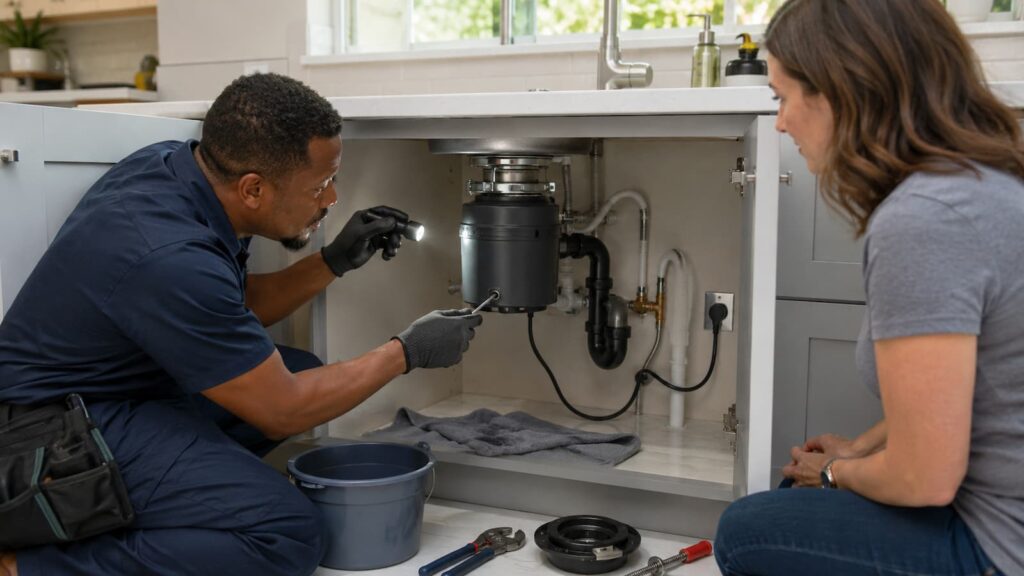
A garbage disposal that hums but does not spin is usually trying to run, but something is stopping it from turning.
That low humming sound is an important clue. It often means the disposal is receiving power and the motor is energized, but the grinding plate, flywheel, or internal rotating parts are stuck. In many cases, the unit is jammed by food waste, a small utensil, a piece of bone, fruit pit, bottle cap, glass shard, or another object that should not be inside the disposal. In other cases, the motor has overheated, the reset button has tripped, the internal parts are worn, or the disposal is reaching the end of its service life.
The most important thing to know is this: do not keep turning the switch on and off while the disposal is humming. A humming disposal is under strain. If the motor cannot spin, repeated attempts can overheat the unit, damage the motor, trip the reset button, or create an electrical problem. The humming sound is not a sign to “try harder.” It is a sign to stop and troubleshoot safely.
Also, never put your hand inside a garbage disposal. Even when the switch is off, that is not a safe habit. Disposals can have sharp internal parts, hidden debris, and electrical risk. A jam should be cleared from outside the grinding chamber whenever possible, using the proper reset procedure, hex wrench socket, tongs, pliers, or professional tools.
This guide explains why a garbage disposal hums but does not spin, what homeowners can safely check, how to tell whether the issue is a jam, reset problem, drain clog, or failing motor, what not to do, and when it is time to call a plumber. If your disposal is jammed, leaking, backing up, or repeatedly failing, Smart Plumbing USA can help with professional garbage disposal repair and installation.
What does it mean when a garbage disposal hums but does not spin?
A garbage disposal hums when the motor is trying to operate but the rotating assembly is not moving freely. In a normal cycle, the motor spins a plate or flywheel inside the disposal. Small impellers attached to that rotating plate help knock food waste against the grind ring so particles can wash down the drain with water. The blades or impellers are not supposed to be sharp like blender blades. The disposal works by impact and grinding, not slicing.
When something blocks that rotating plate, the motor may still receive electricity, but it cannot turn. That creates the humming or buzzing sound. If the switch stays on too long, the motor can overheat. Many disposals have an overload protector that trips to protect the motor. When that happens, the disposal may stop humming and appear completely dead until the reset button is pressed after the unit cools.
A humming disposal is different from a disposal that makes no sound. No sound may point to a power issue, tripped breaker, loose plug, bad switch, tripped reset button, or failed motor. Humming usually points more strongly toward a jammed mechanism or motor that cannot start under load. That distinction helps narrow the problem.
A disposal that hums and then shuts off quickly may be overheating or tripping its internal overload protection. A disposal that hums every time and never spins may have a jammed flywheel or failing motor. A disposal that hums but the sink also backs up may have both a mechanical jam and a drain restriction. A disposal that hums after a spoon, bottle cap, or hard food item fell in likely has a foreign object jam.
The best response is to stop using the switch, cut power if needed, and identify whether the unit can be safely freed. Continuing to run a jammed disposal is one of the easiest ways to turn a simple jam into a burned-out motor.
Safety first: what to do immediately
If your garbage disposal hums but does not spin, the first step is simple: turn it off. Do not keep flipping the wall switch to see if it starts. That humming sound means the disposal is under electrical and mechanical strain.
Next, make sure the disposal cannot turn on unexpectedly while you inspect it. Depending on the installation, this may mean unplugging it from the outlet under the sink, switching off the correct breaker, or making sure the wall switch is off and no one else can turn it on. If the disposal is hardwired and you are not sure how to safely disconnect power, do not attempt internal work.
Never reach your hand into the disposal opening. This is the most important safety rule. Even if the power is off, the grinding chamber can contain sharp fragments, broken glass, food debris, or loose metal. Use a flashlight to look into the chamber from above. If you see an object, remove it with long-handled tongs or pliers only after power is safely off. Do not use your fingers.
If there is standing water in the sink, be extra careful. Standing water can hide debris, make the area slippery, and create unpleasant exposure if food waste is present. Do not use chemical drain cleaner in a disposal. If the sink is backed up and the disposal is jammed, chemical cleaner can sit in the water and create hazards for anyone who later removes the trap, plunges, or services the unit.
If the disposal smells like burning, sparks, leaks water, trips the breaker repeatedly, or feels hot, stop troubleshooting and call a professional. Those are not normal jam symptoms to keep testing.
Safe disposal troubleshooting is about patience. Power off, hands out, proper tools only, and no repeated switch flipping.
Cause 1: the flywheel or grinding plate is jammed
The most common reason a garbage disposal hums but does not spin is a jammed flywheel or grinding plate. The motor is trying to rotate the plate, but something inside the chamber is preventing movement. The unit hums because electricity is reaching the motor, but the mechanism cannot turn.
Jams can happen when hard or fibrous material gets wedged between the rotating plate and the grind ring. Common culprits include fruit pits, small bones, shell fragments, bottle caps, twist ties, broken glass, silverware, measuring spoons, screws, coins, plastic tabs, and tough vegetable scraps. Sometimes the object is obvious. Other times, it is hidden beneath food debris.
Many disposals have a hex socket underneath the unit. This socket allows you to manually turn the flywheel from below using the correct hex wrench, often a 1/4-inch wrench supplied with the disposal. Turning the wrench back and forth can free a jam without reaching into the disposal. The motion may feel stuck at first, then loosen as the object shifts.
If the disposal has a bottom hex socket, make sure the power is off, insert the wrench into the socket, and gently move it back and forth. Do not force it violently. The goal is to free the jam, not break the mechanism. Once the flywheel moves freely, remove any visible object from the top using tongs or pliers, restore power, run cold water, and test the disposal briefly.
Some disposal models do not have a bottom hex socket. In those cases, a specialized disposal wrench or careful tool use from above may be needed. Again, hands should stay out of the chamber. If you cannot free the jam safely, call for service.
A simple jam does not always mean the disposal needs replacement. But if the unit jams frequently, struggles with normal food scraps, or hums even after being freed, the motor or internal parts may be wearing out.
Cause 2: a foreign object is stuck inside
A foreign object inside the disposal can stop the unit from spinning instantly. This is different from a soft food clog. A spoon, fork, bottle cap, glass shard, screw, twist tie, jewelry item, or small kitchen tool can wedge in the grinding chamber and lock the rotating plate.
The clue is often timing. If the disposal started humming immediately after something fell into the sink, assume it is jammed by that object until proven otherwise. Do not turn the unit on again to “see what happens.” Running the disposal with a foreign object inside can damage the impellers, grind ring, motor, or mounting assembly. It can also make the object harder to remove.
To inspect safely, turn off power to the disposal and use a flashlight from above. Look around the outer edge of the grinding chamber, not just the center. Objects often lodge along the side. If you can see the object, use long-handled tongs or needle-nose pliers to remove it. Do not use your hand.
If the object is glass, be especially careful. Broken glass can be hard to see in standing water or food residue. Do not reach in. If needed, remove standing water first using a cup, sponge, or wet/dry vacuum if safe and appropriate, then inspect with a flashlight.
After removing the object, manually rotate the disposal from below if the model has a hex socket. This confirms that the flywheel moves freely. Then reset the disposal if the overload button has tripped. Run cold water and test the unit briefly.
If the disposal still hums after the object is removed, internal damage may have occurred or another piece may still be lodged. At that point, professional diagnosis is safer than repeated attempts.
Cause 3: too much food waste was fed into the disposal
Garbage disposals are helpful, but they are not designed to handle unlimited food waste at once. Overloading the disposal can cause the grinding plate to jam, the motor to strain, or the drain line to clog. If the unit hums after a large batch of scraps went down the sink, overload is a likely cause.
Large amounts of food can pack into the chamber faster than the disposal can grind and flush them away. This is especially common when water flow is too low, when the disposal is older, or when the waste is fibrous or starchy. The disposal may start, slow down, jam, hum, or trip the reset button.
Some foods are especially difficult for disposals. Potato peels can form a paste. Rice and pasta can swell and clump. Celery, onion skins, corn husks, and artichoke leaves can be stringy. Coffee grounds can settle like sediment. Eggshell fragments can mix with grease and sludge. Fruit pits and bones can jam the grinding mechanism. Grease can coat the drain line and trap food particles.
If the disposal hums after heavy use, turn it off and allow it to cool. Check for a jam using the proper manual rotation method. Remove visible debris safely with tongs. Press the reset button only after the jam is cleared and the unit has cooled. Then run cold water and test briefly.
If water is standing in the sink, the problem may not be only the disposal. The drain line may also be clogged. A disposal can be freed mechanically and still not drain because the P-trap, disposal discharge pipe, or branch drain is blocked with food and grease.
The best prevention is to feed waste slowly, use plenty of cold water, avoid difficult materials, and scrape plates into the trash before rinsing. The disposal should help with small scraps, not replace the trash can.
Cause 4: the reset button tripped after overheating
Most garbage disposals have an overload protector. This is often a small red or black reset button on the bottom or side of the unit. If the motor overheats or draws too much current, the overload protector trips and shuts the unit off to reduce damage.
A disposal may hum at first, then stop completely after the overload trips. Homeowners sometimes think the unit died, but it may simply need to cool and be reset. However, the reset button should not be used as a substitute for clearing the jam. If the disposal tripped because the flywheel is stuck, pressing reset and turning it on again may cause it to hum and trip again.
The safe sequence matters. First turn the disposal off. Let it cool. Make sure the flywheel can move freely by using the bottom hex socket if available. Remove any visible obstruction with tongs or pliers. Then press the reset button. After that, run cold water and briefly test the disposal.
If the reset button pops out again, or if the disposal hums and trips repeatedly, stop. Repeated overload trips can indicate a jam that has not been cleared, failing motor windings, electrical problems, worn bearings, internal damage, or a disposal that is near the end of its life.
Also check whether the disposal is plugged into a GFCI-protected outlet or connected to a switch that may have tripped. Some under-sink outlets include reset buttons. But if the unit hums, it usually has power, so the main issue is likely mechanical rather than a total power loss.
A reset button is a safety feature. If it trips once after a jam, that may be normal. If it trips repeatedly, the disposal needs diagnosis.
Cause 5: the motor is failing
Not every humming disposal can be saved by freeing a jam. Sometimes the motor itself is weak, worn, or failing. In that case, the disposal may hum because the motor is trying to start but no longer has enough torque to spin the grinding plate properly.
Motor failure is more likely in older disposals, disposals that have jammed repeatedly, units that have been overloaded often, or units that smell hot or burned during operation. The disposal may hum even when the flywheel can be moved manually. It may run briefly, then stop. It may trip the reset button without a clear jam. It may sound weaker than before or vibrate strangely.
Internal wear can also make the disposal harder to turn. Bearings may wear. Seals may fail. Corrosion may affect internal parts. The grinding components may become loose or damaged. If the unit leaks from the bottom, that often means internal seal failure and replacement is usually more practical than repair.
Garbage disposal motors are not usually repaired in the same way larger appliances are. For many residential units, replacement makes more sense when the motor is failing, especially if the disposal is older, noisy, leaking, rusted, or repeatedly tripping.
A professional can help determine whether the problem is a removable jam or a failing unit. That distinction matters because replacing a disposal unnecessarily costs more than clearing a simple jam, but repeatedly trying to revive a failing motor can waste time and risk leaks or electrical issues.
Cause 6: the disposal is spinning, but the drain is clogged
Sometimes the disposal problem is misunderstood. The unit may hum or struggle at first, then begin spinning, but the sink still does not drain. In that case, the disposal may not be the only issue. The P-trap, disposal discharge pipe, dishwasher connection, or kitchen branch drain may be clogged.
A disposal can grind food and still leave the drain line blocked. Ground food particles must move through the discharge pipe and trap. If grease, sludge, coffee grounds, rice, pasta, or food debris has built up in the line, the sink can back up even after the disposal runs.
This is common when both sides of a double kitchen sink back up. If water rises in the non-disposal side while the disposal side is draining, the restriction is often downstream of where the two sides connect. The clog may be in the P-trap, trap arm, or wall drain rather than inside the disposal chamber.
Signs of a drain line problem include standing water in both basins, gurgling after the disposal runs, dirty water backing up into the other sink bowl, dishwasher water entering the sink, bad odors, or recurring backups after food cleanup.
If the disposal is clear but the sink still backs up, do not keep running the disposal to force the clog through. That can strain the motor and make the mess worse. The drain line needs to be cleared. Smart Plumbing USA provides kitchen drain cleaning for sink backups, disposal-related clogs, grease buildup, and branch drain restrictions.
Step-by-step: what homeowners should do first
If your garbage disposal is humming but not spinning, use a careful sequence. Skipping steps can make the problem worse or create safety risks.
1. Turn the disposal off immediately. Do not let it keep humming. A stuck motor can overheat quickly.
2. Cut power if you plan to inspect it. Unplug the disposal under the sink if it has a plug, or turn off the correct breaker if needed. Make sure no one can accidentally turn it on.
3. Do not put your hand inside. Use a flashlight to look into the chamber from above. If you see an object, remove it with long tongs or pliers only after power is off.
4. Use the bottom hex socket if your model has one. Insert the proper hex wrench into the socket underneath the disposal and move it back and forth gently until the flywheel turns freely. This is often the safest way to free a jam.
5. Remove loosened debris from the top. Once the flywheel moves, inspect again from above and remove visible objects with tools, not fingers.
6. Press the reset button if it has tripped. The reset button is often on the bottom of the unit. If it will not stay in, the disposal may still be hot or may have a deeper issue.
7. Restore power and test with cold water. Run cold water first, then turn on the disposal briefly. If it spins normally and drains, continue running water for a short time.
8. Stop if it hums again. If the disposal still hums, trips, smells hot, leaks, or does not drain, call for service. Do not keep trying.
This process can solve many simple jams. But it should never involve hands inside the disposal, chemical drain cleaner, or repeated switch flipping.
How to use the disposal hex wrench safely
Many garbage disposals have a small hex-shaped socket in the center of the bottom of the unit. This feature is designed for freeing jams. If your disposal came with a small wrench, that is likely what it is for. If the wrench is missing, a properly sized hex key may work, depending on the model.
Before using the wrench, make sure the disposal switch is off. If possible, unplug the disposal or shut off power. Place a towel under the cabinet if there is standing water or a possible leak. Insert the wrench into the socket from underneath. Move it back and forth. You may feel resistance at first. That is the jam. Work gently until the mechanism moves more freely.
Do not use excessive force. If the wrench will not move at all, the jam may be severe, the unit may be damaged, or the wrong tool may be in use. Forcing the mechanism can damage the disposal or mounting connections.
After the flywheel moves freely, look inside the disposal from above with a flashlight. A freed object may now be loose in the chamber. Remove it with tongs or pliers. Then check the reset button. If it has popped out, press it back in after the unit has cooled.
When testing, run cold water first. Then turn the disposal on briefly. If it runs normally, let water continue for a short time to flush small particles through. If it hums again, turn it off immediately. The jam may not be fully cleared, or the motor may be failing.
If your disposal does not have a bottom hex socket, do not improvise with unsafe tools. Some models require different clearing methods. A plumber can free the jam or recommend replacement if the unit is damaged.
What if the reset button keeps popping out?
A reset button that keeps popping out is a sign that the disposal is still overloaded, jammed, overheating, or failing electrically. The reset button is not the problem by itself. It is responding to a problem.
If the reset button trips once after a jam, that may be normal. The motor overheated while trying to turn. After the jam is cleared and the unit cools, the button may reset and the disposal may run normally.
If the reset button trips again immediately, something is still wrong. The flywheel may still be stuck. A foreign object may still be lodged inside. The motor may be failing. The disposal may be drawing too much current. The unit may have internal damage.
Do not keep pressing reset and turning the switch on. That cycle can overheat the unit repeatedly. It can also create electrical stress. If the reset button will not stay in or trips every time the disposal is tested, stop using the disposal.
A professional can determine whether the disposal is jammed, repairable, or ready for replacement. In many cases, an older disposal that repeatedly trips the reset button is not worth extended troubleshooting, especially if it also leaks, vibrates, smells burned, or struggles with normal use.
What if the garbage disposal hums and the sink backs up?
A disposal that hums while the sink backs up may have two issues at the same time: the disposal is jammed, and the drain line is restricted. This is common after heavy food waste, grease, pasta, rice, vegetable peels, or dishwasher discharge overwhelms the kitchen drain.
Standing water makes troubleshooting harder. First, do not keep running the disposal. If the unit cannot spin and the water cannot drain, you are only adding strain. Second, do not pour chemical drain cleaner into the standing water. If the cleaner does not clear the clog, it remains in the sink and under-sink piping, creating a hazard.
If the disposal is jammed, free it first using safe steps. But even if the disposal begins spinning, the sink may still not drain. That means the clog is likely in the disposal discharge pipe, P-trap, trap arm, or kitchen branch drain. In a double sink, water may move from one basin into the other because the shared drain path is blocked.
Homeowners sometimes assume the disposal should clear the drain clog. It usually cannot. A disposal grinds food inside the unit. It does not clean grease buildup from the pipe walls or clear a blockage several feet downstream.
If the sink remains backed up after the disposal is freed, the drain line needs cleaning. This may involve removing the P-trap, clearing the trap arm, cleaning the branch drain, or using professional drain equipment. If the problem returns often, grease buildup or pipe condition may be involved.
What not to do with a humming garbage disposal
A humming disposal can often be saved if handled correctly. The wrong response can damage the unit or create safety risks.
Do not keep flipping the switch. Repeated humming without spinning overheats the motor.
Do not put your hand inside the disposal. Use tongs, pliers, or proper tools only after power is off.
Do not pour chemical drain cleaner into the disposal. Chemicals can sit in standing water, damage components, create fumes, and create hazards for later repair.
Do not run the disposal without water. Water helps carry ground particles away and cool the system during use.
Do not use boiling water to solve a disposal jam. Boiling water will not free a mechanical jam and may damage some plumbing connections or splash dangerously.
Do not force the hex wrench violently. If the flywheel will not move, the jam may be severe or the disposal may be damaged.
Do not ignore leaks from the bottom of the disposal. Bottom leaks often indicate internal seal failure, and replacement is usually the practical solution.
Do not assume the disposal is fixed just because it spins once. If it smells hot, trips reset, drains slowly, or jams again, the issue is not fully resolved.
A disposal is a powered appliance connected to plumbing. Treat it with the same caution you would use around electricity, water, and moving parts.
Repair or replace: how to decide
A garbage disposal that hums but does not spin is not automatically ready for replacement. Many units simply have a jam. If the disposal is newer, not leaking, and runs normally after being freed and reset, repair is usually enough.
Repair or clearing makes sense when the unit jammed because of one obvious object, the flywheel can be freed, the reset button stays in, the disposal runs smoothly afterward, there is no leak, and the sink drains properly. In that case, the disposal may continue working for years with better usage habits.
Replacement becomes more likely when the disposal is old, hums repeatedly, cannot be freed, trips the reset button again and again, smells burned, leaks from the bottom, vibrates heavily, rusts internally, drains poorly even after clearing, or no longer handles normal use. A motor that cannot start reliably is often not worth repeated repair attempts.
Leaks are especially important. A leak from a loose mounting ring, discharge pipe, or dishwasher connection may be repairable. But water leaking from the bottom of the disposal body often means an internal seal has failed. Once water enters areas where it should not, replacement is usually safer and more practical.
Noise and vibration also matter. A disposal that shakes violently, rattles even when empty, or sounds like metal grinding after a jam may have internal damage. Continuing to use it can stress under-sink piping and create leaks.
The decision is not only about whether the disposal can be made to run one more time. It is about whether it can run safely, quietly, and reliably without damaging the drain system or creating repeat backups.
When to call a plumber
Call a plumber if the disposal hums but will not free with the proper reset and hex wrench steps, if the reset button keeps tripping, if the unit leaks, if the sink is backed up, if the disposal smells burned, if the breaker trips, or if you are not sure how to safely disconnect power.
Professional help is also smart when the under-sink plumbing is old, corroded, leaking, or poorly configured. A disposal connects to the sink flange, dishwasher drain hose, discharge pipe, P-trap, trap arm, and electrical supply. Replacing or repairing the disposal can disturb those connections. If they are already weak, a simple repair can turn into a leak under the cabinet.
If the disposal is jammed and the sink is also backing up, the plumber may need to clear both the unit and the drain line. The clog may be in the P-trap, disposal discharge pipe, wall drain, or kitchen branch line. If grease buildup is heavy, simple disposal service may not solve the drainage issue.
Call promptly if dishwasher water backs into the sink, water leaks under the cabinet, both sides of a double sink fill with dirty water, or the backup returns after temporary clearing. These symptoms suggest the problem is not limited to the disposal motor.
If the disposal needs replacement, a plumber can also check the mounting assembly, sink flange, drain alignment, dishwasher connection, trap condition, and branch drain. That helps prevent a new disposal from being installed onto old drain problems that will cause backups again.
How to prevent garbage disposal jams
Most disposal jams are preventable. The key is to use the disposal for small scraps, not as a substitute for the trash can.
Scrape plates before rinsing. Throw away or compost large food scraps. Avoid sending hard items, fibrous foods, expandable starches, grease, coffee grounds, bones, fruit pits, shells, and non-food items down the disposal. Even when the disposal can grind something, the drain line may not be able to handle it well.
Run cold water before turning on the disposal. Keep the water running while the disposal operates and for a short time afterward. Cold water helps solidify small amounts of grease so they move through as particles instead of coating the pipe, though grease should still be kept out of the drain as much as possible.
Feed waste slowly. A disposal works better when it handles a little material at a time. Large batches can pack the chamber, jam the flywheel, or overwhelm the drain line. If the unit slows down, stop feeding waste and let it clear before adding more.
Clean the disposal gently. Small pieces of citrus peel can help with odor in some units, but they should not be used in large amounts. Ice cubes are sometimes used to help knock loose minor debris, but they will not fix a jam or clear a drain clog. Avoid harsh chemical cleaners inside the disposal.
Pay attention to early warning signs. If the disposal drains slower, smells bad, vibrates, hums briefly before spinning, or needs frequent resets, it is asking for attention. Addressing small problems early helps prevent full jams and kitchen sink backups.
Foods and materials that commonly jam disposals
Some materials are more likely to jam a disposal or clog the kitchen drain. Keeping these out of the unit can reduce problems significantly.
- Fruit pits and seeds: hard enough to wedge or damage internal parts.
- Bones and shells: may jam the grind ring or create sharp fragments.
- Celery, corn husks, onion skins, and artichokes: fibrous material can wrap around moving parts.
- Potato peels: can turn into a thick paste inside the disposal or drain.
- Rice and pasta: can swell with water and clump in the trap or branch line.
- Coffee grounds: can settle in the P-trap and combine with grease.
- Grease, fats, and oils: coat pipe walls and trap food particles.
- Eggshells: small fragments can mix with sludge and contribute to buildup.
- Plastic tabs, twist ties, labels, and wrappers: non-food items can jam the chamber.
- Spoons, forks, bottle caps, and small tools: common accidental foreign-object jams.
The disposal may survive some of these materials once or twice, but repeated use creates risk. The drain line is often the bigger problem. Even if the disposal grinds food, the kitchen plumbing still has to carry that waste away.
A quick symptom guide for a humming garbage disposal
If your garbage disposal is humming but not spinning, this quick guide can help narrow the likely cause:
- Hums immediately after something fell in: likely foreign object jam.
- Hums after heavy food waste: likely overloaded chamber or jammed flywheel.
- Hums, then shuts off: motor may be overheating and tripping the reset button.
- No sound after humming earlier: reset button, breaker, outlet, or motor protection may have tripped.
- Flywheel frees with hex wrench and unit runs normally: simple jam likely cleared.
- Reset button keeps popping out: jam remains, motor is failing, or electrical issue exists.
- Disposal spins but sink still backs up: likely P-trap, discharge pipe, or branch drain clog.
- Water leaks from disposal bottom: internal seal failure; replacement is usually likely.
- Unit smells burned: stop using it and call for service.
- Disposal jams repeatedly: worn unit, improper use, drain restriction, or internal damage may be present.
The most important dividing line is whether the unit can be freed safely and run normally afterward. If not, stop testing and get help before the motor or drain system is damaged further.
Frequently Asked Questions
A garbage disposal usually hums but does not spin because the motor is getting power but the flywheel or grinding plate is jammed. The cause may be a foreign object, hard food waste, fibrous material, overload, or a failing motor.
No. If the disposal hums but does not spin, turn it off immediately. Repeatedly switching it on can overheat the motor, trip the reset button, damage the unit, or create an electrical problem.
No. Never put your hand inside a garbage disposal. Turn off power and use a flashlight, tongs, pliers, or the bottom hex wrench socket if your model has one. If the object cannot be removed safely, call a plumber.
The reset button is usually on the bottom or lower side of the disposal. It may be red or black. If it has popped out, let the unit cool, clear any jam first, then press reset. If it trips again, stop using the disposal.
If the disposal still hums after resetting, the flywheel may still be jammed or the motor may be failing. Turn it off, use the proper hex wrench method if available, and do not keep resetting or switching it on repeatedly.
The disposal may be jammed and the drain line may also be clogged. Food waste, grease, and debris can block the disposal discharge pipe, P-trap, trap arm, or kitchen branch drain. Freeing the disposal may not clear the drain line.
Replacement is more likely if the disposal cannot be freed, hums repeatedly, trips the reset button often, smells burned, leaks from the bottom, vibrates heavily, is old, or no longer handles normal use reliably.
Call a plumber if the jam will not clear, the reset button keeps tripping, the disposal leaks, the sink backs up, the unit smells burned, the breaker trips, or you are not comfortable safely disconnecting power and troubleshooting the unit.
Final thoughts
A garbage disposal that hums but does not spin is usually jammed, overloaded, overheated, or failing internally. The motor is trying to work, but the rotating assembly is not moving. That is why the safest first step is to turn it off and stop testing it with the switch.
Many simple jams can be cleared by turning off power, using the bottom hex wrench socket, removing visible objects with tongs, pressing the reset button after the unit cools, and testing briefly with cold water. But hands should never go inside the disposal, and chemical drain cleaners should not be used in a backed-up sink.
If the disposal hums again, trips repeatedly, leaks, smells burned, backs up the sink, or cannot be freed safely, it is time for professional help. A quick repair may be enough for a simple jam. An older, leaking, or repeatedly failing disposal may be better replaced before it causes more kitchen drain problems.