
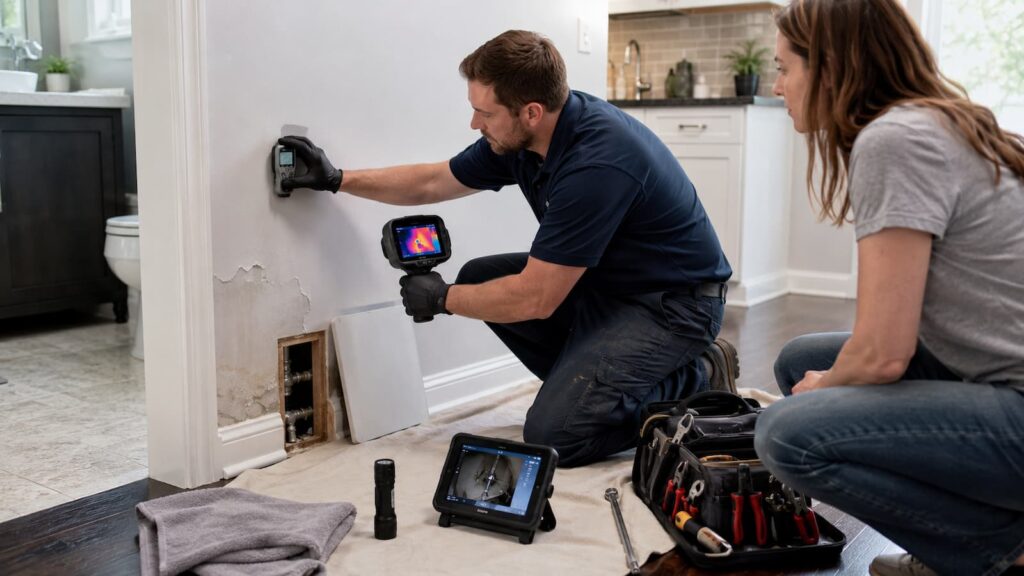
A pipe leaking behind a wall can be one of the most stressful plumbing problems because the leak is hidden, but the damage is not.
You may not see water spraying. You may not hear a dramatic drip. You may not know which pipe is involved. Instead, you notice a stain on the drywall, paint that starts bubbling, a musty smell that will not go away, a soft spot near the baseboard, or a water bill that suddenly looks wrong. The leak may be small, but if it is inside a wall, even a slow drip can soak insulation, damage framing, stain surfaces, attract mold growth, and spread into nearby rooms before it becomes obvious.
Hidden wall leaks are tricky because water does not always appear directly below the pipe that is leaking. It can travel along framing, pipes, drywall paper, insulation, flooring, cabinets, or baseboards. A stain in one location may come from a pipe several feet away. A wet baseboard may come from a leak higher in the wall. A ceiling stain below a bathroom may come from a supply pipe, drain pipe, toilet seal, shower valve, tub overflow, or even a roof or HVAC issue. That is why the goal is not just to prove that water is present. The goal is to identify the source accurately.
The good news is that homeowners can often recognize the warning signs early. You can inspect visible clues, check nearby fixtures, listen for water movement, watch the water meter, compare symptoms before and after fixture use, and avoid making the problem worse. The bad news is that guessing can be expensive. Opening the wrong wall, ignoring a supply leak, or assuming a drain leak is minor can lead to more damage.
This guide explains how to tell if a pipe is leaking behind a wall, what symptoms matter most, how to narrow down the source, what homeowners can safely check, what not to do, and when professional leak detection is the right next step. If you suspect an active hidden leak, Smart Plumbing USA provides professional leak detection and repair to help locate the problem before unnecessary demolition or wider water damage occurs.
Why hidden wall leaks are hard to spot
Leaks behind walls are difficult because the pipe is concealed by drywall, tile, cabinets, insulation, plaster, or framing. By the time you see the first visible sign, the water may have already been leaking for days, weeks, or longer. A supply pipe under pressure can leak continuously. A drain pipe may leak only when a fixture is used. A shower valve may leak only during showers. A toilet seal may leak only during flushing. Each pattern leaves different clues.
Water also moves in confusing ways. It follows gravity, but it also follows surfaces. It can run along a pipe before dripping. It can soak into insulation and spread sideways. It can travel behind baseboards and appear at a corner far from the leak. It can drip through a wall cavity and show up on the ceiling below. This is why visible staining is not always a reliable map of the leak source.
Another challenge is that not every wall stain is a pipe leak. Moisture behind a wall can come from roof leaks, window leaks, exterior wall leaks, condensation, HVAC condensate problems, appliance leaks, shower enclosure failures, or previous water damage that was never fully dried. A plumber’s job is not only to find wet material. It is to determine whether plumbing is the cause and, if so, which part of the system is leaking.
That distinction matters because the repair path changes. A pressurized supply pipe leak may require shutting off water and repairing the pipe. A drain leak may require fixture testing and access to the drain assembly. A shower waterproofing failure may need tile or enclosure repair. A roof leak needs roofing work, not pipe repair. Accurate diagnosis prevents wasted time and unnecessary wall damage.
Hidden wall leaks are not always dramatic, but they should be treated seriously. The longer moisture stays hidden, the more likely it is to damage building materials and create mold-friendly conditions.
Sign 1: water stains on drywall, ceilings, or baseboards
A visible stain is one of the most common signs of a leak behind a wall. The stain may look yellow, brown, gray, or slightly darker than the surrounding surface. On painted drywall, it may appear as a soft-edged patch. On ceilings, it may look like a ring or spreading mark. On baseboards, it may appear as discoloration near the floor.
Water stains matter because drywall, paint, wood, and insulation are not supposed to stay wet. A stain that grows, darkens, returns after drying, or feels cool and damp to the touch is especially suspicious. If the stain is near a bathroom, kitchen, laundry room, water heater, refrigerator line, or exterior hose bibb, plumbing should be considered.
The location of the stain can provide clues. A stain behind a shower wall may point to a shower valve, supply pipe, tub spout connection, or tile/waterproofing issue. A stain below a bathroom may involve a toilet, tub drain, shower drain, sink drain, or supply line. A stain under a kitchen sink wall may involve sink drain piping, dishwasher line, refrigerator water line, or supply plumbing. A stain near the floor may be from water running downward inside the wall.
However, do not assume the pipe is directly behind the stain. Water can travel before it becomes visible. A ceiling stain below a bathroom could be from the toilet area, shower area, tub overflow, sink drain, or supply line several feet away. A wall stain near a corner could be caused by an exterior leak rather than plumbing. That is why a stain is a warning sign, not a final diagnosis.
If the stain is new, photograph it and mark the edge lightly with painter’s tape or a pencil. Check it again later. If it grows, the moisture source may still be active. If it appears after specific fixture use, that pattern is important for diagnosis.
Sign 2: bubbling, peeling, or soft paint
Paint and drywall paper can bubble, peel, blister, or wrinkle when moisture gets behind them. This happens because water breaks the bond between paint and wall surface. At first, the area may look slightly raised. Later, the paint may split, sag, or peel away.
Bubbling paint is especially concerning when it appears near plumbing fixtures or wet rooms. A bubble behind a bathroom wall, under a sink, near a laundry area, or on the wall behind a refrigerator may indicate hidden moisture. If the bubble feels soft, cool, or damp, water may still be present.
Peeling paint can also appear after repeated humidity exposure, poor ventilation, or old paint failure, so it does not always prove a pipe leak. The difference is often location and pattern. General peeling in a poorly ventilated bathroom may be humidity-related. A localized bubble that grows or appears near plumbing is more suspicious.
Do not pop or cut open a paint bubble just to “see what happens” unless you are prepared to handle wet material and possible water release. If a pressurized pipe is leaking behind the wall, opening damaged material may expose wet insulation or allow water to spread. It is better to document the area, check whether the water meter is moving, and call for detection if the signs point to an active leak.
If paint damage returns after being patched or repainted, the moisture source was not fixed. Cosmetic repairs do not solve hidden leaks. The source must be found and corrected first, then wet materials should be dried or replaced before finishing work is done.
Sign 3: musty odors or mold-like smells
A musty odor can be one of the earliest signs of hidden moisture. You may notice it in one room, near one wall, inside a cabinet, near a baseboard, or when opening a closet. The smell may become stronger after the door has been closed for a while or after a shower, dishwasher cycle, or laundry use.
Moisture trapped inside walls creates conditions where organic materials can become musty. Drywall paper, wood framing, dust, insulation, and baseboards can all hold moisture. If the area does not dry properly, odor may develop even before visible staining becomes obvious.
A musty smell does not always mean there is an active plumbing leak. It can come from old water damage, poor ventilation, condensation, roof leaks, crawlspace moisture, or HVAC issues. But if the odor is localized near plumbing or appears with stains, soft drywall, warped trim, or high water bills, a hidden pipe leak should be considered.
Do not cover the smell with air freshener and ignore it. Odor is a clue. Try to identify whether it is strongest near a sink cabinet, bathroom wall, shower wall, toilet area, laundry room, or appliance water line. Notice whether it gets worse after using a fixture. Those details help separate plumbing leaks from general humidity.
If mold-like growth is visible, avoid disturbing it unnecessarily. Scrubbing the surface may not solve the underlying moisture source. If the wall is still wet inside, the problem will return. Leak repair and proper drying come before cosmetic cleanup.
Sign 4: soft, swollen, or crumbling drywall
Drywall loses strength when it stays wet. A wall with hidden moisture may feel soft, spongy, swollen, crumbly, or uneven. If you press gently near the stain, the surface may give slightly. The paper may peel away. The texture may look distorted. In severe cases, the wall may sag or break apart.
Soft drywall is more serious than a surface stain because it suggests water has penetrated the wall material. The longer the drywall stays wet, the more likely it is to require removal and replacement. If insulation behind the wall is wet, it may hold moisture longer and spread damage.
Pay attention to walls behind showers, tubs, toilets, vanities, kitchens, laundry rooms, water heaters, and refrigerators with ice makers. These areas have plumbing hidden nearby. Soft drywall near the floor may indicate water has been running down inside the wall cavity and collecting at the bottom.
Do not press hard into damaged drywall. If the material is saturated, it may break. Also, if the leak is active, opening the wall can expose more moisture than expected. If there is bulging drywall with water trapped behind it, a professional may need to open the area carefully to control water and assess damage.
Once drywall has become soft from water, drying alone may not restore it. The pipe leak must be fixed, wet materials must be dried properly, and damaged drywall may need replacement. Trying to repaint soft drywall usually leads to recurring stains, odor, and surface failure.
Sign 5: warped baseboards, trim, flooring, or cabinets
Water inside a wall often travels downward. That means baseboards, toe kicks, cabinets, and flooring may show damage before the wall surface looks dramatic. Wood and MDF trim can swell, separate, bow, or pull away from the wall. Paint or caulk at the baseboard may crack. Flooring may cup, buckle, stain, or feel soft near the wall.
In kitchens and bathrooms, cabinet damage can be an important clue. The back panel of a vanity may swell. The cabinet floor under a sink may warp. A toe kick may discolor. A base cabinet near a dishwasher, refrigerator, or sink may smell musty. Since cabinets can hide moisture, leaks may go unnoticed until the material starts changing shape.
Warped trim does not always prove a pipe leak. Mopping, pet water bowls, shower splashing, exterior wall leaks, or previous damage can also affect baseboards. But when trim damage appears on a wall with plumbing inside it, or when it grows over time, a hidden leak should be investigated.
Look for a pattern. Is the trim damage near a bathroom wall? Is there a sink, shower, tub, toilet, laundry room, or kitchen on the other side? Does the floor feel damp after using a fixture? Is the damage spreading? Does the water meter move when all fixtures are off? These clues help determine whether plumbing is involved.
Baseboard and cabinet damage can be expensive because water may have been present for a while. If the wall cavity is wet, simply replacing trim will not solve the problem. The leak must be located first.
Sign 6: unexplained increase in the water bill
A higher water bill can be a major clue that water is escaping somewhere, even if you cannot see it. A pressurized supply pipe leak behind a wall may run continuously. Even a small leak can waste a surprising amount of water over time. If your water use has not changed but the bill increased, do not ignore it.
Many high water bills are caused by toilets, irrigation systems, hose bibbs, water softeners, pool fill lines, or appliance issues rather than wall leaks. Still, hidden pipe leaks should be considered when the bill increase appears with stains, musty odors, damp walls, floor changes, or water meter movement.
Compare the timing. Did the bill increase suddenly? Did it happen after plumbing work? Did you recently notice a stain or soft wall? Is the water heater area dry? Are toilets running? Is irrigation active? Checking these items can help narrow the cause.
A water meter test can be useful. Turn off all fixtures and water-using appliances in the home. Make sure toilets are not refilling, faucets are off, irrigation is off, and no one is using water. Then check the water meter. If the leak indicator moves or the meter changes, water is flowing somewhere. That does not prove the leak is behind a wall, but it shows that the system should be investigated.
If the meter moves with everything off and you cannot find an obvious toilet, irrigation, or fixture leak, professional leak detection is the next sensible step. Guessing and opening walls randomly can cost more than targeted diagnosis.
Sign 7: the water meter moves when everything is off
The water meter can help identify whether water is moving through the plumbing system when it should not be. This is one of the most useful homeowner checks for suspected supply-side leaks.
To do a basic meter check, turn off every water fixture and appliance in the home. Do not run faucets, showers, toilets, washing machines, dishwashers, irrigation, pool fillers, or ice makers. Make sure no toilet is refilling. Then look at the water meter. Many meters have a small leak indicator, often a triangle, star, or small dial. If it moves while everything is off, water may be flowing through the system.
If the meter is digital, you may need to follow the display instructions or watch for flow indicators. Some meters show active flow. Others require checking the reading, waiting a period of time, and checking again. If the reading changes while nothing is being used, there may be a leak.
This test is most useful for pressurized water supply leaks. It may not detect a drain leak because drain pipes only carry water when fixtures are used. A shower drain leaking behind a wall may not move the meter unless water is actively running. A toilet wax ring leak may not show unless the toilet is flushed. A tub overflow leak may only appear during baths.
If the meter moves and you cannot find a running toilet, leaking irrigation valve, hose bibb leak, water heater leak, or appliance leak, a hidden pipe leak becomes more likely. At that point, professional equipment can help locate the leak path without opening multiple walls unnecessarily.
For homeowners dealing with unexplained meter movement, leak detection is usually more efficient than guessing. Smart Plumbing USA can help locate and repair hidden plumbing leaks before they spread further.
Sign 8: sounds of dripping, hissing, or running water
Sometimes you can hear a hidden leak before you see it. A slow drip inside a wall may create a faint tapping or dripping sound. A pressurized pinhole leak may create a hiss. A larger leak may sound like water running even though every fixture is off.
Listen during quiet times. Turn off appliances, HVAC, fans, and TVs. Stand near the suspected wall and listen. Then check nearby rooms, cabinets, and the other side of the wall. Sound can travel through framing and pipes, so the loudest location may not be exactly where the leak is.
A hissing sound near a wall with water supply piping can be especially suspicious. Pressurized leaks may produce a constant sound because the supply line is under pressure even when no fixtures are being used. If you hear water movement and the meter is moving, the leak may be active.
Dripping sounds after fixture use may point to a drain leak. For example, if you hear dripping only after someone showers, the leak may involve the shower drain, tub overflow, shower valve, or water escaping behind tile. If you hear dripping only after a toilet flushes, the toilet drain, wax ring, or nearby pipe may be involved.
Do not rely on sound alone. It is a clue, not proof. Pipes, HVAC ducts, appliances, and exterior noises can mislead. But when sound appears with stains, moisture, odor, or meter movement, it becomes an important part of the diagnosis.
Supply leak vs drain leak: why the pattern matters
One of the most important distinctions is whether the hidden leak is from a supply pipe or a drain pipe. Supply pipes carry pressurized clean water to fixtures. Drain pipes carry wastewater away only when fixtures are used. The symptoms can overlap, but the pattern is different.
A supply leak can leak constantly because the pipe is under pressure. The water meter may move even when everything is off. Moisture may continue spreading overnight. You may hear hissing or running water. The wall may stay damp all the time. Supply leaks can waste water quickly and may need urgent attention.
A drain leak may appear only when a fixture is used. A shower drain leak may show after showers. A sink drain leak may appear when the sink runs. A tub overflow leak may happen only when the tub is filled high. A toilet drain leak may show after flushing. The water meter may not move when everything is off because no supply water is being used at that moment.
This difference helps guide testing. If the meter moves with all fixtures off, a supply leak is more likely. If moisture appears only after using one fixture, a drain, fixture seal, or waterproofing issue may be more likely. If a stain grows during rain, the source may not be plumbing at all.
Drain leaks can still be serious because they may involve wastewater and can damage framing, ceilings, cabinets, and flooring. They are sometimes harder to catch because they are intermittent. A wall may dry between uses, then become wet again after showers or sink use.
When describing the issue to a plumber, mention timing. “The wall is always damp” is different from “the wall gets damp after the shower runs for ten minutes.” That detail can save time during diagnosis.
Common places where pipes leak behind walls
Some wall areas are more likely to hide plumbing leaks because they contain supply lines, drain lines, valves, or fixture connections. Knowing these locations can help you inspect more intelligently.
Behind showers and tubs, leaks can come from shower valves, tub spout connections, supply risers, shower arms, tub drains, overflow assemblies, or failed waterproofing. If the wall behind or below a shower is stained, timing the moisture with shower use is important.
Behind bathroom vanities, leaks can come from supply lines, angle stops, sink drains, trap connections, or pipes inside the wall. Cabinet damage, musty smells, and damp drywall behind the vanity are common clues.
Behind toilets, water may come from the supply line, shutoff valve, tank bolts, toilet base, wax ring, or drain connection. A leak at the toilet base can travel under flooring or into the wall behind the toilet.
Behind kitchen sinks, leaks can involve hot and cold supply lines, sink drains, dishwasher connections, disposal piping, refrigerator water lines, or wall drain connections. Cabinet floors and back panels often show damage first.
Laundry walls can hide leaks from washing machine valves, supply hoses, drain standpipes, or wall boxes. Since laundry equipment may release large amounts of water, damage can spread quickly.
Walls near water heaters may hide hot and cold lines, recirculation lines, condensate lines, or relief discharge piping. A leak near a water heater should be evaluated promptly because water and energy sources are close together.
Exterior walls with hose bibbs can leak inside the wall, especially if fittings are damaged, poorly supported, or affected by movement. Moisture near an exterior faucet should not be ignored.
If a stain appears near any of these areas, plumbing should be high on the list of possible causes.
How to check for a hidden pipe leak without opening the wall
Homeowners can do several safe checks before cutting drywall. These checks do not replace professional leak detection, but they can help you decide how urgent the problem is and provide useful information.
- Inspect visible surfaces. Look for stains, bubbling paint, soft drywall, warped baseboards, musty odors, and cabinet damage.
- Check nearby fixtures. Look under sinks, behind toilets, around tubs, near showers, behind appliances, and around water heaters.
- Watch the water meter. With all water off, check whether the meter moves. Movement may indicate a supply leak.
- Test fixtures one at a time. Run a shower, sink, tub, or appliance separately and watch whether moisture appears or worsens.
- Listen for water sounds. A hiss or drip when everything is off may suggest an active supply leak.
- Feel for dampness carefully. Use the back of your hand near suspicious areas, but do not press hard into damaged drywall.
- Check the other side of the wall. A stain in one room may be connected to a fixture in another room.
- Look at ceilings below bathrooms or kitchens. Drain leaks often show below the room where the fixture is located.
- Document the pattern. Take photos, note when moisture appears, and mark stain edges to see whether they grow.
If the wall is actively wet, the meter is moving, or damage is spreading, do not delay. Shut off water if needed and call for service. If the pattern is intermittent, stop using the suspected fixture until the source is identified.
What a moisture meter or thermal camera can show
Professional leak detection often uses tools that help locate moisture without immediately opening large sections of wall. Two common tools are moisture meters and thermal imaging cameras.
A moisture meter helps identify areas where building materials contain elevated moisture. It can compare suspicious wall sections with dry areas nearby. This helps determine whether a stain is old and dry or still wet. It can also help map how far moisture has spread behind a surface.
A thermal camera can show temperature differences on a wall or ceiling. Wet areas may appear cooler or warmer than surrounding dry materials depending on conditions. Thermal imaging can help trace moisture patterns, but it does not see through walls like X-ray vision. It shows temperature differences that must be interpreted correctly.
These tools are valuable because they reduce guesswork. Instead of opening an entire wall, a plumber can narrow the suspected area. However, tools are only as useful as the person interpreting them. A cold spot may be wet, but it could also be an air leak, insulation gap, HVAC influence, or exterior wall condition. A moisture reading shows moisture, but not automatically the source.
Professional diagnosis combines tools with plumbing knowledge. The plumber considers pipe routing, fixture layout, water meter behavior, pressure, drain patterns, stain location, and timing. That combined approach is what helps locate the actual leak instead of just the visible damage.
If you suspect a hidden leak, non-invasive detection is often the best first step. It can help avoid unnecessary holes and focus repairs where they are actually needed.
When the leak may be a pinhole pipe leak
A pinhole leak is a small opening in a pipe that can release water slowly but continuously. Pinhole leaks are often associated with copper piping, but small leaks can occur in different pipe materials and fittings depending on age, water chemistry, pressure, installation quality, and wear.
Pinhole leaks can be hard to detect because they may begin as a fine spray or drip inside a wall cavity. The pipe may leak for a while before visible staining appears. If the leak is on a pressurized supply line, it may continue even when no fixtures are in use. The water meter may move, and the wall may stay damp.
Signs that suggest a supply pipe pinhole leak include constant moisture, a hissing sound, unexplained water meter movement, a localized wet spot near known pipe routing, recurring wall stains, or dampness that does not depend on fixture use. If several pinhole leaks have occurred in the home, the plumbing system may need a broader evaluation rather than isolated patching forever.
Pinhole leaks should not be ignored because they can expand or create hidden damage. The visible hole may be tiny, but the surrounding pipe may be weakened. A temporary patch may slow the leak, but the pipe should be properly repaired or replaced. If pipe condition is poor in multiple areas, targeted repair may not be enough long-term.
For homeowners with repeated hidden pipe leaks, professional pipe repair can address the immediate leak, while broader inspection can help determine whether aging or damaged piping is becoming a recurring problem.
When the leak may be from a shower valve or tub connection
Showers and tubs are common sources of hidden wall leaks because they include both supply and drain components. A shower wall may hide hot and cold supply pipes, the shower valve body, cartridge, shower riser, tub spout connection, and sometimes multiple fittings. The tub or shower drain and overflow may also be nearby.
A shower valve leak may show as moisture behind the wall, stains on the ceiling below, dampness near the tub, or water appearing after showers. If the leak happens only when the shower is running, the problem may be on the pressurized side after the valve, the shower arm connection, tub spout connection, or water escaping through failed tile or enclosure seals.
A tub overflow leak may appear only when the tub is filled high enough for water to enter the overflow opening. A tub drain leak may show when the tub drains. A shower drain leak may appear after longer showers. These timing differences are extremely useful.
Homeowners can do simple observations. Does the stain worsen after showers? Does it worsen after baths? Does it happen only when water hits a certain wall? Does the ceiling below drip while the tub drains? Does the moisture appear even when the bathroom has not been used? Each answer points to a different part of the system.
Do not assume all shower leaks are pipe leaks. Tile grout, caulk, door tracks, shower pans, and wall penetrations can also allow water into walls. A plumber can help determine whether the leak is from plumbing, but tile or waterproofing issues may require additional repair after plumbing is ruled out or corrected.
When the leak may be from a drain pipe
Drain pipe leaks are often intermittent because drain lines carry water only when fixtures are used. That makes them harder to identify than active supply leaks. A wall or ceiling may be dry most of the day, then become damp after someone showers, drains a tub, runs a sink, or flushes a toilet.
Common drain leak sources include loose slip-joint fittings, cracked trap arms, leaking tub drains, failed shower drains, damaged toilet wax rings, cracked drain pipes, loose drain assemblies, or deteriorated pipe joints. Drain leaks may also be associated with clogs because backed-up water can escape through weak joints.
The water meter may not help with a drain leak unless the fixture is actively running. This is why fixture testing is important. Run one fixture at a time and observe whether moisture appears. For example, if the ceiling below a bathroom gets wet only when the tub drains, the tub drain or overflow is more likely than a pressurized supply pipe. If it gets wet only when the toilet flushes, the toilet seal or drain connection may be involved.
Drain leaks can involve wastewater, so they should be addressed promptly. Even if the leak is small, moisture from drain lines can create odor and sanitation concerns. Also, if a drain leak is connected to a clog, water may back up and leak more severely under certain conditions.
Professional diagnosis may include fixture testing, drain inspection, opening access panels, checking traps, and sometimes using a camera depending on the pipe and access. The goal is to confirm the leak source before cutting into finished walls or ceilings unnecessarily.
Could it be something other than a pipe leak?
Yes. One of the biggest mistakes homeowners make is assuming every wet wall is a leaking pipe. Plumbing is a common cause, but it is not the only cause.
Roof leaks can travel down walls and show up far from the roofline. Window leaks can soak framing and drywall around or below windows. Exterior stucco, siding, flashing, or waterproofing problems can allow rainwater into wall cavities. HVAC condensate lines can leak or overflow. Air conditioning ducts can create condensation. Poor bathroom ventilation can cause moisture damage on surfaces. Refrigerator lines, dishwashers, washing machines, and water heaters can leak nearby and mimic wall leaks.
The timing helps separate causes. If the stain grows after rain, look beyond plumbing. If it appears after showers, plumbing or shower waterproofing is more likely. If it appears when the air conditioner runs, HVAC condensation or condensate drainage may be involved. If the water meter moves when everything is off, a pressurized supply leak is more likely.
Location also helps. A stain on an exterior wall may be rain-related, especially near windows or rooflines. A stain behind a bathroom or kitchen wall may be plumbing-related. A stain below an air handler or condensate line may be HVAC-related. A stain near a refrigerator or dishwasher may involve appliance water lines.
The source matters because the wrong repair will not stop the damage. A plumber can rule in or rule out plumbing causes, but if the issue is roofing, exterior waterproofing, or HVAC, those systems may need attention too.
What to do if you suspect an active leak behind the wall
If you suspect an active leak behind a wall, act quickly but calmly. The goal is to limit damage and avoid unnecessary demolition.
First, determine whether the leak may be active right now. Is the wall wet to the touch? Is the stain growing? Is the water meter moving with everything off? Do you hear running water? Is water dripping from a ceiling or baseboard? If yes, shut off the water supply if needed. You can usually stop a pressurized supply leak by turning off the main water shutoff to the home.
Next, stop using suspected fixtures. If the leak appears after showers, do not use that shower until it is checked. If it appears after the upstairs toilet flushes, avoid using that toilet. If it appears during laundry, stop running the washing machine. Limiting water use can prevent more moisture from entering the wall cavity.
Move furniture, boxes, rugs, and valuables away from the affected wall. Protect flooring if water is visible. Photograph the damage for your records. If the drywall is bulging and filled with water, do not puncture it casually without a plan to capture water and manage wet materials.
Call for leak detection and repair. If the leak is active, spreading, or near electrical outlets, do not delay. Water and electrical components can be dangerous. A plumber can determine whether water should remain off, whether the leak is supply or drain-related, and where access is needed for repair.
After the plumbing repair, the affected materials may still need drying or restoration. Fixing the pipe stops new water, but it does not automatically dry wet drywall, insulation, flooring, or cabinets. Do not close or repaint wet materials until they are properly dried or replaced.
What not to do with a suspected wall leak
Hidden leaks are stressful, and it is easy to make decisions that create more damage or delay the real repair.
Do not ignore a stain because it is small. Small stains can be the first visible sign of a larger hidden moisture problem. If the stain grows or returns, the source is still active.
Do not paint over stains before fixing the source. Stain-blocking primer may hide the mark temporarily, but it will not stop water from leaking behind the wall. The stain will likely return, and hidden damage may continue.
Do not cut large holes randomly. Opening drywall may be necessary, but targeted access is better than guessing. Leak detection can often narrow the area before walls are opened.
Do not assume the first wet spot is the leak source. Water can travel. The visible damage may be downstream from the actual pipe problem.
Do not keep using the suspected fixture to “test it” if water is actively spreading. Repeated testing can soak the wall further. If testing is needed, it should be controlled and observed carefully.
Do not rely on temporary patches for hidden supply leaks. Tape, putty, clamps, or sealants may slow some visible leaks temporarily, but a concealed pressurized pipe needs proper repair. A temporary patch inside a wall is not a reliable long-term solution.
Do not forget to dry the area after repair. A fixed pipe does not remove moisture already in the wall. Wet materials can continue causing odor and damage if they are closed up too soon.
When to call a plumber immediately
Some suspected wall leaks can be observed briefly while you gather information. Others need urgent attention.
Call a plumber immediately if the water meter moves when all fixtures are off, water is actively dripping, the wall or ceiling is bulging, the stain is growing quickly, there is wet drywall near electrical outlets, you hear running water inside the wall, the leak is near a water heater or appliance, the floor is soft or buckling, or you cannot identify the source.
You should also call quickly if the leak is in a ceiling below a bathroom, if water appears after every shower or flush, if there is mold-like growth or strong musty odor, or if the same area has been repaired before and moisture returned.
If the leak is severe, shut off the water supply to the home before service arrives. If you are not sure where the main shutoff is, locating it now is a good idea for any plumbing emergency. If water is near electrical outlets, panels, or wiring, avoid touching wet electrical areas and consider shutting off power to the affected area if it is safe to do so.
For sudden active leaks, burst pipes, or water spreading quickly, Smart Plumbing USA provides emergency plumbing service to help limit damage and restore safe plumbing operation.
How plumbers repair pipes leaking behind walls
The repair process depends on the leak source, pipe material, location, and surrounding damage. A plumber will first locate the leak as accurately as possible. Then they will create access if needed, shut off water, remove damaged pipe or fittings, make the repair, test the system, and confirm the leak has stopped.
For supply pipe leaks, the repair may involve replacing a section of copper, PEX, CPVC, or another pipe material. The plumber may repair a pinhole leak, failed fitting, cracked pipe, damaged valve, or corroded section. The goal is not just to stop the visible leak, but to use a repair method appropriate for the pipe and pressure.
For drain leaks, the repair may involve replacing a trap arm, drain fitting, tub waste and overflow, shower drain, toilet seal, or cracked drain section. Drain repairs often require fixture testing afterward because leaks may only appear when water flows through the drain.
Sometimes a single repair is enough. Other times, the leak is a sign of a broader piping issue. If multiple leaks have occurred, if the pipe is heavily corroded, or if the system is aging, repeated patch repairs may become less practical. In those cases, broader pipe replacement or repiping may be discussed.
After the plumbing repair, drywall, insulation, cabinets, or flooring may need drying and restoration. The plumber repairs the pipe; damaged building materials may need separate restoration or reconstruction depending on the extent of water damage.
A good repair should include testing. The water should be turned back on, pressure checked where appropriate, fixtures operated, and the repaired area monitored to confirm the leak is resolved before the wall is closed.
When repeated wall leaks may mean repiping is worth considering
One hidden wall leak does not automatically mean the whole home needs repiping. Many leaks are isolated: a failed fitting, a nail puncture, a damaged valve, a worn supply line, or one corroded section. But repeated pipe leaks are different.
If your home has had multiple pinhole leaks, recurring slab or wall leaks, rusty water, low water pressure, visible corrosion, or aging pipes throughout the house, repeated patch repairs may become expensive and disruptive. Each repair opens walls, interrupts water service, and addresses only one weak point. If the rest of the system is in similar condition, another leak may appear later.
Repiping may be worth considering when the piping material is aging, leaks are recurring, water quality has damaged the system, or the cost and disruption of repeated repairs are becoming unreasonable. Repiping is a larger project, but it can reduce the risk of future hidden leaks when the existing system is no longer reliable.
The decision should be based on evidence, not fear. A plumber can evaluate pipe material, age, leak history, visible condition, water pressure, water quality, and the location of prior failures. If the issue is isolated, repair may be enough. If the pattern points to system-wide deterioration, repiping may be the better long-term investment.
For homes with repeated leaks or aging supply lines, Smart Plumbing USA provides repiping to replace unreliable piping and help prevent ongoing hidden leak problems.
A quick symptom guide for hidden wall leaks
If you are trying to decide what your symptoms may mean, this quick guide can help:
- Water meter moves when everything is off: possible pressurized supply leak, running toilet, irrigation leak, or appliance line leak.
- Wall is always damp: possible active supply leak or ongoing exterior moisture source.
- Wall gets wet after showers: possible shower valve, shower arm, tub spout, shower drain, or waterproofing issue.
- Ceiling stains below a bathroom: possible toilet, tub, shower, sink drain, supply pipe, or overflow leak.
- Musty odor near one wall: possible hidden moisture, old water damage, condensation, or active leak.
- Soft drywall or bubbling paint: likely moisture intrusion that should be investigated before cosmetic repair.
- Warped baseboard near plumbing wall: possible water traveling down inside the wall cavity.
- Dripping sound after fixture use: possible drain leak or fixture connection leak.
- Hissing sound when no water is running: possible pressurized supply leak.
- Stain grows after rain: possible roof, window, exterior wall, or flashing leak rather than plumbing.
This guide cannot replace an on-site inspection, but it helps you read the pattern. Hidden leaks are easier to solve when you know when the moisture appears, where it spreads, and whether the water system is active when all fixtures are off.
Frequently Asked Questions
Common signs include water stains, bubbling paint, soft drywall, warped baseboards, musty odors, mold-like growth, dripping or hissing sounds, unexplained water meter movement, and higher water bills. The strongest warning signs are active moisture, growing stains, or meter movement when all water is off.
Yes. Even a slow leak can soak drywall, insulation, framing, flooring, and cabinets over time. Hidden moisture can also create musty odors and mold-friendly conditions. Small visible signs should be investigated before damage spreads.
A water meter can help detect pressurized supply leaks. If the meter moves while all fixtures and appliances are off, water is flowing somewhere. However, drain leaks may not show on the meter unless the related fixture is running.
A hidden supply leak may sound like hissing, running water, or a faint spray when no fixtures are being used. A drain leak may sound like dripping after a shower, sink, tub, or toilet is used. Sound is only a clue and should be confirmed with inspection.
Do not cut large holes randomly. If the leak source is not obvious, professional leak detection can help narrow the location first. Targeted access usually causes less damage than guessing and opening the wrong area.
Yes. Wall stains can also come from roof leaks, window leaks, exterior wall leaks, HVAC condensation, appliance leaks, or old water damage. Timing helps: stains after rain may point outside, while stains after fixture use may point to plumbing or fixture waterproofing.
Stop using suspected fixtures, check the water meter, document visible damage, move belongings away, and shut off the main water supply if the leak appears active. Then call a plumber for leak detection and repair before opening walls unnecessarily.
A hidden wall leak is urgent if water is actively dripping, the stain is spreading quickly, the wall or ceiling is bulging, the meter moves with all water off, water is near electrical components, or you hear running water inside the wall.
Final thoughts
A pipe leaking behind a wall can start quietly, but the warning signs are usually there: stains, bubbling paint, soft drywall, warped trim, musty odors, meter movement, or sounds of water when everything should be off. The sooner those signs are taken seriously, the easier it is to limit damage.
The most important step is to understand the pattern. Constant moisture and meter movement suggest a supply leak. Moisture after fixture use suggests a drain, valve, fixture, or waterproofing issue. Stains after rain may point outside the plumbing system. Guessing can lead to unnecessary wall damage, so targeted leak detection is often the best first move.
If the leak appears active, shut off water if needed, stop using suspected fixtures, protect nearby belongings, and call a plumber. Hidden leaks rarely fix themselves, and cosmetic repairs should wait until the source is found, repaired, and the affected area is properly dried.