
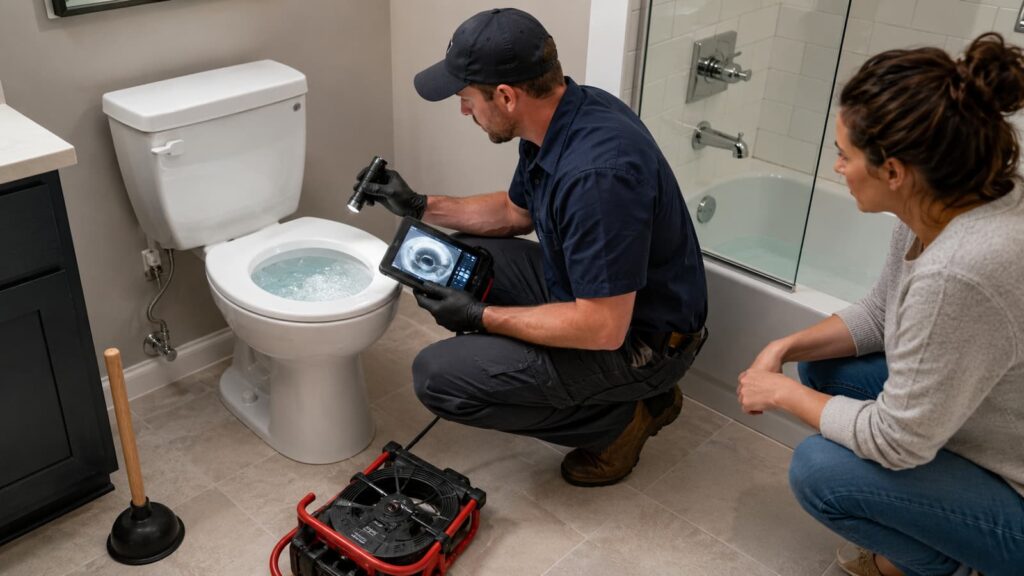
A toilet that gurgles when you shower, flush, drain the tub, or run another fixture is not just making a strange noise.
That bubbling, gulping, or “glug-glug” sound usually means the plumbing system is struggling to move air and water the way it should. In a healthy drain system, wastewater flows down the drain while air moves through the vent system to balance pressure. When that airflow is blocked, restricted, or disrupted by a partial clog, the system may start pulling or pushing air through the nearest available opening. Sometimes that opening is the toilet bowl.
This is why toilet gurgling often happens at odd moments. The toilet may bubble when the shower is running. It may gurgle when the bathtub drains. It may make noise after the washing machine discharges. It may burp after another toilet flushes. It may even bubble when no one is using the toilet at all, but another fixture nearby is moving a large volume of water. The toilet is not always the source of the problem. It may simply be the fixture where the plumbing system is showing symptoms.
Sometimes the cause is relatively local: a partial clog in a bathroom branch drain, a blocked toilet trapway, a slow shower drain affecting nearby piping, or a venting issue in one bathroom group. Other times, toilet gurgling can be an early warning sign of a deeper drain or sewer line problem. If several fixtures are affected, if lower drains are slow, if the toilet bubbles when the shower runs, or if sewage backs up into a tub or shower, the issue should be treated seriously.
This guide explains what toilet gurgling means, why it happens during showers or flushing, how to tell the difference between a local fixture issue and a main sewer concern, what homeowners can safely check, what not to do, and when it is time to call a plumber. If your toilet gurgling is connected to slow drains, recurring backups, or multiple affected fixtures, professional drain cleaning may be the right first step to restore proper flow and identify the cause.
What does toilet gurgling actually mean?
Toilet gurgling is usually the sound of air moving through water in a way it should not. The water sitting in the toilet bowl acts like a visible seal. Under normal conditions, that bowl water should stay calm unless the toilet is being flushed. If air bubbles up through it, or if the water level rises and falls when another fixture drains, the drain system is experiencing pressure changes.
Plumbing drains need air to work correctly. When water flows through a pipe, it pushes air ahead of it and can create negative pressure behind it. Plumbing vents allow air to enter and exit the system so wastewater can move smoothly. If air cannot move through the vent path, the system may try to equalize pressure through fixture traps. A toilet bowl is one of the most noticeable places this can happen because you can see and hear the water react.
Gurgling can happen when air is being pulled through the toilet trap because another fixture is draining and creating suction. It can also happen when air is being pushed back toward the toilet because a downstream drain is partially blocked and wastewater cannot move freely. In both cases, the toilet is showing that air and water are not moving through the plumbing system in the correct balance.
The exact meaning depends on the pattern. A toilet that gurgles only once after a rare heavy drain event may not be as concerning as a toilet that gurgles every time the shower runs. A toilet that gurgles along with slow drains is more concerning than a toilet that makes one brief noise with no other symptoms. A toilet that bubbles while sewage appears in the tub or shower is urgent.
The key is to treat gurgling as a symptom, not a diagnosis. The sound tells you the drain system is reacting abnormally. The next step is figuring out whether the cause is local, vent-related, or farther down the sewer line.
Why does the toilet gurgle when the shower is running?
A toilet gurgling when the shower runs is one of the clearest signs that two fixtures are interacting through the drain system. The shower sends water into the bathroom drain line. If that water cannot flow freely, or if the vent cannot balance the air pressure, the toilet may respond with bubbling or gurgling.
One common scenario is a partial clog in the bathroom branch drain. The shower and toilet may connect to the same drain branch before that branch joins a larger line. If the branch is restricted by hair, soap scum, sludge, mineral buildup, wipes, or other debris, shower water may create pressure changes as it tries to move past the restriction. Air may then bubble through the toilet because the system is searching for relief.
Another possibility is a venting problem. If the bathroom vent is blocked or not functioning properly, the shower drain may pull air through the toilet trap instead of through the vent. This can create a gurgling sound, a bubbling bowl, or a toilet water level that moves slightly while the shower drains.
A deeper sewer restriction can also create this symptom. If the main line is partially blocked, shower water may struggle to leave the home. Because showers release a steady amount of water, they can reveal a restriction that smaller fixtures do not. The toilet, sitting nearby and connected to the same drainage system, becomes the place where trapped air escapes.
The pattern matters. If only one bathroom toilet gurgles when only that shower runs, the issue may be local to that bathroom group. If toilets in multiple bathrooms gurgle when any shower runs, or if the lowest shower or tub drains slowly at the same time, the problem may be farther downstream.
A toilet that gurgles during shower use should be watched closely. If the shower also drains slowly, if the toilet water rises or bubbles heavily, or if water backs up into the tub or shower, stop using the affected fixtures and schedule service promptly.
Why does the toilet gurgle after flushing?
A toilet that gurgles after flushing may be dealing with a restriction in the toilet itself, the nearby drain line, the vent system, or the sewer line. Flushing sends a large volume of water through the trapway and into the drain quickly. If the system is restricted, the flush may create pressure changes that produce gurgling after the bowl clears.
If the toilet flushes weakly, rises too high, drains slowly, or needs multiple flushes, the problem may be in the toilet trapway or closet bend. A partial blockage inside the toilet can allow some water through while still disrupting airflow. Common causes include excessive toilet paper, non-flushable wipes, hygiene products, small objects, hard buildup, or a clog lodged in the trapway.
If the toilet flushes normally but gurgles afterward, the issue may be farther down the line. The flush may be moving water into a partially restricted branch drain or main line. As water pushes against the restriction, air may come back through the toilet or nearby drains.
If another toilet gurgles when you flush this one, that is more concerning. It suggests the fixtures are sharing a drainage path and pressure is transferring through the system. The same is true if a tub or shower drain bubbles when a toilet flushes. That kind of cross-fixture reaction often points beyond one toilet.
Gurgling after flushing can also be related to venting. A vent allows air to enter behind the rushing water so the trap does not siphon or pull air through other fixtures. If the vent is blocked, undersized, improperly connected, or restricted, the toilet may gurgle because air is being pulled from the wrong place.
One isolated gurgle after an unusual flush may not mean disaster. Repeated gurgling after normal flushing deserves attention, especially if the toilet is also slow, the bowl water level changes, or other fixtures respond.
Why does the toilet gurgle when the tub drains?
A bathtub releases a large amount of water compared with a bathroom sink. When a tub drains, it can expose drain problems more clearly than smaller fixtures. If the toilet gurgles while the tub drains, the plumbing system may be struggling to move that larger volume of wastewater.
The cause may be a partial clog in the bathroom drain branch. Hair, soap scum, conditioner residue, bath oils, dirt, and debris can build up in tub and shower drains. Over time, that buildup can narrow the branch line shared by the tub and toilet. When the tub drains, wastewater moves slowly, pressure changes develop, and the toilet bowl bubbles.
The cause may also be farther downstream. A tub draining can reveal a developing main line restriction because it sends enough water to stress the system. If the tub is on a lower level, or if it is one of the lowest drains in the home, it may be one of the first fixtures to show symptoms when the main sewer line is restricted.
Pay close attention if the tub drains slowly and the toilet gurgles at the same time. That combination suggests the water is not leaving the bathroom group freely. If the tub backs up with dirty water when another fixture runs, stop using the plumbing and call for service. Wastewater backup into a tub or shower is not a normal slow-drain issue.
Also note whether the gurgling happens only with one bathtub or with multiple fixtures throughout the home. One bathroom group points more toward a local branch issue. Multiple fixtures point more toward a shared line or main sewer problem.
The most common causes of toilet gurgling
Toilet gurgling can come from several different plumbing problems. The most common causes include partial drain clogs, blocked plumbing vents, main sewer line restrictions, toilet trapway blockages, and poor drain system airflow.
A partial drain clog is one of the most common causes. The pipe is not fully blocked, so water still drains, but it drains poorly enough to disturb air movement. This can create bubbling, slow drainage, odors, and recurring clogs.
A blocked vent can also cause gurgling. Plumbing vents usually extend through the roof and allow air into the drainage system. Leaves, nesting material, debris, improper installation, or damage can restrict venting. When the system cannot breathe through the vent, it may pull air through fixture traps.
A main sewer line restriction is more serious. Roots, grease, wipes, sludge, broken pipe sections, pipe bellies, offset joints, or collapsed piping can restrict flow. When several fixtures share the same restricted line, symptoms can appear throughout the home.
A toilet-specific blockage can cause gurgling after flushing. The toilet may flush partially, drain slowly, or make gulping sounds because the obstruction is affecting how water and air pass through the trapway.
Drain layout or installation issues can also contribute, especially after remodeling, fixture relocation, or DIY plumbing changes. Improper venting, poor slope, undersized drains, or incorrect connections can cause chronic gurgling even when there is no obvious clog.
The right fix depends on which of these causes is present. Pouring cleaner into the drain or plunging repeatedly may not help if the issue is venting or a sewer line restriction. That is why symptom patterns are so important.
Cause 1: a partial clog in the bathroom drain line
A partial clog in the bathroom drain line is a common reason a toilet gurgles when the shower or tub drains. The drain is not completely blocked, so water can still move, but the opening inside the pipe is restricted. That restriction changes how air and water move through the branch line.
Bathroom branch drains deal with a lot of clog-forming material. Hair, soap scum, toothpaste residue, conditioner, body oils, toilet paper, wipes, and mineral buildup can all contribute. Over time, the pipe may narrow enough that a shower or tub drain creates pressure changes. The toilet may then bubble because air is being pushed or pulled through the closest water seal.
This kind of clog often develops gradually. At first, the shower drains a little slower. Then the toilet gurgles occasionally. Then the tub takes longer to empty. Eventually, the toilet may bubble every time the shower runs, or water may rise in the shower drain when the toilet flushes.
A partial clog can be deceptive because the fixture may still work. The toilet still flushes. The shower still drains. The sink still empties. But the system is operating with reduced capacity. The gurgling is a warning that the drain is not moving water and air properly.
If the problem is truly local, professional drain cleaning can often clear the restriction. The exact method depends on the drain size, location, material, and type of buildup. Repeated gurgling after clearing may mean the clog was not fully removed or another issue is present farther down the line.
Cause 2: a blocked or restricted plumbing vent
Plumbing vents are essential because drains need air. A vent allows air to enter the drainage system so wastewater can flow without siphoning traps or creating pressure problems. If the vent is blocked, the system may pull air from the toilet, shower, sink, or tub trap instead.
Vent-related gurgling can be tricky because the drains may not be fully clogged. You may hear gurgling even when water still drains. The toilet bowl may bubble when the shower runs. A sink may gurgle after the toilet flushes. The water level in a toilet may move slightly when another fixture drains. These symptoms can happen because the drain is searching for air.
Vent restrictions can happen for several reasons. Roof vent openings may be blocked by leaves, debris, animal nesting material, or weather-related obstruction. In older homes, vents may be damaged, undersized, or improperly connected. After remodeling, venting mistakes can create chronic drainage issues. In some cases, an air admittance valve, if present, may fail or stick.
Homeowners should be careful with vent troubleshooting. Plumbing vents often terminate on the roof, and climbing onto the roof is risky. Also, not every gurgle is a vent problem. A partial clog can mimic vent symptoms because a restricted drain also disrupts air movement. The vent and drain system need to be evaluated together.
A useful clue is whether the drains are slow. If gurgling happens with slow drainage, a clog may be likely. If drainage speed seems normal but multiple traps gurgle when fixtures run, venting may be higher on the list. Still, a professional inspection is usually needed to confirm the difference.
Cause 3: a developing main sewer line clog
A main sewer line clog is one of the most important possibilities to consider when a toilet gurgles. The main sewer line carries wastewater from the home to the municipal sewer or septic system. If that line becomes restricted, multiple fixtures can begin reacting to one another.
Main line restrictions can be caused by tree roots, grease buildup, wipes, paper products, sludge, scale, broken pipe sections, offset joints, bellied pipe, collapsed pipe, or foreign objects. The line may not block all at once. Many sewer problems start as partial restrictions that allow some water through while creating pressure problems during heavier use.
Toilet gurgling can be an early warning sign because toilets connect directly to larger drain lines and hold visible water in the bowl. When the main line struggles, air can push back through the toilet. You may see bubbles, hear gurgling, or notice the bowl water level moving unexpectedly.
The main sewer line becomes more likely if several fixtures are affected. Warning signs include multiple slow drains, toilets gurgling in more than one bathroom, tubs or showers backing up when toilets flush, floor drains bubbling, sewage odor, recurring clogs, or wastewater appearing in the lowest drain in the home.
If you suspect a main sewer issue, avoid using large amounts of water. Running showers, laundry, dishwashers, or multiple toilets can make a backup worse if the line is restricted. This is the point where professional diagnosis matters. A plumber may recommend cleaning the line, locating the blockage, or performing a camera inspection if the problem is recurring.
When gurgling is connected to repeated backups or multiple affected fixtures, a sewer camera inspection in Vista, CA can help identify whether the problem is roots, grease, damaged pipe, a belly, or another physical condition inside the line.
Cause 4: a toilet trapway obstruction
Sometimes the toilet itself is the problem. The toilet trapway is the curved internal passage that holds water in the bowl and allows waste to leave during a flush. If something is lodged in that passage, the toilet may flush poorly, gurgle, drain slowly, or require multiple flushes.
Common toilet trapway obstructions include too much toilet paper, wipes, cotton products, hygiene products, dental floss, small toys, plastic caps, cleaning tools, and other non-flushable items. The object may not fully block the toilet. It may sit in the trapway and catch paper, creating intermittent symptoms.
A toilet-specific obstruction is more likely if only one toilet has symptoms and nearby fixtures are otherwise normal. If the toilet bowl rises high during flushing, drains slowly, or leaves waste behind, the trapway or closet bend may be restricted. If the toilet gurgles only after it is flushed and not when the shower or tub runs, the problem may be closer to the toilet.
A plunger may help with a simple toilet blockage. A toilet auger may be needed for obstructions lodged in the trapway. However, repeated plunging can be a sign that the real problem is not fully resolved. If the same toilet keeps gurgling or clogging, something may still be stuck, the toilet may have poor flushing design, or there may be a drain issue beyond the toilet.
Be careful with chemical drain cleaners in toilets. They are often ineffective for solid obstructions and can create safety risks, damage parts, or splash during plunging. Mechanical clearing and diagnosis are usually better choices.
Cause 5: a septic system issue
Homes connected to septic systems can also experience toilet gurgling when wastewater is not moving away from the home properly. The cause may be a clogged building drain, full septic tank, blocked outlet filter, saturated drain field, or another septic-related issue. While many urban and suburban homes are connected to municipal sewer, septic systems require their own troubleshooting approach.
Septic-related gurgling is more likely if multiple fixtures drain slowly, the lowest drains back up, there are sewage odors indoors or outdoors, the yard near the drain field is wet or unusually green, or the septic tank has not been pumped or maintained on schedule.
If a septic issue is suspected, avoid excessive water use and contact the appropriate septic professional. Drain cleaning may help if the blockage is in the home’s building drain, but it will not solve a full tank or drain field problem. The location of the restriction matters.
For homeowners, the key is recognizing that toilet gurgling is still a pressure and drainage symptom. Whether the home drains to sewer or septic, wastewater must be able to leave the building freely. If it cannot, air and water will find other ways to move, often through toilets, tubs, and showers.
How serious is a gurgling toilet?
A gurgling toilet can be minor, but it can also be an early warning before a messy backup. The seriousness depends on the pattern, frequency, and related symptoms.
A single brief gurgle after one unusual flush may not be urgent if every fixture drains normally afterward. A toilet that gurgles every time the shower runs is more concerning. A toilet that gurgles while the shower drains slowly is more concerning still. A toilet that gurgles while wastewater backs up into a tub, shower, or floor drain should be treated as urgent.
Think about the plumbing system as a connected network. If one fixture makes noise but everything else works normally, the issue may be local. If several fixtures respond to each other, the problem is likely in a shared drain or main line. The more fixtures involved, the farther downstream the issue may be.
Frequency also matters. A symptom that repeats is more meaningful than a one-time event. If the toilet gurgled once after a large amount of water drained, monitor it. If it keeps happening, the system is giving you a pattern. Patterns are what plumbers use to find the cause.
The safest approach is to take gurgling seriously before it becomes a backup. Drain and sewer problems are usually easier to handle at the warning-sign stage than after wastewater appears where it should not.
Warning signs that the problem may be in the main sewer line
Toilet gurgling becomes more concerning when it appears with other whole-house drainage symptoms. These signs suggest that the issue may be in a shared line or main sewer lateral rather than one fixture.
- more than one toilet gurgles or bubbles,
- the toilet gurgles when the shower, tub, washer, or dishwasher drains,
- several drains are slow at the same time,
- water backs up into a tub or shower when the toilet flushes,
- the lowest drain in the home backs up first,
- there is sewage odor near drains,
- clogs keep coming back after temporary clearing,
- the toilet bowl water rises or moves when other fixtures run,
- floor drains bubble or overflow,
- or previous drain service did not solve the problem for long.
If several of these signs are present, do not keep testing the plumbing by running more water. Additional water can worsen a backup if the main line is restricted. Stop using affected fixtures and schedule a professional inspection.
Recurring main line symptoms often require more than a quick plunger or basic clearing. The line may need proper cleaning, and if the problem returns, a camera inspection may be needed to see what is happening inside the pipe. If the inspection finds damaged pipe, roots, severe offsets, or a collapsed section, targeted sewer line repair may be necessary to stop the pattern.
What homeowners can safely check first
Before calling a plumber, you can gather useful information without taking apart the plumbing system. These checks help determine whether the problem is isolated or part of a larger pattern.
- Test nearby fixtures one at a time. Run the bathroom sink, shower, and tub separately. Watch whether the toilet gurgles during one fixture or all of them.
- Flush the toilet once and observe. Does the bowl rise high, drain slowly, or gurgle afterward?
- Check whether other toilets react. If one toilet flush causes another toilet to bubble, the issue may be in shared drainage.
- Look for slow drains. A gurgling toilet plus slow shower or tub drain usually points toward a restriction.
- Listen for sink or tub gurgling. Multiple gurgling fixtures suggest air pressure problems beyond one toilet.
- Check the lowest drains. Lower-level tubs, showers, and floor drains often show main line problems first.
- Look for sewage odor. Odor can indicate trap siphoning, venting problems, or backup risk.
- Think about recent changes. New toilet installation, bathroom remodel, roof work, landscaping, heavy rain, or recent drain clearing can all provide clues.
- Note whether the issue is getting worse. A growing pattern is more concerning than an isolated sound.
These checks are not meant to fix the problem. They are meant to help you describe it clearly. “The toilet gurgles when the upstairs shower runs” is useful. “Both downstairs toilets bubble when the washing machine drains” is even more useful. The more specific the symptom pattern, the faster the cause can usually be narrowed down.
What not to do when your toilet gurgles
When a toilet starts gurgling, some common reactions can make the situation worse or delay the right repair.
Do not keep flushing repeatedly to “test” the toilet if other fixtures are slow or backing up. If the line is restricted, adding more water can push wastewater into tubs, showers, or floor drains.
Do not pour chemical drain cleaner into the toilet or shower and hope it solves the issue. Chemical products often do little for sewer line restrictions, roots, wipes, or vent problems. They can also create hazards if a plumber later needs to use equipment in the line.
Do not assume the toilet is the only problem just because the sound comes from the toilet. The toilet may be the symptom point, while the restriction may be in a shared drain or main line.
Do not climb onto the roof to clear vents unless you have the right equipment and experience. Roof work is dangerous, and vent blockages can be misdiagnosed. A drain restriction can mimic vent symptoms, so clearing a vent may not address the real cause.
Do not ignore recurring gurgling after a drain was recently cleared. If symptoms return quickly, the line may not have been fully cleaned, or there may be a physical pipe problem such as roots, a belly, or damage.
Finally, do not wait until wastewater backs up. Gurgling is often an early warning. Acting at this stage is usually easier, cleaner, and less expensive than waiting for a full blockage.
Can plunging fix a gurgling toilet?
Plunging may help if the problem is a simple toilet obstruction. If the toilet bowl rises during flushing, drains slowly, or seems partially clogged, a proper toilet plunger may clear the trapway or nearby blockage.
However, plunging is less likely to help if the gurgling happens mainly when the shower, tub, washing machine, or another toilet drains. In that case, the toilet may not be clogged at all. The issue may be in the shared drain, vent, or main sewer line.
Plunging can also give a false sense of success. It may temporarily move a partial blockage enough for water to pass, but if buildup remains on pipe walls or if roots and debris are still present, symptoms may return. This is common with recurring drain problems.
If you plunge once and the toilet returns to normal with no other symptoms, monitor it. If gurgling continues, if other fixtures are affected, or if backups recur, plunging is no longer a real solution. The line needs proper diagnosis.
Use the right type of plunger if you try it. A flange-style toilet plunger seals better in the bowl than a flat sink plunger. Avoid harsh chemicals before or after plunging, because splashing chemical water can create safety risks.
Can a slow shower drain cause the toilet to gurgle?
Yes. A slow shower drain and gurgling toilet often go together because the shower and toilet may share part of the bathroom drainage system. If the shower drain is partially clogged, wastewater may move through the branch line slowly and disturb air pressure. The toilet then bubbles or gurgles as air seeks another path.
Hair and soap scum are common shower drain problems, but the issue may not be limited to the visible drain opening. Buildup can extend farther into the line. If the drain cover is cleaned but the shower remains slow and the toilet still gurgles, the restriction may be deeper than the trap area.
The combination of slow shower drain plus toilet gurgling should be taken more seriously than either symptom alone. It tells you the fixtures are interacting, and that usually means the shared piping is involved. If the shower drain is the lowest fixture in the bathroom, it may also become the place where water backs up if the restriction worsens.
If the shower drain is slow and the toilet gurgles only in that bathroom, a local bathroom branch clog may be likely. If other bathrooms or lower-level fixtures are also affected, the main line becomes more likely.
Can a washing machine make a toilet gurgle?
Yes. A washing machine can make a toilet gurgle because it discharges a large amount of water quickly. That sudden discharge can stress a partially restricted drain system. If the line cannot handle the flow, air may bubble through a toilet or nearby drain.
This symptom can be especially important because washing machines often connect to larger drain branches. If a toilet gurgles when the washer drains, or if a nearby tub, shower, or floor drain bubbles during laundry, the issue may involve a shared branch or main line restriction.
A laundry-related gurgle may also point to venting problems if the washer drain pulls air from nearby traps. However, slow drains, bubbling toilets, or backups during washer discharge often suggest a flow restriction that should be addressed before it becomes a bigger backup.
If you see water backing up into a laundry sink, shower, tub, or floor drain when the washing machine drains, stop using the washer until the drain system is checked. Laundry discharge can quickly turn a partial clog into an overflow situation.
How plumbers diagnose toilet gurgling
A plumber diagnoses toilet gurgling by looking at the pattern, not just the toilet. The first question is usually which fixtures are affected and when the sound happens. Does it happen during showers? During toilet flushing? During laundry? In one bathroom or the whole house? Are any drains slow? Has there been a backup?
The plumber may test fixtures in sequence to reproduce the symptom. Running a shower while watching the toilet, flushing nearby toilets, checking tub drainage, and observing lower-level drains can reveal whether the problem is local or shared.
If a toilet-specific obstruction is suspected, a toilet auger may be used. If a branch drain clog is suspected, the plumber may clear the line through an appropriate cleanout, fixture drain, or access point. If the main sewer line is suspected, the plumber may use larger drain equipment or recommend a camera inspection after restoring flow.
Camera inspection is especially useful for recurring problems. It can show roots, cracks, offsets, bellies, heavy buildup, grease, wipes, or collapsed sections. A camera is not always the first step for a simple local clog, but it becomes valuable when symptoms return or when the pattern suggests a sewer condition rather than a one-time blockage.
Vent inspection may also be part of the process if the symptom pattern points toward airflow. Depending on the home, that may involve checking accessible vent piping, roof terminations, air admittance valves, or signs of improper plumbing layout.
The best diagnosis identifies both the immediate blockage and the reason it happened. Opening the line is important, but understanding why the line gurgled helps prevent the problem from returning.
When drain cleaning is enough
Drain cleaning may be enough when the gurgling comes from a local or branch drain restriction and there is no evidence of pipe damage, major root intrusion, or recurring main line trouble. For example, if one bathroom group has slow drainage because of hair, soap scum, and buildup, clearing that branch line may restore normal airflow and drainage.
Drain cleaning is also a logical first step when the toilet gurgles with a nearby slow shower or tub and the symptoms are limited to one area. Once the restriction is removed, the toilet should stop reacting because water and air can move normally again.
The cleaning method depends on the situation. A simple toilet auger may handle a toilet trapway obstruction. A drain snake may clear a branch clog. More thorough cleaning may be needed for heavy buildup. If symptoms return quickly after cleaning, that suggests either the line was not fully cleared or the pipe has an underlying condition that catches debris.
Drain cleaning solves flow restrictions, but it does not repair broken pipe, correct poor slope, remove a pipe belly, or fix vent installation mistakes. That is why recurring gurgling after repeated clearing should not be treated as “just another clog.” It deserves a closer look.
When a sewer camera inspection makes sense
A sewer camera inspection makes sense when toilet gurgling is recurring, when multiple fixtures are affected, when the main line has backed up before, when drain cleaning does not last, or when symptoms suggest roots, pipe damage, or a deeper sewer issue.
The camera allows the plumber to see inside the pipe. This matters because different sewer problems can produce similar symptoms. Roots, grease, wipes, a sagging pipe, a broken section, and a heavy sludge restriction can all cause slow drainage and gurgling. The repair approach changes depending on what is actually inside the line.
A camera inspection can identify whether the line is open after cleaning, whether debris remains, whether roots are entering through joints, whether the pipe has a belly holding water, whether the pipe is cracked or offset, and whether the issue is located near the home or farther out in the yard.
It is important to understand that a camera inspection is most useful when the line has enough opening for the camera to pass. If the line is fully blocked, the plumber may need to restore flow first. After that, the camera can help explain why the blockage happened.
For homeowners, the value of a camera inspection is clarity. Instead of guessing why the toilet keeps gurgling or why clogs keep returning, you can make decisions based on the condition of the pipe.
When sewer line repair may be needed
Sewer line repair may be needed when gurgling and backups are caused by a physical pipe problem rather than a simple removable clog. Cleaning can remove debris, but it cannot fix a collapsed section, severe offset, broken pipe, or sagging line that keeps holding waste and water.
Tree roots are a common reason sewer symptoms return. Cleaning may cut roots back temporarily, but if roots are entering through cracks or joints, they may regrow. A camera inspection can show where roots are entering and whether repair is needed.
A bellied sewer line can also cause repeated gurgling and backups. A belly is a sag in the pipe where water and solids collect instead of flowing away. Cleaning may clear the immediate debris, but the low spot remains. Over time, material builds up again.
Pipe offsets and cracks can catch paper, wipes, sludge, and roots. Collapsed pipe can restrict flow severely. In these cases, repeated drain cleaning becomes a temporary workaround rather than a permanent solution.
Sewer repair is not the first assumption for every gurgling toilet. Many cases are simpler. But if the problem keeps returning, if the camera shows physical damage, or if backups are becoming more frequent, repair may be the only way to stop the pattern.
A quick symptom guide for toilet gurgling
If you are trying to understand what your symptoms may mean, this quick guide can help:
- Toilet gurgles only after flushing: possible toilet trapway obstruction, nearby branch restriction, or vent issue.
- Toilet gurgles when the shower runs: possible shared bathroom drain restriction, blocked vent, or main line issue.
- Toilet gurgles when the tub drains: possible branch drain clog or downstream sewer restriction.
- Toilet gurgles when the washing machine drains: possible shared drain or main line restriction due to high-volume discharge.
- Several fixtures gurgle: more likely a venting problem or shared drain/main line problem.
- Several fixtures are slow: more likely a significant restriction in shared piping.
- Water backs up into a tub or shower: urgent sign of a drain or sewer blockage.
- Gurgling returns after drain cleaning: possible roots, pipe damage, belly, heavy buildup, or incomplete cleaning.
- Gurgling with sewage odor: possible trap siphoning, venting issue, or sewer backup risk.
- One toilet gurgles and flushes weakly: possible local toilet obstruction or fixture-specific issue.
This guide does not replace professional diagnosis, but it helps you understand why the symptom matters. The more fixtures involved, the more likely the issue is beyond one toilet.
Frequently Asked Questions
A toilet usually gurgles when you shower because the shower drain and toilet are interacting through the same drain system. The cause may be a partial bathroom drain clog, blocked plumbing vent, or a restriction farther down the sewer line that is changing air pressure in the pipes.
Gurgling after flushing can be caused by a partial toilet clog, a restriction in the nearby drain line, a blocked vent, or pressure changes from a downstream sewer restriction. If the toilet also drains slowly or other fixtures react, the problem should be checked.
A gurgling toilet is not always an emergency, but it can become urgent if multiple drains are slow, water backs up into a tub or shower, sewage odor is present, or the toilet bubbles heavily when other fixtures run. Those signs may indicate a developing sewer blockage.
Yes. If the plumbing vent is blocked or restricted, the drain system may pull air through the toilet or another fixture trap instead of through the vent. This can create gurgling, bubbling, or water level movement in the toilet bowl.
Yes. A partial main sewer line clog can push or pull air through toilets and other fixtures. Main line issues are more likely when several drains are slow, multiple toilets gurgle, or water backs up into lower fixtures such as tubs, showers, or floor drains.
Plunging may help if the toilet itself has a simple partial clog. It usually will not fix a blocked vent, shared branch drain restriction, or main sewer line problem. If gurgling happens when other fixtures run, the issue is likely beyond the toilet bowl.
If the toilet gurgles lightly but all drains work normally, monitor it and avoid heavy use until you understand the pattern. If drains are slow, water backs up, or multiple fixtures are affected, stop running large amounts of water and call a plumber.
Call a plumber if toilet gurgling happens repeatedly, occurs when showers or tubs drain, affects multiple fixtures, comes with slow drains or sewage odor, returns after drain cleaning, or is followed by water backing up into a tub, shower, or floor drain.
Final thoughts
A toilet that gurgles when you shower, flush, drain the tub, or run the washing machine is usually reacting to air pressure changes in the plumbing system. Sometimes the cause is a simple toilet obstruction or local bathroom drain clog. Other times, it is a sign of a blocked vent, shared drain restriction, or developing main sewer line problem.
The most important thing is to look at the pattern. One toilet with one occasional sound is different from multiple fixtures gurgling, slow drains throughout the home, or water backing up into a tub or shower. The more fixtures involved, the more likely the issue is in shared piping or the main sewer line.
Do not ignore repeated gurgling, and do not keep running water if backups begin. A gurgling toilet is often an early warning. Handled early, the problem may be a manageable drain cleaning or vent correction. Ignored too long, it can become a messy sewer backup or a recurring plumbing issue that requires deeper inspection and repair.