
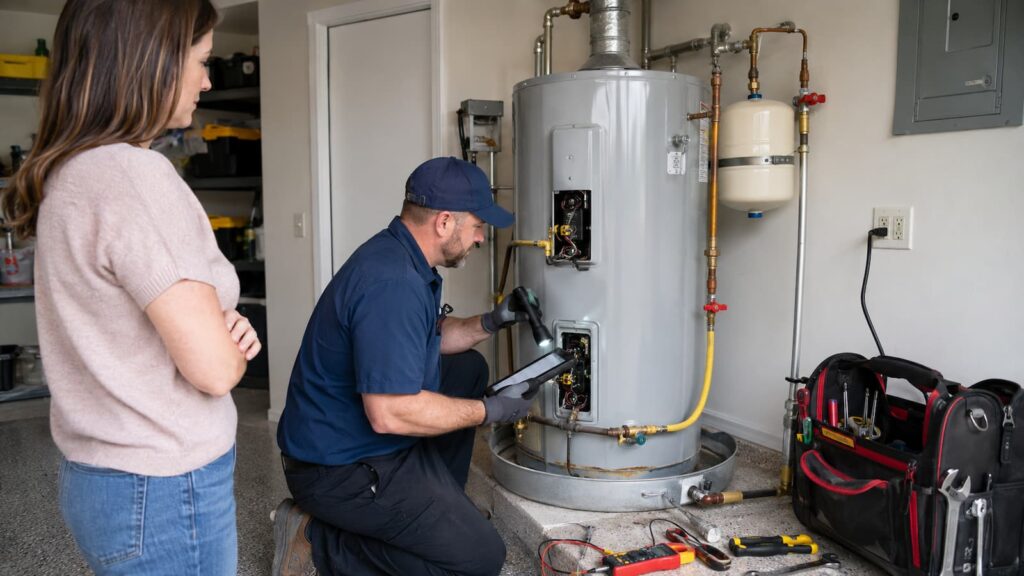
No hot water in the house is one of those plumbing problems that immediately disrupts the day.
A cold shower is usually the first clue. Then the kitchen sink never warms up. The dishwasher does not seem to clean as well. Laundry plans change. Someone checks the water heater, but everything looks normal from the outside. There may be no leak, no loud noise, and no obvious sign that anything has failed. The only clear symptom is that the house simply does not have hot water when it should.
The frustrating part is that “no hot water” can mean many different things. A gas water heater may have a pilot light, ignition, gas supply, thermocouple, gas control valve, venting, or burner issue. An electric water heater may have a tripped breaker, failed heating element, bad thermostat, wiring problem, or high-limit switch trip. A tankless water heater may have a flow sensor issue, error code, clogged filter, scale buildup, ignition failure, or demand problem. In some homes, the water heater is working, but a mixing valve, crossover, plumbing restriction, or fixture problem is making it seem like the whole house has no hot water.
That is why the first step is not guessing. The first step is narrowing down the pattern. Is there no hot water anywhere, or only at one fixture? Is the water completely cold, or just lukewarm? Did the problem happen suddenly, or has the water been getting colder over time? Is the water heater gas, electric, tankless, or traditional tank-style? Is there an error code? Is there water around the unit? Did the breaker trip? Did the gas supply get interrupted?
This guide walks through the most common causes of no hot water in the house, what homeowners can safely check before calling a plumber, what should not be handled as a DIY repair, and when professional service is the smarter and safer next step. If the basic checks do not restore hot water, Smart Plumbing USA provides professional water heater repair for gas, electric, tank-style, and tankless water heater problems.
First, define the problem: no hot water, not enough hot water, or lukewarm water?
Before looking at the water heater, it helps to describe the symptom accurately. Many homeowners say they have “no hot water,” but the actual problem may be more specific. Those details matter because different symptoms point to different causes.
No hot water at all usually means water comes out cold from every hot water fixture in the home. This often points to a water heater that is not heating, has lost power or fuel, has a failed ignition system, has tripped a safety device, or is locked out by a tankless error code.
Not enough hot water means the water gets hot at first but runs out too quickly. This is common with undersized tank water heaters, sediment buildup, a broken dip tube, a failed lower heating element in an electric water heater, heavy simultaneous usage, or an aging unit that no longer recovers properly.
Lukewarm water means the water is warm but never reaches the expected temperature. This can happen when one element fails in an electric tank, the thermostat is set too low, sediment is interfering with heating, the burner is not operating correctly, a mixing valve is malfunctioning, or cold water is crossing into the hot side through a bad fixture cartridge.
Hot water at some fixtures but not others often suggests a fixture-specific problem rather than a complete water heater failure. A shower valve, faucet cartridge, clogged aerator, anti-scald setting, or local plumbing restriction may be involved. If the kitchen sink has hot water but one shower does not, the water heater is probably producing hot water, and the issue may be at that shower.
Taking a few minutes to identify the exact pattern can prevent unnecessary repairs. It also gives a plumber better information if professional diagnosis is needed.
Quick safety checks before troubleshooting
Water heaters involve hot water, electricity, gas, combustion, pressure, and sometimes exhaust venting. Some checks are safe for homeowners. Others should be left alone. Before doing anything, look for obvious safety concerns.
If there is water around the water heater, do not ignore it. A leaking tank or valve can damage the home and may create electrical hazards. For an electric water heater, water near electrical access panels is especially concerning. Shut off the breaker if there is active leaking or wet electrical area, and call for service.
If you smell gas near a gas water heater, do not attempt to relight the pilot, operate switches, or troubleshoot the appliance. Leave the area and contact the gas utility or emergency services according to local safety guidance. Gas odor is not a normal no-hot-water symptom to experiment with.
If the temperature and pressure relief valve is discharging water, do not cap or plug the discharge pipe. That valve is a safety device. Water coming from it may indicate high pressure, overheating, a failed expansion tank, or a faulty valve. Blocking it can create a dangerous condition.
If the water heater is making loud popping, rumbling, banging, or whistling noises, especially with poor hot water performance, it may be dealing with sediment, pressure, overheating, or another internal problem. Do not keep forcing the system to operate if symptoms seem unsafe.
Safe basic checks include looking at the breaker, checking whether the gas control is on, confirming the water supply is open, reading a tankless error code, checking whether the thermostat setting was changed, and testing multiple fixtures. Opening gas components, bypassing safety devices, removing electrical parts, or modifying venting should be handled by a professional.
Cause 1: the water heater has lost power
Power issues are one of the simplest causes of no hot water, and they are easy to overlook. Electric water heaters need electricity to heat the water. Gas tankless water heaters also need electricity for controls, ignition, fans, sensors, and the display. Some gas tank-style water heaters use electronic ignition and controls as well. If the unit loses power, it may not operate even if everything else is fine.
For an electric tank water heater, check the electrical panel for a tripped breaker. A tripped breaker may appear halfway between on and off. If you reset it once and the water heater begins working again, monitor the system. However, if the breaker trips again, do not keep resetting it. Repeated trips may indicate a failed heating element, wiring issue, short, thermostat problem, or another electrical fault.
For a tankless unit, check whether the display is on. If the display is blank, the unit may have no power. Look for a nearby outlet, service switch, GFCI reset, or breaker depending on the installation. Some tankless systems plug into an outlet near the unit. Others are hardwired. If a GFCI outlet has tripped, the display may go dark and the unit will not fire.
Power outages can also create confusion. After power returns, some units may need time to restart. Tankless heaters may display an error code after an interruption. If the problem began right after a power outage, note that detail.
If restoring power does not bring back hot water, or if power repeatedly trips, the problem needs diagnosis. Water heaters draw significant electrical load, and electrical faults should not be treated casually.
Cause 2: the pilot light or ignition system failed
Gas water heaters need a way to ignite the burner. Older tank-style units may have a standing pilot light. Newer units may use electronic ignition, spark ignition, hot surface ignition, or other controlled ignition systems. If ignition fails, the burner will not heat the water.
If your water heater has a standing pilot and the pilot is out, the water in the tank will eventually become cold. Many units have relighting instructions printed on the heater. If you choose to relight it, follow the manufacturer instructions exactly. Do not improvise. If the pilot will not stay lit, goes out repeatedly, or you smell gas, stop and call a professional.
A pilot that will not stay lit may point to a dirty pilot assembly, faulty thermocouple, thermopile problem, gas control valve issue, draft problem, or combustion air problem. On newer gas water heaters, the issue may involve a flame sensor, igniter, control board, pressure switch, or safety lockout.
Tankless gas water heaters often display an error code when ignition fails. The code may indicate failed ignition, flame loss, or combustion interruption. The cause may be gas supply, venting, air intake, burner condition, flame sensing, or internal controls. A code is useful, but it is not always the full diagnosis.
Ignition problems should be taken seriously. Repeatedly resetting a gas appliance without finding the cause can be unsafe. If the unit fails to ignite more than once, or if hot water returns briefly and then fails again, professional diagnosis is the right move.
Cause 3: the gas supply is interrupted or inadequate
A gas water heater cannot operate without proper gas supply. Sometimes the problem is simple: the gas valve near the heater has been turned off. This can happen during maintenance, construction, appliance work, or accidentally if the valve is near storage or traffic in a garage or utility area.
If the gas valve handle is perpendicular to the gas pipe, it is usually off. If it is parallel to the pipe, it is usually on. Do not force a valve that is stuck or corroded. Do not disconnect gas lines or open gas components.
In some cases, gas supply is available but inadequate. This is especially important for tankless water heaters because gas tankless units can require high fuel input when hot water demand is high. If the gas line is undersized, the unit may ignite poorly, lose flame, show error codes, or fail under heavy demand. A traditional gas tank may have worked for years on the same gas line, but a tankless upgrade can have different requirements.
Other gas appliances can provide clues. If the stove, furnace, dryer, or other gas appliances are also not working, the issue may be broader than the water heater. If only the water heater is affected, the problem may be local to the appliance or its gas supply.
Gas pressure and gas line sizing require professional tools and training. If a gas supply issue is suspected, this is not a DIY adjustment. A plumber or qualified technician should evaluate the appliance and fuel supply safely.
Cause 4: a heating element failed in an electric water heater
Electric tank water heaters usually have one or two heating elements. Most common residential models have an upper and lower element controlled by thermostats. When one element fails, the symptoms can vary depending on which one is affected.
If the upper element fails, the water heater may produce little or no hot water because the upper portion of the tank does not heat properly. If the lower element fails, the heater may produce some hot water, but the supply may run out quickly because only the upper portion of the tank is being heated effectively.
A failed element can also trip a breaker if it shorts. Mineral buildup can shorten element life by causing the element to overheat or work harder. In hard-water homes, sediment and scale can contribute to recurring element problems.
Testing or replacing heating elements involves electricity and should be done carefully. The power must be off, the element must be tested properly, and the tank may need to be drained for replacement. If the breaker keeps tripping or if you are not comfortable working around electrical equipment and water, call a professional.
A failed heating element is often repairable, especially if the tank itself is in good condition. However, if the water heater is old, leaking, full of sediment, or already near the end of its service life, replacement may be more practical than repairing one component.
Cause 5: the thermostat or temperature setting is wrong
Sometimes the water heater is working, but the temperature setting is too low or the thermostat is not controlling the unit correctly. This can create lukewarm water, inconsistent hot water, or the feeling that the heater is not keeping up.
On a tank-style gas water heater, the temperature dial is often on the gas control valve. On an electric water heater, thermostats are usually behind access panels. On a tankless water heater, the temperature is commonly set through a digital controller or buttons on the unit. Someone may have lowered the setting during service, after a child-safety concern, during troubleshooting, or by accident.
Be careful with temperature adjustments. Setting water too high can create scalding risk, especially for children, older adults, or anyone with reduced sensitivity. Setting it too low can create comfort problems and may not be appropriate for all household needs. Many homes use settings around 120°F as a practical balance, though conditions and equipment vary.
If the setting is normal but the water is still lukewarm, the thermostat may be faulty or the heater may not be able to reach the set temperature because of another issue. In an electric unit, one thermostat or element may fail. In a gas unit, the burner may not be operating correctly. In a tankless unit, the system may be restricted, undersized, scaled, or limited by flow or fuel supply.
Temperature settings are worth checking, but they should not be used to hide another problem. If the only way to get comfortable water is to keep raising the heater temperature, the system may need diagnosis.
Cause 6: the high-limit switch tripped
Electric water heaters usually have a high-limit safety switch, often called the ECO or reset button. It is designed to shut the unit down if water temperature gets too high or if the control system detects unsafe conditions. When it trips, the water heater may stop heating.
Some homeowners discover this button behind the upper access panel and simply reset it. That may restore hot water temporarily, but the real question is why it tripped. A high-limit switch may trip because of a faulty thermostat, stuck relay, wiring problem, failed element, overheating, or other electrical issue.
If the reset button trips once after an unusual event, it may not indicate a major problem. If it trips repeatedly, do not keep resetting it. The switch is a safety device, not a normal operating control. Repeated trips mean the heater needs service.
Accessing the reset button requires removing a cover panel and insulation on many electric water heaters. Power should be shut off before opening panels. If you are not comfortable doing that safely, call a professional instead.
A tripped high-limit switch can be a repairable problem, but only if the cause is found. Resetting without diagnosis may allow the same unsafe condition to return.
Cause 7: sediment buildup is reducing performance
Sediment buildup is one of the most common long-term causes of poor hot water performance in traditional tank water heaters. Minerals and debris settle at the bottom of the tank over time. In hard-water areas, sediment can accumulate more quickly.
Sediment can create several symptoms. The heater may make popping, rumbling, or crackling noises during operation. Hot water may run out faster. Recovery may become slower. The tank may use more energy to heat the same amount of water. In severe cases, sediment can contribute to overheating at the bottom of the tank and shorten the life of the heater.
Sediment does not usually cause a sudden complete loss of hot water by itself unless it has contributed to another failure. More often, it creates gradual decline. The water heater used to keep up, then slowly became weaker. Showers became shorter. The tank took longer to recover. The water never felt quite as hot. Eventually, a heating element, burner performance issue, or tank problem may appear.
Flushing a tank can help remove some sediment, especially if done regularly. However, if a heater has not been flushed for many years, sediment may harden or become difficult to remove. In older units, opening the drain valve can also create problems if the valve is clogged or fragile.
If the water heater is old and showing sediment symptoms along with poor hot water, replacement may be more practical than trying to restore a heavily neglected tank. If the unit is newer, maintenance and repair may make sense.
Cause 8: the dip tube is broken or damaged
A dip tube is a simple but important part inside many traditional tank water heaters. It directs incoming cold water toward the bottom of the tank so it can be heated. Hot water is then drawn from the top of the tank. If the dip tube breaks, cracks, or falls apart, cold water may mix near the top and leave through the hot outlet before it has been heated properly.
The classic symptom of a dip tube problem is hot water that starts warm but runs out very quickly. The water heater may be full, the burner or elements may work, and the tank may appear normal, but the usable hot water supply is much shorter than expected.
Another possible clue is small plastic particles appearing in faucet aerators, showerheads, or hot water lines if the dip tube material has deteriorated. This is not always present, but it can happen.
A dip tube may be replaceable, depending on the age and condition of the heater. However, as with many water heater repairs, the age of the tank matters. Replacing a dip tube on a newer unit may make sense. On an older tank that already has sediment, corrosion, or other issues, replacement may be more reasonable.
Dip tube problems are easy to confuse with thermostat, element, or sizing problems, so proper diagnosis is important before replacing parts.
Cause 9: the tank is leaking or failing
If the water heater is leaking, no-hot-water symptoms may be part of a larger failure. A leaking tank can lose water, damage components, create unsafe conditions, and signal that the appliance has reached the end of its practical life.
Look around the base of the heater, the drain pan, the drain valve, the temperature and pressure relief valve discharge pipe, and all visible connections. Water at the bottom does not always mean the tank itself is leaking, but it does mean the source should be identified quickly.
If the internal tank is leaking, repair is usually not practical. A tank leak usually means corrosion or structural failure. Unlike a valve or connector, the tank body is not a replaceable service part in normal residential repair. Replacement is usually the right choice.
A leaking water heater may still produce hot water for a while, but that does not mean it is safe to keep using. A small leak can become a larger leak, and water damage can spread into flooring, drywall, storage, and nearby rooms. If the unit is leaking and not heating properly, turn off the water supply and energy source safely and call for service.
If replacement is needed, it may be a good time to evaluate the correct size and type of new system rather than simply matching the old unit. Smart Plumbing USA provides water heater installation and replacement for homeowners dealing with failed, leaking, undersized, or aging systems.
Cause 10: the water heater is undersized for the household
Sometimes the water heater is not broken. It is simply being asked to do more than it was designed to handle. This is especially common when household habits change. More people move in. Guests stay longer. A bathroom is added. A large tub is installed. Laundry and showers overlap. The old water heater may have been adequate years ago but no longer matches the home’s demand.
With a traditional tank, undersizing usually shows up as hot water that runs out quickly. The first shower may be fine, the second may be warm, and the third may be cold. The tank then needs time to recover. If morning routines consistently overwhelm the unit, the issue may be capacity rather than a repair problem.
With a tankless system, undersizing shows up differently. The water may stay hot when one fixture is running but become lukewarm when multiple fixtures run at the same time. Tankless capacity depends on flow rate and temperature rise. If the household demands more hot water than the unit can heat at once, performance drops.
Undersizing can be confused with equipment failure. The difference is often pattern. If the heater works well under light use but struggles only during high-demand periods, sizing or capacity should be considered. If the heater suddenly stops producing hot water under all conditions, a fault is more likely.
A plumber can evaluate fixture demand, household usage, water heater capacity, recovery rate, tankless flow rating, and installation conditions. If the unit is truly undersized, repair will not solve the comfort issue. Replacement or system redesign may be needed.
Cause 11: a tankless water heater has an error code or flow problem
Tankless water heaters can stop producing hot water for reasons that are different from traditional tank heaters. Since tankless units heat water on demand, they need proper flow, power, fuel or electrical capacity, clean internal passages, working sensors, and safe venting. If one of those conditions is wrong, the system may not fire or may shut down.
If your tankless water heater has no hot water, first check the display. Is there an error code? Take a photo of it before resetting the unit. Error codes vary by manufacturer, so the model-specific manual matters. Codes may relate to ignition failure, flame loss, overheating, scale buildup, venting issues, fan problems, temperature sensors, flow sensors, or communication faults.
A tankless heater may also fail to activate if the flow rate is too low. This can happen with clogged aerators, restricted showerheads, partially closed valves, a dirty inlet filter, or mineral scale inside the heat exchanger. The unit may work at one fixture but not another because the flow pattern is different.
Scale buildup is another common tankless issue. Hard water minerals can collect inside the heat exchanger, reducing flow and heat transfer. Symptoms may include temperature swings, low hot water flow, error codes, or shutdowns during high demand.
If your tankless system has repeated codes, no hot water, unstable temperature, or poor flow, professional diagnosis is recommended. If you are planning to replace an old tank or install a new on-demand system, Smart Plumbing USA also provides tankless water heater installation with proper sizing and installation planning.
Cause 12: a mixing valve or plumbing crossover is diluting hot water
Not every hot water problem starts at the water heater. Sometimes the heater is making hot water correctly, but cold water is mixing into the hot side somewhere in the plumbing system. This is called a crossover.
Crossover can happen through a failed single-handle faucet cartridge, shower valve, thermostatic mixing valve, recirculation system, laundry valve, or other fixture that allows cold water to enter the hot water line. The result can feel like the whole house has lukewarm water, even though the water heater is doing its job.
A mixing valve may also be installed intentionally to temper hot water and reduce scald risk. If that valve fails or is misadjusted, it can deliver water that is cooler than expected. Some homes have mixing valves at the water heater, at bathrooms, or at specific fixtures.
Crossover problems can be tricky because the water heater may pass basic checks. The burner or elements work. The tank heats. The tankless unit fires. But by the time water reaches the fixture, it is diluted with cold water. The homeowner naturally blames the water heater because the symptom is lukewarm water.
If hot water temperature is inconsistent throughout the home and the heater appears to be operating, a plumber may test for crossover by isolating valves and checking temperature changes. Fixture cartridges and mixing valves are often repairable, but the correct source must be found first.
Cause 13: a shower valve or anti-scald setting is the real problem
If the no-hot-water complaint is mostly about one shower, the water heater may not be the problem at all. Modern shower valves often include pressure-balancing or thermostatic features that help reduce sudden temperature changes. Many also have an adjustable limit stop, sometimes called an anti-scald setting.
If the limit stop is set too low, the handle may not turn far enough toward hot. The shower may feel lukewarm even though other fixtures have plenty of hot water. This can happen after a cartridge replacement, remodeling work, handle repair, or accidental adjustment.
A failing shower cartridge can also restrict hot water, allow cold water to mix improperly, or create temperature swings. Mineral buildup inside the valve can make the problem worse. If only one shower has no hot water while sinks and other showers work normally, the shower valve should be inspected before replacing or repairing the water heater.
This is a common source of unnecessary confusion. Homeowners may call with “no hot water,” but the heater is working fine. The problem is that one fixture cannot deliver it properly.
Test several fixtures before assuming the water heater failed. If the kitchen sink, bathroom sink, and laundry have hot water but one shower does not, the diagnosis should focus on that shower.
Cause 14: the hot water line is restricted
Hot water delivery depends not only on the heater but also on the piping. A restriction in the hot water line can reduce flow, delay heating, or make certain fixtures seem like they have no hot water. This is more likely in older homes, homes with galvanized piping, homes with mineral buildup, or plumbing systems that have had recent repair work.
Restrictions can happen at shutoff valves, fixture supply lines, faucet cartridges, aerators, mixing valves, old galvanized pipes, or debris screens. Sometimes sediment released during plumbing work travels downstream and clogs a fixture. Sometimes mineral scale gradually narrows piping or fixtures over time.
If hot water flow is weak at one fixture, check the aerator or showerhead first. If hot water flow is weak throughout the home, the restriction may be closer to the water heater or in the main hot water distribution piping.
Low flow is especially important for tankless systems because they need enough flow to activate. A restricted line or clogged filter can prevent the unit from firing consistently.
When hot water restrictions are tied to aging or damaged piping, the issue may require broader plumbing repair. In homes with recurring pipe problems, corrosion, leaks, or poor water pressure, services such as pipe repair or repiping may eventually be part of the solution, but those decisions should be based on diagnosis rather than assumptions.
Cause 15: the water heater is simply old
Age is not a diagnosis by itself, but it matters. Older water heaters are more likely to have sediment buildup, corrosion, worn valves, failing thermostats, weak burners, deteriorated dip tubes, depleted anode rods, electrical component failure, and reduced efficiency. A unit that has worked for many years may eventually reach the point where repairs become less sensible.
If an older water heater suddenly has no hot water, it may be repairable. A failed thermocouple, heating element, thermostat, or gas control issue can sometimes be fixed. But if the unit also has rust, leaks, poor recovery, rumbling noises, rusty hot water, or a history of repeated repairs, replacement may be the better long-term choice.
Age also affects risk. A no-hot-water call on a newer unit may be a component issue. A no-hot-water call on an old tank with corrosion may be an early warning before a leak. Waiting for total failure can lead to emergency replacement, water damage, and less time to choose the right new system.
If you do not know the age of your water heater, look for the manufacturer label and serial number. The date is often encoded in the serial number, though the format varies by brand. A plumber can usually help identify the age during service.
For older units, the question is not only “Can it be repaired?” It is also “Is repair worth it compared with replacing the unit before the next failure?”
What homeowners can safely check before calling a plumber
Before calling for service, there are several simple checks that may help you understand the situation. These checks do not require opening gas components, removing electrical parts, or disassembling the heater.
- Check multiple fixtures. Test hot water at the kitchen sink, bathroom sinks, showers, and laundry if possible. This helps determine whether the problem is whole-house or fixture-specific.
- Check whether the water is cold or lukewarm. Completely cold water points to a different problem than water that is warm but not hot enough.
- Look for a tripped breaker. For electric water heaters and many tankless systems, power loss can stop hot water production.
- Look at the water heater display. Tankless units and some newer heaters may show error codes. Take a photo before resetting.
- Check the gas control or pilot status if accessible. Follow only the manufacturer’s instructions. Stop if you smell gas or if the pilot will not stay lit.
- Look for leaks. Check the drain pan, base, valves, top connections, and T&P discharge pipe.
- Check the temperature setting. Someone may have lowered it, or the setting may be inappropriate for household needs.
- Think about recent changes. Power outage, gas interruption, plumbing work, new fixtures, new showerhead, or recent maintenance can provide clues.
- Listen for unusual sounds. Rumbling, popping, or banging may point to sediment or pressure-related issues.
- Do not keep resetting safety devices. If a breaker, reset button, or error code keeps returning, the system needs diagnosis.
These checks may not fix the problem, but they help narrow it down. They also help you describe the issue clearly when scheduling service.
What not to do when you have no hot water
No hot water can be annoying enough that homeowners start trying random fixes. Some of those fixes create more risk than reward.
Do not keep resetting a breaker that trips repeatedly. A breaker is a safety device. If it trips again after reset, there may be an electrical fault. Repeated resetting can create a hazard.
Do not relight a pilot repeatedly if it keeps going out. A pilot that will not stay lit may indicate a faulty thermocouple, gas valve issue, draft problem, or combustion concern. If you smell gas, stop immediately.
Do not raise the water heater temperature dramatically to compensate for poor performance. This can create scald risk and may not solve the real problem. If the water is lukewarm because of a failed element, mixing valve, sediment buildup, or crossover, raising the setting may only mask the issue or create unsafe temperatures elsewhere.
Do not cap a leaking T&P discharge pipe. This is dangerous. If water is coming from the relief valve pipe, the cause needs to be diagnosed.
Do not open electrical access panels unless the power is off and you understand what you are doing. Water heaters use high voltage, and water near electrical components increases the risk.
Do not assume every no-hot-water issue means replacement. Many problems are repairable. At the same time, do not assume every old unit is worth repairing. The correct decision depends on the source, age, condition, safety, and cost.
When to call a plumber right away
Some no-hot-water situations can wait for a scheduled repair. Others should be treated as urgent.
Call a plumber promptly if there is active leaking, water around electrical components, repeated breaker trips, a gas smell, a pilot that will not stay lit, repeated tankless error codes, water coming from the T&P discharge pipe, rusty water with poor heating, loud unusual noises, or a complete loss of hot water in a household that depends on it for daily needs.
You should also call if the unit is older and showing multiple signs of failure. A water heater that is old, noisy, leaking, and no longer producing reliable hot water may be nearing the end of its life. In that case, professional inspection can help you avoid spending money on repairs that only delay replacement briefly.
Tankless systems also deserve professional attention when error codes return after reset, the unit shuts down during use, hot water temperature swings throughout the home, or the unit has not been maintained and hard water may have caused scale buildup.
If the situation is disrupting the home and cannot wait, Smart Plumbing USA provides emergency plumbing service for urgent plumbing and water heater problems.
Repair or replace: how to think about the decision
Once the cause is found, the next question is whether repair or replacement makes more sense. The answer depends on more than the failed part.
Repair often makes sense when the water heater is relatively new, the tank is not leaking, the problem is isolated, parts are available, and the cost is reasonable. Examples include a failed heating element, thermostat, thermocouple, drain valve, pilot assembly, or certain tankless components.
Replacement is usually more sensible when the tank is leaking, the unit is old, the heater has multiple problems, hot water capacity no longer meets household needs, repairs are expensive, or the system has a history of repeated failures.
A good rule is to consider age, condition, repair cost, safety, and comfort. A low-cost repair on a newer unit is usually reasonable. A major repair on an old, inefficient, corroded, or undersized heater may not be.
This is also the time to think about whether the replacement should be traditional or tankless, larger or smaller, gas or electric, standard or high-efficiency. A failed water heater is inconvenient, but it is also an opportunity to correct sizing, efficiency, and comfort issues that may have existed for years.
The best decision is not “repair whenever possible” or “replace whenever something breaks.” The best decision is the one that gives the home reliable hot water safely and cost-effectively.
A quick symptom guide for no hot water
If you are trying to narrow down the cause, this quick guide can help:
- No hot water anywhere and electric heater breaker is tripped: possible electrical fault, failed element, thermostat issue, or short.
- No hot water anywhere and gas pilot is out: possible pilot, thermocouple, gas control, draft, or gas supply issue.
- Tankless unit has no hot water and shows an error code: check the code, take a photo, and avoid repeated resets if it returns.
- Water is warm but not hot: possible thermostat setting, failed element, mixing valve, crossover, sediment, or undersized heater.
- Hot water runs out quickly: possible undersized tank, failed lower element, broken dip tube, sediment buildup, or heavy demand.
- Only one shower has no hot water: likely shower valve, cartridge, anti-scald setting, or fixture issue.
- Hot water flow is weak: possible clogged aerator, valve restriction, scale, filter issue, or piping problem.
- No hot water plus leaking tank: replacement may be needed, especially if the tank itself is leaking.
- Repeated breaker trips, gas smell, or T&P discharge: stop troubleshooting and call for professional help.
This guide is not a final diagnosis, but it helps separate simple checks from problems that need service.
Frequently Asked Questions
A sudden loss of hot water can be caused by a tripped breaker, failed heating element, pilot light or ignition problem, gas supply issue, tankless error code, thermostat fault, safety switch trip, or leaking water heater. The first step is to check whether the problem affects the whole house or only one fixture.
Check multiple fixtures, look for a tripped breaker, confirm the water heater has power, check the pilot or ignition status if it is a gas unit, look for tankless error codes, check the temperature setting, and inspect for leaks around the water heater.
Lukewarm water may be caused by a low thermostat setting, failed heating element, sediment buildup, burner problem, mixing valve issue, plumbing crossover, undersized water heater, or tankless flow and scale problems.
Hot water that runs out quickly can come from an undersized tank, heavy simultaneous usage, failed lower heating element, broken dip tube, sediment buildup, aging equipment, or a water heater that is no longer recovering properly.
Yes. Electric water heaters and many tankless units need power to operate. If the breaker trips once, resetting it may restore hot water. If it trips again, do not keep resetting it because there may be an electrical fault or failed component.
If only one shower has no hot water while other fixtures work normally, the problem is likely at the shower valve, cartridge, anti-scald setting, or local fixture piping rather than the water heater itself.
Not always. Many no-hot-water problems are repairable, especially on newer units. Replacement is more likely when the tank is leaking, the heater is old, repairs are expensive, performance has been declining, or the unit no longer meets the household’s hot water needs.
Call a plumber if basic checks do not restore hot water, the breaker keeps tripping, the pilot will not stay lit, the tankless unit has repeated error codes, the water heater is leaking, you smell gas, or the problem affects the whole house.
Final thoughts
No hot water in the house can come from a simple reset issue, a failed component, a gas or electrical problem, a tankless error code, sediment buildup, a fixture problem, or a water heater that is reaching the end of its life. The key is to avoid guessing and look at the pattern first.
Test more than one fixture. Check whether the water is cold or just lukewarm. Look for leaks. Check the breaker or display. Note any error code. Think about whether the problem started suddenly or has been getting worse over time. Those details help separate minor issues from problems that need professional repair.
If the basic checks do not explain the problem, or if there are safety concerns such as gas smell, leaking, repeated breaker trips, relief valve discharge, or recurring tankless errors, it is time to call a plumber. Restoring hot water is important, but restoring it safely is even more important.