
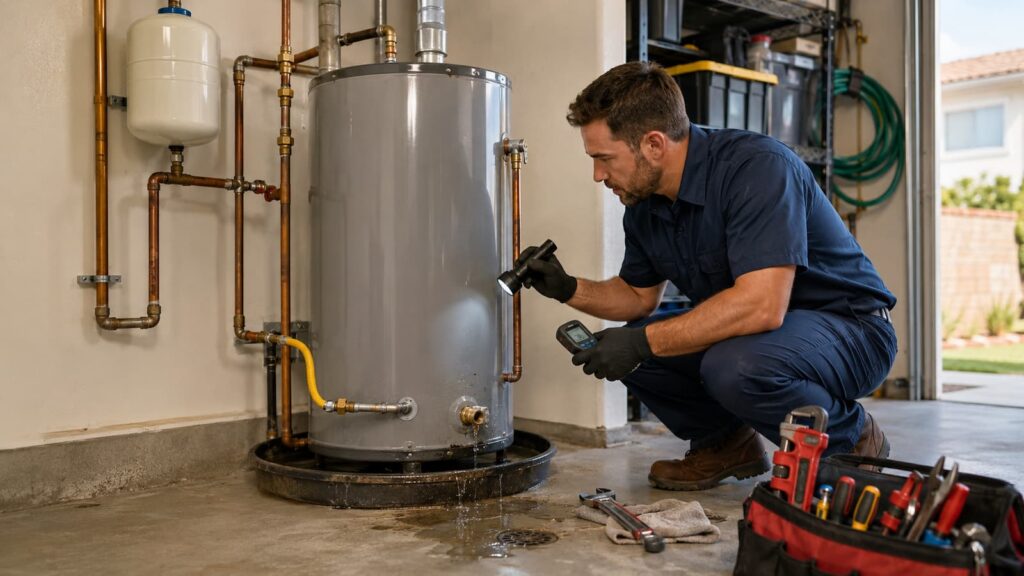
Water around the bottom of a water heater is one of those problems homeowners should never ignore.
Sometimes it is a small, repairable issue. A drain valve may not be fully closed. A fitting may be loose. A temperature and pressure relief valve may be discharging water through a pipe that ends near the floor. A cold water line above the heater may be dripping down the side of the tank and collecting underneath. In those situations, the heater itself may not be ruined.
But sometimes water at the bottom means something much more serious: the internal tank is leaking. When a storage water heater tank begins leaking from corrosion, cracking, or internal failure, it is usually not repairable in a practical or safe way. The tank is the body of the appliance. Once it is compromised, patching the outside is not a real solution. The leak may start small, but it can turn into a much larger water damage event with little warning.
That is why the first step is not panic, but it is also not delay. The goal is to figure out where the water is actually coming from. “Leaking from the bottom” is a symptom, not a diagnosis. Water obeys gravity. A leak from the top, side, valve, pipe, or discharge tube can travel down and make it look like the base is leaking. A puddle under the unit does not automatically prove the tank has failed, but it does mean you need to investigate carefully.
This guide explains the most common reasons a water heater leaks from the bottom, which issues may be repairable, when replacement is the smarter choice, what to do immediately, and how to avoid making the situation worse. If your water heater is actively leaking, producing rusty water, losing hot water capacity, or showing signs of age, Smart Plumbing USA can help with professional water heater repair and honest guidance on whether repair or replacement makes more sense.
First: is it really leaking from the bottom?
Before deciding whether a water heater can be repaired, you need to confirm the source of the water. A puddle at the base does not always mean the lower tank is leaking. It only means water ended up there.
Start by looking above the puddle. Check the cold water inlet, hot water outlet, shutoff valve, flexible connectors, nipples, fittings, expansion tank connection, and any nearby pipe joints. A small leak from an upper fitting can run down the side of the tank, collect around the jacket seam, drip into the pan, and look like a bottom leak. In some cases, the actual leak is several feet above the floor.
Next, inspect the temperature and pressure relief valve, usually called the T&P valve or TPR valve. It is often located near the top or side of the tank, with a discharge pipe that runs downward. If this valve is releasing water, the water may appear near the bottom even though the tank itself is not leaking. The valve may be faulty, or it may be doing its job because pressure or temperature is too high. Those are very different situations, so do not simply plug or cap the discharge pipe.
Then check the drain valve near the bottom of the tank. This valve is used to drain or flush the water heater. If it is loose, cracked, worn, or not fully closed, water may drip directly from the lower front area. A leaking drain valve is one of the more repairable causes of water at the bottom, especially if the tank itself is otherwise in good condition.
Also look for condensation. In certain situations, especially with gas water heaters, a cold tank, high humidity, heavy hot water use, or temporary startup conditions can create condensation that drips down and collects at the base. Condensation is not the same as a tank leak, but it can be mistaken for one. Persistent water, growing puddles, rusty water, or dripping from a specific metal seam is more concerning.
The key is to trace the water path. Use a dry paper towel or cloth to wipe suspected areas, then watch where moisture returns first. If the top and side connections stay dry but water continues appearing from beneath the tank jacket or from the bottom seam, the internal tank may be leaking.
What to do right away if your water heater is leaking
A leaking water heater can damage flooring, drywall, cabinets, stored belongings, framing, and nearby equipment. Even a slow leak deserves quick action because water can spread farther than it appears on the surface. If the leak is significant, safety comes first.
If water is actively spreading, shut off the cold water supply to the heater. The shutoff valve is usually on the cold water pipe entering the top of the unit. Turn it clockwise if it is a round handle, or turn the lever perpendicular to the pipe if it is a ball valve. If the valve is stuck, badly corroded, or will not stop the flow, you may need to shut off water to the house at the main shutoff.
Next, turn off the energy source. For an electric water heater, switch off the correct breaker. Do not work around an electric water heater while water is leaking and power is on. For a gas water heater, turn the gas control to off according to the manufacturer instructions if it is safe to do so. If you smell gas, leave the area and contact the gas utility or emergency services as appropriate. Do not operate switches, create sparks, or attempt repairs around a suspected gas leak.
Place towels, a bucket, or a wet/dry vacuum as needed to control water. If the unit has a drain pan and the pan is connected to a drain, make sure the pan is not clogged or overflowing. If there is no drain pan, protect nearby belongings and remove anything stored around the water heater. Garages and utility closets often contain boxes, tools, drywall, trim, and stored items that can be damaged quickly.
If the leak is small and you are not sure where it is coming from, take photos before wiping everything dry. Photos help show the original pattern. Then dry the area and watch for the first point where water reappears. This can help distinguish a valve leak from a tank leak.
Do not ignore a leak because it looks small. A pinhole tank leak may remain slow for a while, or it may suddenly worsen. A leaking T&P valve may indicate unsafe pressure or temperature. A leaking drain valve may be manageable, but if it breaks while being handled, water can release quickly. When in doubt, stop the water supply and call a professional.
Cause 1: the drain valve is leaking
The drain valve is located near the bottom of a traditional tank water heater. It allows the tank to be drained for maintenance, flushing, repair, or replacement. Because it sits low on the unit, a drain valve leak is often described as a water heater leaking from the bottom.
A drain valve may leak because it is not fully closed, the internal washer or seal is worn, sediment is preventing the valve from sealing, the valve body is cracked, or the threads are failing. Plastic drain valves on some units can become brittle over time. Brass valves are generally more durable, but they can still leak if the seal is damaged or debris is trapped inside.
If the leak is coming directly from the valve outlet, the valve may simply be loose or not fully seated. A small bucket or hose cap may temporarily reduce dripping, but that is not a permanent fix. If the valve body is cracked or leaking around the tank connection, the repair becomes more involved.
A leaking drain valve is often repairable if the tank is otherwise healthy. The valve can sometimes be replaced, but the tank must usually be drained below the valve level first. On older units, replacing the valve can be risky because corrosion, sediment, or brittle fittings may complicate removal. A plumber may recommend replacing the water heater instead if the unit is old, heavily corroded, or showing other failure signs.
The key question is whether the valve is the only issue. If the heater is newer and the valve is clearly the leak source, repair may make sense. If the heater is near or past its expected service life and the drain valve is leaking along with rust, rumbling, poor hot water, or visible corrosion, replacement may be the smarter investment.
Cause 2: the temperature and pressure relief valve is discharging
The temperature and pressure relief valve is a critical safety device. Its job is to release water if temperature or pressure inside the tank becomes too high. The valve usually has a discharge pipe that runs downward and ends near the floor or drain pan. When water appears at the bottom of the heater, homeowners sometimes assume the tank is leaking, but the water may actually be coming from this discharge pipe.
A T&P valve can leak for several reasons. The valve itself may be worn or contaminated by debris. The home’s water pressure may be too high. Thermal expansion may be causing pressure to rise when water heats. The thermostat may be set too high or malfunctioning. The expansion tank, if installed, may be failed, undersized, or not properly charged. In some cases, the valve is opening because it is doing exactly what it is designed to do.
This distinction matters. Replacing a leaking T&P valve may solve the problem if the valve is defective. But if high pressure or overheating is the cause, installing a new valve without correcting the underlying issue may lead to another leak. Worse, capping or plugging the discharge pipe is dangerous and should never be done. The relief valve must be able to discharge safely.
If water is coming from the T&P discharge pipe, the water heater may be repairable, but the cause should be diagnosed. A plumber may check water pressure, thermostat setting, expansion tank condition, relief valve operation, and whether the system has a pressure reducing valve or closed plumbing system. The repair could be as simple as replacing a valve or as involved as correcting pressure control.
A T&P leak is not the same as a leaking tank, but it still deserves immediate attention. It is connected to safety and pressure control, not just nuisance dripping.
Cause 3: water is leaking from the tank itself
This is the cause homeowners worry about most, and for good reason. If water is leaking from the actual storage tank, replacement is almost always necessary. The tank is not designed to be patched from the outside. A leak through the tank wall usually means corrosion or structural failure has already compromised the metal.
Traditional water heaters have a steel tank lined with a protective glass-like coating. They also have a sacrificial anode rod that helps protect the tank from corrosion. Over time, the anode rod deteriorates. Sediment may build up. The lining may develop small cracks or weak points. Water chemistry, heat, pressure, and age all contribute to the tank’s gradual decline. Eventually, corrosion can create a leak.
Tank leaks often appear at the bottom because sediment and water sit there, heat concentrates there, and gravity pulls leaking water downward. A tank may also leak through a seam, around a lower fitting, or from beneath the outer jacket. Sometimes the leak is hidden by insulation and only becomes visible when water exits near the base.
Signs that the tank itself may be leaking include water appearing from underneath the tank even after all valves and fittings are dry, rust stains near the base, water seeping from the lower jacket, a growing puddle in the drain pan, rusty hot water, popping or rumbling noises from sediment, and an older unit with no clear external leak source.
If the tank is leaking, repair is usually not a safe or economical option. Even if the leak seems tiny, the underlying corrosion can spread. A small leak can become a larger rupture, especially when the tank is under pressure. Replacement is normally the correct solution.
This is one of the most important homeowner takeaways: a leaking valve may be repairable; a leaking tank is replacement territory.
Cause 4: condensation that looks like a leak
Condensation can occasionally make a water heater look like it is leaking from the bottom. This is more common with gas water heaters under certain conditions, especially when a large amount of cold water enters the tank and humid air contacts cooler surfaces. The moisture can drip down and collect near the base.
Condensation is more likely after the heater has been off, after a long hot water draw refills the tank with cold water, during humid weather, or when combustion produces moisture that condenses before the system warms fully. In many cases, condensation is temporary. Once the tank and venting system warm up, the dripping stops.
The challenge is that condensation and leaks can look similar at first. The difference is usually pattern and persistence. Condensation often appears during startup or heavy recovery and then stops. A true leak usually continues, gets worse, or reappears even when the heater is not in a startup condition.
If you suspect condensation, dry the area thoroughly and observe when the water returns. Does it happen only after heavy hot water use? Does it stop once the heater has been running for a while? Is the water clear and not rusty? Are all fittings dry? Those details help separate condensation from a tank leak.
Even if condensation is the cause, it may still be worth checking the venting and combustion conditions on a gas unit. Persistent condensation, poor drafting, or unusual moisture can point to installation or operating issues that deserve professional attention.
Cause 5: an upper connection is dripping down the tank
One of the easiest mistakes is assuming the leak is at the bottom because the puddle is at the bottom. Water may be leaking from the cold inlet, hot outlet, dielectric nipples, flexible connectors, shutoff valve, expansion tank connection, or nearby piping. From there, it can run down the tank jacket and collect at the base.
Upper connection leaks may be repairable. A loose fitting may need tightening. A flexible connector may need replacement. A corroded nipple may need repair. A failing shutoff valve may need to be replaced. If a nearby pipe is leaking, the water heater may be perfectly fine.
The easiest way to check is to dry the top of the heater and all visible connections. Then use a flashlight and look for moisture returning. Pay attention to the underside of fittings, the top rim of the tank, and any pipe insulation that may be hiding water. Sometimes a slow drip only appears when the heater is heating and pressure rises.
Upper leaks should not be ignored because they can damage the water heater even if the tank has not failed. Water dripping onto the top of the heater can cause corrosion, damage insulation, affect electrical components on electric models, or create rust around connections. A repairable leak can become a bigger problem if left alone.
If the unit is newer and the leak is clearly from a connection, repair is usually worth considering. If the unit is old and several connections are corroded, replacement may be more practical, especially if repair requires disturbing brittle or rusted fittings.
Cause 6: the drain pan or nearby plumbing is the real source
Sometimes the water heater is blamed when the real leak comes from something nearby. A leaking pipe above the heater, a condensate line, a water softener, HVAC equipment, a washing machine connection, a pressure relief discharge from another appliance, or even rainwater intrusion near a garage wall can create water around the heater.
A drain pan can also confuse the diagnosis. If the pan contains water, homeowners may assume the tank leaked into it. But the pan may be receiving water from a discharge pipe, dripping upper connection, or nearby source. If the pan drain is clogged, a small amount of water can accumulate and make the problem look larger.
Look at everything in the area, not just the heater. Follow pipes upward. Check nearby walls. Look for stains, mineral trails, rust marks, damp insulation, or water tracks. If the water heater is in a garage, slope in the floor can carry water from another location toward the unit. A puddle beside the heater may not mean the heater created it.
This is another reason professional diagnosis can save money. Replacing a water heater that was not actually leaking is an expensive mistake. On the other hand, assuming the leak is from a nearby source when the tank has failed can lead to water damage. The source matters.
Repairable vs not repairable: the practical rule
When deciding whether a leaking water heater can be repaired, the practical rule is straightforward:
- Leaks from fittings, valves, pipes, or external components may be repairable.
- Leaks from the internal tank usually require replacement.
Repairable sources may include a loose supply connection, failed flexible connector, leaking drain valve, faulty T&P valve, leaking shutoff valve, expansion tank connection, or nearby pipe. These issues can often be corrected without replacing the entire heater, especially when the tank is newer and in good condition.
Non-repairable or replacement-leaning sources include water seeping from the tank body, lower seam, rusted tank wall, or beneath the jacket with no external valve or pipe source. Once the tank is compromised, the appliance has reached the end of its practical life.
Age changes the calculation. A repair that makes sense on a three-year-old heater may not make sense on a 12-year-old heater. If the unit is old, inefficient, heavily corroded, noisy, producing rusty water, or already struggling to provide hot water, spending money on a small repair may only delay replacement briefly.
Condition matters too. A clean, well-maintained water heater with one leaking fitting is a very different situation from a rusty unit with sediment noise, poor recovery, and water in the pan. The source of the leak tells you what can be fixed. The age and condition tell you whether fixing it is worth it.
When repair usually makes sense
Repair is usually worth considering when the water heater is relatively new, the tank itself is dry and sound, and the leak is clearly coming from an external component. For example, a leaking drain valve on a newer unit may be repairable. A loose cold water connection may be corrected. A failed T&P valve may be replaced after pressure and temperature causes are checked. A leaking flexible connector may be swapped out.
Repair also makes sense when the cost is reasonable compared with the age and value of the heater. If the unit has many years of expected service left and the problem is isolated, replacing the entire heater would be unnecessary. A proper repair can restore safe operation and prevent water damage.
The best repair candidates usually have these qualities:
- the tank is not leaking,
- the heater is not near the end of its expected service life,
- the leak source is visible and external,
- there is no major rust or corrosion around the tank,
- hot water performance is otherwise normal,
- replacement parts are available,
- and the repair does not require disturbing severely corroded connections.
Even when a leak looks repairable, it is smart to address it quickly. Small valve or fitting leaks can damage surrounding metal, insulation, drywall, flooring, and nearby components. A minor repair today may prevent a more expensive replacement or water damage issue later.
When replacement is usually the safer choice
Replacement is usually the better choice when the tank itself is leaking, the heater is old, the unit has multiple symptoms, or repairs would cost too much relative to the remaining life of the appliance.
A leaking tank is the clearest replacement sign. If water is coming from inside the tank or from the lower tank body, the heater should be replaced. This is not a cosmetic issue. The tank holds pressurized hot water. Corrosion can worsen, and a slow leak can become a major release.
Age is another major factor. Many traditional tank-style water heaters are replaced around the later years of their expected service life, especially once leaks, corrosion, rusty water, rumbling noises, or reduced hot water appear. A newer unit with a bad valve is one thing. An older unit with water in the pan and rust around the base is another.
Replacement also makes sense when the water heater no longer meets the household’s needs. If the unit is leaking and also runs out of hot water quickly, recovers slowly, makes loud popping sounds, or has rising operating costs, simply repairing one leak may not solve the larger comfort problem.
Consider replacement if you notice:
- water seeping from the tank body or bottom seam,
- rust around the base of the tank,
- rusty or brown hot water,
- frequent rumbling or popping noises,
- multiple leaking fittings on an older unit,
- repeated repairs in a short period,
- poor hot water capacity,
- or a tank that is already near the end of its useful life.
If replacement is the right move, it may also be a good time to reconsider the type and size of water heater. Some homeowners replace with a similar tank model. Others use the failure as an opportunity to upgrade to a larger, more efficient, or tankless system. Smart Plumbing USA provides water heater installation and replacement for homeowners who need a safe, properly sized replacement after a leak.
Does a small leak mean you can wait?
A small leak can be tempting to ignore, especially if the water heater still produces hot water. That is risky. The seriousness of a leak is not measured only by the size of today’s puddle. It is measured by the source of the leak and the likelihood that it will worsen.
A tiny drip from a drain valve may remain manageable for a short time, but it can also worsen if the valve seal fails or the valve body cracks. A slow drip from a T&P valve may indicate pressure problems that should not be ignored. A small tank leak is especially concerning because it often means corrosion has already penetrated the tank wall.
Water damage also accumulates. A few ounces of water per day can damage drywall, baseboards, wood framing, flooring, stored boxes, and nearby equipment. In enclosed closets, moisture can also create musty odors and mold-friendly conditions. In a garage, water can travel under storage racks or into wall cavities before the homeowner notices the full extent.
If the leak is from the tank, waiting is not a repair strategy. It is a gamble. The leak may stay slow for a while, or it may expand. Since the tank is pressurized, a failure can release a significant amount of water. Replacing the heater before that happens is usually much less stressful than dealing with a flooded area after the fact.
If you cannot schedule service immediately, at least shut off the water supply when the heater is not needed, protect the surrounding area, and monitor the leak closely. But do not treat a leaking tank as a normal condition.
Why water heaters leak from the bottom as they age
Bottom leaks are common in older tank-style water heaters because of the way tanks age. Over years of operation, the tank is exposed to hot water, minerals, pressure changes, thermal expansion, and internal corrosion. The bottom of the tank is also where sediment tends to collect.
Sediment forms when minerals and debris settle out of the water. In hard-water areas, this buildup can become more significant. Sediment can reduce heating efficiency, create popping or rumbling sounds, and contribute to hot spots at the bottom of the tank. Those hot spots can stress the tank lining and metal over time.
The sacrificial anode rod is designed to help slow corrosion inside the tank. It corrodes instead of the tank metal. But once the anode rod is depleted, the tank has less protection. Many homeowners never inspect or replace the anode rod, so internal corrosion progresses quietly until symptoms appear. A leak is often one of the final symptoms, not the first.
Water chemistry also matters. Hard water, aggressive water, high pressure, thermal expansion, and lack of maintenance can all influence how quickly a tank deteriorates. Two identical water heaters can have different lifespans in different homes because the operating conditions are different.
This is why maintenance can help, but it cannot make a tank last forever. Flushing sediment, checking the anode rod, inspecting valves, and controlling pressure may extend the life of the heater, but all storage tanks eventually reach the point where replacement becomes necessary.
Tank water heater vs tankless: does leaking change the upgrade decision?
A leaking tank-style water heater often forces a decision quickly: replace with another tank, or upgrade to tankless. The right choice depends on budget, space, hot water demand, gas or electrical capacity, water quality, and how long you plan to stay in the home.
Replacing with a similar tank model is usually the most straightforward path. It may involve fewer changes to plumbing, venting, gas, or electrical systems. If the household was happy with the old system before it started leaking, a properly sized tank replacement may be the practical choice.
Tankless may be worth considering if you want to save space, reduce standby heat loss, avoid running out of stored hot water, or modernize the system. However, tankless is not just a smaller swap. It may require gas line evaluation, venting changes, condensate drainage, service valves, electrical access, and attention to water hardness. A rushed emergency replacement is not always the best moment for a complex conversion unless the site is already a good fit.
If your existing tank has failed from age and your household often ran out of hot water anyway, it may be worth discussing both options. If the tank failed suddenly and you need the fastest, most budget-conscious solution, a standard replacement may make more sense.
The leak creates urgency, but it does not remove the need for proper sizing. Whether you choose tank or tankless, the new system should match your household’s real hot water use, available utilities, installation location, and maintenance expectations.
How a plumber diagnoses a bottom leak
A good diagnosis is systematic. The plumber is not just looking at the puddle. They are tracing the water back to its source and evaluating the overall condition of the heater.
The process usually starts with visual inspection. The plumber checks the top connections, shutoff valve, hot and cold piping, expansion tank, T&P valve and discharge pipe, drain valve, pan, tank jacket, base, venting, and nearby plumbing. They may dry the unit and watch for moisture to reappear.
Next, they determine whether the leak is active, intermittent, pressure-related, temperature-related, or connected to hot water use. A leak that appears only while heating may suggest pressure expansion or a T&P issue. A leak that continues with the water supply on and all fittings dry may suggest tank failure. A leak after a maintenance attempt may point to the drain valve.
They may also check water pressure, especially if the T&P valve is discharging or if multiple valves have leaked. High water pressure can stress plumbing fixtures and water heaters. If the home has a pressure reducing valve or expansion tank, those components may need evaluation.
The plumber also considers age and condition. A repairable external leak on a newer unit may be fixed. The same leak on an old, corroded heater may lead to a replacement recommendation because disturbing the fittings could reveal more problems. Diagnosis is not just about whether repair is possible. It is about whether repair is wise.
When the leak source is not obvious or when water may be coming from nearby piping, broader plumbing inspection may be useful. If water damage suggests hidden moisture beyond the heater area, professional leak detection and repair can help identify the true source before unnecessary replacement decisions are made.
What not to do with a leaking water heater
When a water heater leaks, the wrong response can make the problem more dangerous or more expensive.
Do not ignore the leak because the heater still makes hot water. A leaking tank can worsen. A dripping T&P valve may indicate pressure or temperature problems. A valve leak can spread water damage. Hot water production does not mean the appliance is safe or healthy.
Do not cap or plug the T&P valve discharge pipe. This pipe is part of a safety system. Blocking it can create a dangerous pressure condition. If water is coming from the discharge pipe, the cause needs to be diagnosed.
Do not apply sealant, epoxy, tape, or patch products to a leaking tank and assume it is fixed. External patching does not repair internal corrosion. It may temporarily slow visible water while the tank continues to deteriorate.
Do not keep forcing old valves. A stuck drain valve or shutoff valve can break. If a valve is corroded or difficult to turn, stop and get help. Breaking a valve on a full tank can release water quickly.
Do not work on electrical components while water is present and power is on. Electric water heaters should be shut off at the breaker before inspection around wet areas. Water and electricity are a serious combination.
Do not assume the leak is minor without finding the source. The same puddle can come from a repairable valve or a failed tank. The source is what determines the correct next step.
How to reduce the risk of future water heater leaks
No water heater lasts forever, but maintenance can reduce the risk of early failure and help you catch problems before they cause major water damage.
Flush the tank periodically to reduce sediment buildup. Sediment can make the heater noisier, less efficient, and more stressed. The best flushing frequency depends on water quality and usage, but annual maintenance is a practical baseline for many homes.
Have the anode rod inspected and replaced when needed. The anode rod is one of the most important corrosion-protection components in a tank-style water heater. If it is depleted, the tank becomes more vulnerable to internal corrosion.
Test and inspect the T&P valve according to manufacturer guidance. The valve must be able to operate safely. If it leaks, sticks, or shows signs of corrosion, it should be addressed properly.
Check water pressure. Excessive pressure can stress water heaters, fixtures, valves, and pipes. If the home has high pressure, a pressure reducing valve or expansion control may be needed. If a pressure reducing valve already exists, it should be working correctly.
Use a drain pan where appropriate and make sure it drains correctly. A drain pan does not prevent a leak, but it can reduce water damage if a leak occurs. This is especially important when a water heater is installed in a finished area, closet, attic, or any location where water damage could spread quickly.
Inspect around the heater every few months. Look for moisture, rust, corrosion, mineral deposits, damp insulation, valve drips, and water stains. Many water heater problems begin with small warning signs.
Finally, do not wait too long to replace an aging unit. Proactive replacement may feel inconvenient, but it is usually less disruptive than emergency replacement after a leak damages the surrounding area.
A quick decision guide: repair or replace?
If you are standing in front of a leaking water heater and trying to decide what the next step should be, use this practical guide.
- Leak from the drain valve on a newer unit: repair may be possible.
- Leak from a supply connector or fitting: repair may be possible if the tank is healthy.
- Water from the T&P discharge pipe: diagnose pressure, temperature, expansion, and valve condition before deciding.
- Water seeping from the tank body or bottom seam: replacement is usually needed.
- Small puddle with no visible source: dry the unit, trace the water path, and inspect upper connections before assuming tank failure.
- Leak on an old heater with rust and poor performance: replacement is often the smarter choice.
- Leak plus rusty hot water: internal corrosion is more likely, so replacement should be strongly considered.
- Leak plus rumbling, popping, and poor hot water recovery: sediment and age may make replacement more practical than repair.
- Leak near electrical components: shut off power and get professional help.
- Fast leak or spreading water: shut off water supply and treat it as urgent.
This guide cannot replace an on-site diagnosis, but it can help you understand the logic. Repairable leaks are usually external. Replacement leaks usually come from the tank itself.
Frequently Asked Questions
It depends on the source. If the leak is from the drain valve, a fitting, a supply connector, or the T&P discharge pipe, repair may be possible. If water is leaking from the internal tank or bottom seam, replacement is usually required.
A leaking water heater can be dangerous if the leak involves electricity, gas, pressure, or a failing tank. Even a small leak can cause water damage. A leaking T&P valve may indicate pressure or temperature problems and should not be ignored.
Yes, if water is actively leaking or spreading, shut off the cold water supply to the heater and turn off the energy source. For electric units, shut off the breaker. For gas units, turn the gas control off if safe to do so. If you smell gas, leave the area and contact the gas utility or emergency services.
That pipe is often connected to the temperature and pressure relief valve. If water is coming from it, the valve may be faulty, or the heater may have high pressure, thermal expansion, or temperature issues. Do not cap the pipe. The cause should be diagnosed.
The tank may be leaking if all external valves, fittings, and pipes are dry but water continues to appear from underneath the heater, the lower jacket, or the bottom seam. Rust around the base, rusty hot water, and an older unit make tank failure more likely.
It is not a good idea to keep using a leaking water heater without identifying the source. A small valve leak may be repairable, but a small tank leak can worsen and cause significant water damage. The leak should be diagnosed quickly.
Not always. Water in the pan can come from the tank, but it can also come from a drain valve, T&P discharge pipe, upper connection, nearby pipe, or another appliance. The source of the water should be traced before deciding whether replacement is needed.
Replacement is usually recommended when the tank itself is leaking, the heater is old and corroded, rusty hot water is present, hot water performance is poor, or repairs would cost too much compared with the remaining life of the unit.
Final thoughts
A water heater leaking from the bottom is not always a failed tank, but it should always be treated seriously. The leak may be coming from a repairable drain valve, relief valve, fitting, connector, or nearby pipe. It may also be coming from the internal tank, which usually means the water heater has reached the end of its service life.
The most important step is to identify the source. Dry the area, check from top to bottom, look at the T&P discharge pipe, inspect the drain valve, and watch where water returns first. If the tank itself is leaking, do not rely on patches or temporary fixes. Replacement is usually the safest and most practical option.
If the leak is small, act before it becomes large. If the leak is active, shut off the water supply and energy source safely. A quick diagnosis can prevent unnecessary replacement when the issue is repairable — or prevent serious water damage when the tank has truly failed.
Pingback: Washing Machine Drain Pipe Overflowing? | Smart Plumbing