
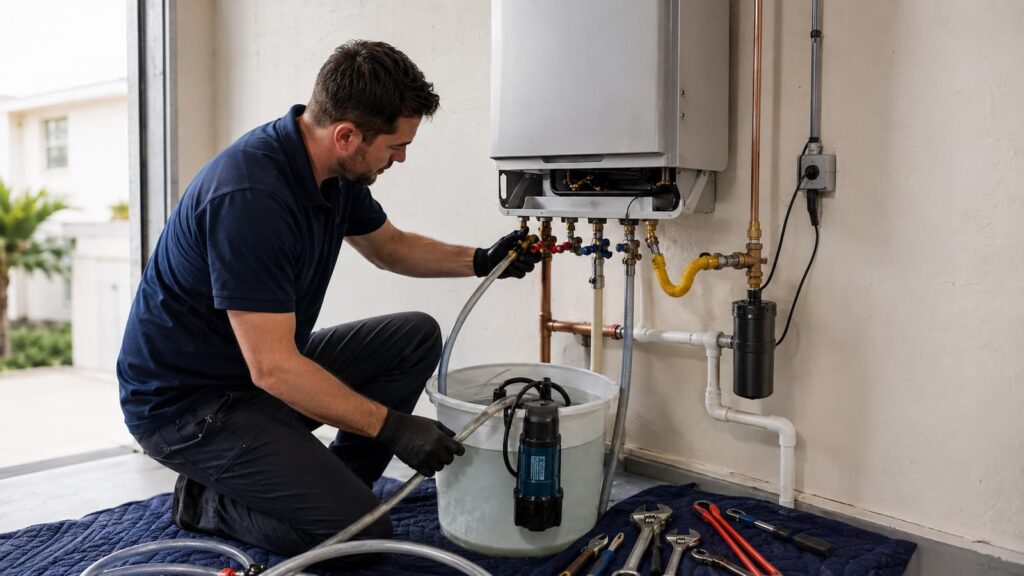
Most tankless water heaters should be flushed about once a year, but that answer is only the starting point.
The real flushing schedule depends on your water hardness, how much hot water your household uses, the age and condition of the unit, the manufacturer’s maintenance instructions, and whether the system has a water softener or other treatment equipment. A lightly used tankless heater in a home with softened water may not need the same service frequency as a heavily used unit in a hard-water home. A system that already shows temperature swings, reduced flow, or error codes may need attention sooner, even if it has not been a full year.
That is where many homeowners get confused. Tankless water heaters are often promoted as efficient, compact, and long-lasting, and they can be all of those things. But “tankless” does not mean “maintenance-free.” In fact, because a tankless unit heats water through narrow passages inside a heat exchanger, mineral scale can become a serious performance issue if the system is ignored. The unit may still look clean from the outside while scale is quietly restricting water flow and reducing heat transfer inside.
Flushing a tankless water heater is the maintenance process used to circulate a descaling solution through the heat exchanger and remove mineral buildup before it causes bigger problems. Done at the right interval, it can help protect hot water performance, reduce strain on the unit, prevent some error codes, and support a longer service life. Skipped for too long, flushing may become less effective because scale can harden, passages can become restricted, and components may already be stressed.
This guide explains how often to flush a tankless water heater, why the schedule changes from one home to another, what hard water does to a tankless system, what signs mean flushing is overdue, whether homeowners can do it themselves, and when professional maintenance makes more sense. If your tankless system is already showing symptoms such as inconsistent hot water, low flow, or recurring fault codes, Smart Plumbing USA can help with professional water heater repair and tankless water heater troubleshooting.
The simple answer: once a year is a good baseline
For many homes, annual flushing is the practical starting point. Once a year is frequent enough to stay ahead of moderate mineral buildup in many systems, especially if the unit is used daily and the local water has some hardness. It is also easy for homeowners to remember: schedule tankless maintenance once a year, just like other important home-service tasks.
But annual flushing is not a universal rule. Some homes need it more often. Some homes may be able to go longer if the water is treated and the unit is lightly used. The problem is that homeowners often do not know which category their home falls into until symptoms appear. That is why the safest general recommendation is this: plan on flushing once a year unless your plumber, manufacturer instructions, water quality, or service history suggest a different interval.
Annual service is especially smart if you do not know your water hardness, if the unit has never been flushed, if the home has no water softener, or if the tankless water heater serves the whole house. It is also important if the unit is still under warranty because some manufacturers expect proper maintenance and may not cover damage caused by scale, water quality, or neglect.
Think of annual flushing as preventive care rather than emergency repair. You are not waiting for the heater to fail. You are removing buildup before it changes how the system performs. That is much better than waiting until the water gets lukewarm, the unit starts throwing error codes, or the heat exchanger becomes difficult to clean.
If you want a quick rule of thumb, use this:
- Soft water and light use: flushing may be needed less often, depending on the manufacturer and service history.
- Average water and normal household use: once a year is usually a sensible baseline.
- Hard water, heavy use, or no treatment system: flushing every 6 to 12 months may be more appropriate.
- Symptoms already present: do not wait for the calendar; service the unit now.
Why tankless water heaters need flushing
A traditional tank water heater stores hot water in a large cylinder. Minerals and sediment often settle at the bottom of the tank. A tankless water heater works differently. It heats water as it flows through a heat exchanger. That heat exchanger has relatively narrow passages, and those passages need to stay clean for the unit to work efficiently.
When hard water is heated, dissolved minerals can separate from the water and form scale. The main minerals involved are usually calcium and magnesium. These minerals create the white crusty buildup many homeowners see on faucets, showerheads, glass shower doors, and appliances. Inside a tankless water heater, that same type of buildup can collect on the heat exchanger surfaces.
Scale creates two major problems. First, it restricts water flow. The more buildup inside the heat exchanger, the harder it is for water to move through the unit at the proper rate. Second, it reduces heat transfer. Scale acts like an insulating layer between the heat source and the water. The heater has to work harder to produce the same outlet temperature, and internal components may run hotter than they should.
This is why a tankless water heater can gradually lose performance even when it still powers on and appears normal. The homeowner may notice that showers are not as hot as they used to be, hot water flow feels weaker, the unit takes longer to stabilize, or temperature swings become more common. Those symptoms may not mean the heater is “old.” They may mean the unit is overdue for descaling.
Flushing helps by circulating a descaling solution through the heat exchanger. The goal is to dissolve and remove mineral buildup before it becomes severe. The process usually uses the service ports and isolation valves installed near the heater. A pump circulates solution through the unit for a set period, then the system is flushed with clean water and returned to service.
The important point is that flushing is not cosmetic. It is not just cleaning the outside cabinet or rinsing the unit. It is internal maintenance that helps keep the water passages and heat transfer surfaces in better condition.
Hard water changes the flushing schedule
Hard water is the biggest reason one home may need tankless flushing more often than another. If your water has a high mineral content, scale can form faster inside the heat exchanger. That means a once-a-year schedule may be the minimum, not the maximum.
Signs of hard water around the home include white spots on dishes, chalky buildup on faucets, crust around showerheads, cloudy glass shower doors, dry-feeling skin after showering, reduced flow at fixtures, and appliances that seem to collect mineral deposits quickly. Those signs do not prove the tankless water heater is scaled, but they do suggest that minerals are present in the water and may be affecting the system.
In hard-water homes, flushing every 6 to 12 months may be appropriate, especially if the tankless unit is heavily used. A large household with multiple showers, daily laundry, frequent dishwashing, and high hot water demand puts more water through the heat exchanger. More water means more mineral exposure. Over time, that can increase scale formation.
A water softener can change the maintenance picture. Softened water reduces the minerals that create hard scale, which may reduce the frequency or severity of descaling needs. However, a softener does not mean the tankless heater should be forgotten forever. The inlet filter still needs attention, the unit still needs inspection, and manufacturer maintenance instructions still matter.
If hard water is a recurring problem in your home, it may be worth addressing water quality rather than only reacting to scale after it forms. Smart Plumbing USA provides water softener installation for homeowners who want to reduce mineral buildup and protect plumbing fixtures, water-using appliances, and water-heating equipment.
The best approach is to know your water. If you do not know whether your home has hard water, you can use a basic water hardness test or ask a plumbing professional during service. Once you understand the hardness level, it becomes much easier to choose a realistic flushing schedule.
Usage matters too: a busy household needs more attention
Water hardness is important, but usage matters almost as much. A tankless water heater in a two-person home does not experience the same workload as one serving a large family with multiple bathrooms. The more hot water the system produces, the more water passes through the heat exchanger, and the more opportunity minerals have to deposit.
Heavy use does not only mean long showers. It can include back-to-back morning showers, frequent laundry on warm or hot settings, daily dishwasher cycles, a large soaking tub, guests staying often, multiple bathrooms used at the same time, or a household where hot water runs throughout the day. Even if each individual use seems normal, the total workload adds up.
A lightly used tankless water heater may be more forgiving, especially with softened water. A heavily used tankless heater in hard water may need a more aggressive service schedule. If your home has both hard water and high usage, waiting several years between flushes is usually not a good idea.
Usage also affects how quickly symptoms become noticeable. In a busy household, small performance changes show up faster because the unit is asked to perform under more demanding conditions. A little scale may not matter much when one faucet is running. It may matter a lot when two showers and a washing machine are running at the same time.
If your tankless unit serves a guest house, vacation property, or rarely used fixture, the schedule may be different. However, low-use systems still need periodic checks. Water can sit, filters can collect debris, valves can stiffen, and manufacturer maintenance recommendations still apply.
The best schedule is based on both water quality and workload. Hard water plus heavy use means more frequent maintenance. Soft water plus light use may allow a longer interval, but the unit should still be inspected regularly.
Signs your tankless water heater is overdue for flushing
A tankless water heater does not always announce scale buildup clearly. In many cases, the symptoms appear gradually. Homeowners often adapt without realizing it. The shower takes a little longer to get hot. The water temperature feels a little less stable. The unit sounds slightly different. Then one day the heater shows an error code or struggles during normal use.
Common signs that flushing may be overdue include:
- hot water is not as hot as it used to be,
- temperature swings during showers,
- hot water starts strong but fades during use,
- lower hot water flow at multiple fixtures,
- the unit takes longer to deliver stable hot water,
- error codes related to overheating, flow, or scale,
- unusual noises from the heater during operation,
- reduced performance during simultaneous fixture use,
- the unit shuts down during high demand,
- and the heater has not been flushed in more than a year or two.
These symptoms do not always mean scale is the only problem. Temperature swings can also be caused by a shower valve, low flow, gas supply issues, venting problems, a dirty filter, or an undersized unit. Low hot water flow can come from a clogged fixture, partially closed valve, or plumbing restriction. Error codes can point to several different causes depending on the manufacturer.
Still, if the unit has not been flushed and the symptoms match a scale pattern, maintenance should be high on the list. Flushing may restore performance if the buildup is still manageable. If scale has been ignored for too long, flushing may improve the unit but not fully reverse the damage or restriction.
Do not wait for total failure before taking action. A tankless water heater that still works but is becoming inconsistent is often giving an early warning. That is the ideal time to service it.
What happens if you never flush a tankless water heater?
If a tankless water heater is never flushed, mineral scale can continue building inside the heat exchanger. The speed of buildup depends on water hardness and usage, but the direction is usually the same: performance slowly gets worse.
At first, the symptoms may be subtle. The heater may still produce hot water, but it may need more energy to do it. The outlet temperature may become less stable. The unit may run hotter internally because scale prevents heat from transferring efficiently into the water. Flow through the heat exchanger may become more restricted.
As buildup increases, the tankless heater may begin showing more noticeable problems. Showers may fluctuate from hot to cool. The unit may struggle when multiple fixtures run. Error codes may appear during high demand. The heat exchanger may overheat. Internal parts may experience more stress. In severe cases, scale can contribute to costly failures.
Neglected flushing can also make future maintenance harder. Fresh or moderate scale is easier to remove than heavy, hardened buildup that has been allowed to accumulate for years. Once the passages are badly restricted, a basic flush may not fully restore the unit. Sometimes the damage has already been done.
There is also a warranty consideration. Many tankless water heater warranties exclude damage from poor water quality, scale, or improper maintenance. If a heat exchanger fails because the unit was never serviced in a hard-water home, the homeowner may be responsible for the cost. That is another reason to keep maintenance records and follow the manufacturer’s guidance.
The short version is simple: skipping one flush may not ruin a tankless heater overnight, but years of neglect can reduce performance, increase repair risk, and shorten the useful life of the equipment.
What flushing actually involves
Flushing a tankless water heater is different from flushing a traditional storage tank. With a tank water heater, flushing usually means draining water from the tank to remove sediment. With a tankless system, flushing usually means isolating the heater and circulating a descaling solution through the heat exchanger.
A proper tankless flush generally involves shutting off power and fuel according to the manufacturer’s instructions, closing the hot and cold isolation valves, connecting hoses to the service ports, placing a pump in a bucket with an approved descaling solution, circulating the solution through the heater, flushing the system with clean water, cleaning the inlet filter if accessible, restoring valves to normal position, and testing hot water operation.
The exact steps vary by brand and model. Some manufacturers allow white vinegar. Others recommend a specific descaling product. Some systems have service valves that make the process straightforward. Others may lack proper isolation valves, which makes flushing harder and may require additional plumbing work before maintenance can be performed correctly.
A well-installed tankless water heater should have hot and cold service valves near the unit. These valves allow the heater to be isolated from the home’s plumbing and connected to flushing hoses. Without them, maintenance becomes more inconvenient and may take longer. If your unit does not have service valves, a plumber may recommend adding them to make future flushing easier.
Flushing also provides an opportunity to inspect the system. A professional may check for leaks, corrosion, venting concerns, condensate drainage, filter restrictions, error history, gas or electrical issues, and signs that the unit is not operating normally. That inspection value is one reason professional maintenance can be more useful than a quick DIY flush.
When done correctly, flushing is a controlled maintenance process. When done carelessly, it can create problems: valves may be left in the wrong position, air may remain in the line, the wrong chemical may be used, hoses may leak, or the unit may not be restored properly. That is why homeowners should follow the exact manual for their unit or hire a professional if they are unsure.
Can you flush a tankless water heater yourself?
Some homeowners can flush a tankless water heater themselves if the unit is accessible, has proper service valves, the manual provides clear instructions, and the homeowner is comfortable working around plumbing, electricity, and gas appliances. However, DIY flushing is not the right choice for everyone.
The DIY process usually requires a submersible pump, two hoses, a bucket, approved descaling solution or vinegar if allowed by the manufacturer, and enough time to circulate the solution and rinse the system properly. The homeowner must also know how to isolate the unit, avoid backfeeding solution into the home’s plumbing, handle hot water safely, and return all valves to normal operation afterward.
The biggest mistake is treating every tankless water heater the same. Brands and models differ. Some instructions specify the type of cleaning solution, amount of solution, circulation time, valve sequence, filter access, and restart procedure. Following a random online video without checking the manual can lead to mistakes.
DIY flushing may be reasonable if the unit is newer, well-installed, easy to access, has service valves, has no error codes, and simply needs routine maintenance. Professional service is usually smarter if the unit has repeated error codes, poor performance, active leaks, ignition trouble, venting concerns, a stuck valve, no service valves, severe scale symptoms, or unknown maintenance history.
There is also the question of diagnosis. If a tankless water heater has temperature swings, flushing may help if scale is the cause. But if the real issue is a failing shower cartridge, gas supply limitation, clogged inlet filter, incorrect venting, or an undersized unit, flushing alone will not solve the problem. A professional can separate maintenance needs from repair issues.
If you are unsure, it is usually safer to have the first service done professionally. You can ask what condition the unit is in, whether the water quality is a concern, whether service valves are set up correctly, and what interval makes sense for your home going forward.
What not to do when flushing a tankless water heater
Tankless flushing is simple in concept, but several mistakes can create safety risks or damage the system.
Do not use harsh chemicals unless the manufacturer specifically allows them. The water passing through the heater is domestic water used for bathing, washing, and often drinking. The wrong cleaner can be unsafe, corrosive, or damaging to internal components. Use only the manufacturer-approved solution or the type of descaling agent allowed in the manual.
Do not skip the manual. Even if the process looks similar across models, details matter. The correct valve positions, circulation time, filter cleaning steps, restart procedure, and safety precautions can vary. The manual is also important for protecting warranty coverage.
Do not force old or stuck valves. A corroded isolation valve can break, leak, or fail to reopen properly. If valves are difficult to turn, that is a sign the system may need professional attention. Forcing a valve near a water heater can turn maintenance into an emergency leak.
Do not ignore gas, venting, or electrical warnings. Flushing addresses mineral scale; it does not fix combustion problems, blocked vents, flame errors, damaged wiring, or internal leaks. If the unit has codes related to ignition, flame loss, overheating, fan operation, exhaust, or sensors, flushing may be only one part of the service.
Do not assume more aggressive is better. Longer circulation, stronger chemicals, or repeated flushing without diagnosis is not always helpful. If the unit is badly scaled, leaking, or repeatedly faulting, a professional diagnosis is more useful than trying to “flush harder.”
Finally, do not forget to rinse and restore the system properly. After descaling, clean water should be used to flush the unit, valves should be returned to normal operating positions, power and gas should be restored according to the instructions, and hot water should be tested at fixtures. Leaving a valve closed or partially closed can cause low flow or no hot water after maintenance.
How long does a tankless flush take?
The flushing portion itself often takes about 30 to 60 minutes of solution circulation, depending on the unit, the cleaning method, and manufacturer guidance. The full service visit or DIY process may take longer because setup, shutdown, hose connection, filter cleaning, rinsing, restart, and testing all take time.
A simple routine flush on a well-maintained unit with good service valves may be relatively straightforward. A neglected unit, a heater with poor access, missing service valves, stuck valves, heavy scale, or error codes can take longer. If the plumber also inspects venting, condensate drainage, gas connections, combustion operation, water filters, and overall performance, the appointment becomes more than just a flush.
Homeowners sometimes focus only on how long the pump runs. That is not the full picture. Proper maintenance also includes safe setup and proper restoration. Rushing the job can lead to mistakes, especially if the person doing it is not familiar with the unit.
If this is your first time servicing a tankless heater, plan for more time than you think you need. Read the manual first. Gather the correct tools. Make sure the area around the heater is clear. Confirm that you know which valves do what. If anything looks different from the instructions, stop and get help rather than guessing.
Does flushing fix temperature swings?
Flushing can fix temperature swings if scale buildup is the cause or a major contributing factor. When scale interferes with heat transfer and flow, the tankless unit may struggle to maintain a stable outlet temperature. Removing that buildup can help the heater respond more smoothly.
However, not every temperature problem is caused by scale. A shower that swings hot and cold may have a failing pressure-balancing valve or thermostatic cartridge. A low-flow showerhead may reduce hot water demand close to the unit’s minimum activation rate. A gas tankless heater may have fuel supply or venting issues. A unit may be undersized for simultaneous use. A plumbing crossover may allow cold water to blend into the hot side.
This is why the pattern matters. If every fixture has unstable hot water and the unit has not been flushed in years, scale is a strong suspect. If only one shower has temperature swings while other fixtures work normally, the shower valve may be more likely. If temperature drops only when multiple fixtures run, the issue may be sizing or demand. If an error code appears at the same time, the code can guide diagnosis.
Flushing is an important maintenance step, but it is not a universal cure. It should be part of a practical troubleshooting process. When temperature swings persist after flushing, the next step is to inspect flow rate, filters, fixture valves, gas or electrical supply, venting, and error history.
Does flushing improve efficiency?
Flushing can improve efficiency when mineral scale is reducing heat transfer. A clean heat exchanger allows the unit to transfer heat into the water more effectively. When scale coats the heat exchanger, the heater may need to work harder to produce the same hot water temperature.
That said, homeowners should be realistic. A flush is not a magic upgrade that makes an old or undersized unit perform like a new premium system. It simply helps the existing unit operate closer to its intended condition. The more scale was affecting performance, the more noticeable the improvement may be.
Efficiency is also affected by temperature setting, hot water habits, fixture flow rates, recirculation settings, pipe insulation, installation quality, fuel type, and equipment age. Flushing is one important part of maintenance, but it is not the only factor in operating cost.
Still, if a tankless water heater has been neglected, flushing is one of the most practical ways to protect efficiency. It addresses the exact part of the system where scale does the most harm: the heat exchanger.
Should you flush a new tankless water heater?
A new tankless water heater usually does not need immediate descaling unless there is a specific water quality or installation issue. However, the maintenance schedule starts from the day the unit begins operating. Waiting until symptoms appear is not the best approach.
For a new installation, the first year is a good time to establish a baseline. If the home has moderate or hard water, schedule a flush around the one-year mark. During that service, the plumber can inspect the inlet filter, check for early scale, verify that service valves are working, confirm proper operation, and recommend whether the next interval should be 6 months, 12 months, or longer.
If the home has very hard water, it may be smart to discuss water treatment at the time of installation rather than waiting for scale to cause problems. A tankless water heater is a long-term investment, and water quality can strongly influence how well it performs.
If you are still planning the upgrade, maintenance access should be part of the installation conversation. A proper tankless setup should include service valves, enough clearance, a sensible location, and a plan for future flushing. Smart Plumbing USA provides tankless water heater installation with attention to sizing, service access, water quality, and long-term performance.
What if the tankless heater has never been flushed?
If your tankless water heater has never been flushed, do not panic, but do not ignore it either. The next step depends on the age of the unit, water hardness, symptoms, and service history.
A unit that is one or two years old, working well, and located in a home with moderate water quality may simply be overdue for routine maintenance. A flush and inspection may be enough. A unit that is five, seven, or ten years old, has hard-water exposure, and now has low flow or temperature problems may need more careful evaluation.
Older neglected units can be tricky. Heavy scale may not dissolve easily in one flush. Valves may be stuck. Filters may be clogged. Internal components may already be stressed. In some cases, flushing can improve performance but not fully restore the heater. In severe cases, the heat exchanger may be damaged or the unit may be near the end of practical repair value.
If the heater has never been flushed and is already showing symptoms, professional service is usually better than a first-time DIY attempt. A plumber can inspect the installation, determine whether the unit has service valves, check for leaks or corrosion, identify error codes, and decide whether flushing is safe and worthwhile.
The longer maintenance has been skipped, the more important diagnosis becomes. The question is no longer only “Should we flush it?” The better question is “What condition is the unit in, and will flushing solve the problem or simply reveal a larger issue?”
Tankless flushing schedule by situation
The following schedule is a practical starting point. Always compare it with the manufacturer’s instructions for your specific unit and adjust based on local water conditions.
- Softened water, light household use: inspect yearly; flushing may be less frequent if the manufacturer allows and no symptoms are present.
- Softened water, normal household use: flush about once a year or as recommended by the manufacturer.
- Moderately hard water, normal use: flush once a year.
- Hard water, normal use: flush every 6 to 12 months.
- Hard water, heavy use: flush every 6 months may be appropriate.
- No known maintenance history: schedule inspection and flushing as soon as practical.
- Temperature swings, low flow, or error codes: do not wait for the scheduled date; diagnose the issue now.
- New tankless installation: establish the first maintenance baseline within the first year, sooner if water is very hard.
This schedule is not meant to replace model-specific instructions. It is meant to help homeowners understand why one neighbor may flush every year while another needs service twice a year. Water quality and usage are the real deciding factors.
Flushing vs filter cleaning: they are not the same thing
Tankless water heater maintenance often includes both flushing and filter cleaning, but these are different tasks.
Flushing or descaling focuses on mineral buildup inside the heat exchanger. It uses a solution circulated through the heater to dissolve scale from internal water passages. This is the task most homeowners think of when they ask how often a tankless unit should be flushed.
Filter cleaning focuses on debris that collects before water enters the heat exchanger. Many tankless units have an inlet filter or screen that catches sediment, grit, and small particles. If that filter becomes clogged, the unit may have reduced water flow or may not activate properly.
A system can need filter cleaning even if scale is not severe. For example, debris from plumbing work, municipal water interruptions, old pipes, or sediment in the supply can clog the inlet screen. That restriction can mimic other problems because tankless heaters are sensitive to flow.
A good maintenance visit should consider both. Cleaning the filter without flushing may leave scale in the heat exchanger. Flushing without checking the filter may leave a flow restriction in place. If the unit has low hot water flow, both should be evaluated.
Is flushing different for gas and electric tankless units?
The basic reason for flushing is similar for gas and electric tankless water heaters: mineral scale can build up inside the water passages and reduce performance. However, the equipment design and safety considerations can differ.
Gas tankless units use a burner and heat exchanger. Maintenance may include flushing, filter cleaning, checking venting, inspecting combustion-related components, verifying condensate drainage on condensing models, and reviewing error history. Gas units also require attention to safe fuel supply, exhaust, and air intake.
Electric tankless units use electric heating elements. They do not have gas combustion or venting, but they still depend on clean water flow and proper electrical operation. Scale can coat heating surfaces and reduce performance. Electrical safety is especially important because whole-house electric tankless systems can use high-amperage circuits.
For homeowners, the takeaway is simple: both types may need descaling, but the maintenance checklist is not identical. Always follow the instructions for your specific unit and do not assume a gas-unit tutorial applies perfectly to an electric model, or the other way around.
Does flushing extend the life of a tankless water heater?
Regular flushing can help extend the useful life of a tankless water heater by reducing scale-related stress. A clean heat exchanger transfers heat more efficiently, maintains better flow, and is less likely to suffer from overheating caused by mineral insulation. That does not guarantee a specific lifespan, but it improves the conditions the unit operates under.
Tankless systems often have long service-life potential, but that potential depends on maintenance. A neglected unit in hard water may develop problems much earlier than expected. A properly installed and regularly serviced unit has a much better chance of delivering reliable hot water over many years.
Flushing is not the only factor. Proper sizing, correct installation, stable gas or electrical supply, good venting, clean filters, water treatment, and timely repairs also matter. But flushing is one of the most important maintenance tasks because it addresses one of the most common enemies of tankless performance: mineral scale.
It is helpful to think of flushing as protection for the heat exchanger. The heat exchanger is one of the most important and expensive parts of the system. Keeping it clean is much easier than dealing with the consequences of severe scale damage later.
When flushing is not enough
Flushing is important, but it does not fix every tankless water heater problem. Sometimes homeowners schedule a flush expecting it to solve all hot water issues, only to discover that the problem is somewhere else.
Flushing may not be enough if the unit is undersized for the home, the gas line cannot supply enough fuel, venting is incorrect, the heat exchanger is damaged, a sensor is failing, the control board has a fault, the inlet filter is clogged with debris, a shower valve is mixing cold water into the hot side, or the plumbing layout creates long hot water delays.
It may also be too late for flushing to fully restore a severely scaled unit. If mineral buildup has been ignored for years, descaling may help but not completely return the heater to original performance. In some cases, repeated error codes or poor output after flushing indicate that repair or replacement should be considered.
This is why maintenance and diagnosis should work together. If the unit is working well and simply due for service, flushing is preventive maintenance. If the unit is already malfunctioning, flushing may be part of troubleshooting, but it should not be the only thing checked.
When in doubt, describe the exact symptoms rather than just asking for a flush. “The unit has not been flushed in two years” is useful. “The unit gets cold after five minutes, shows an error code, and only happens when two showers run” is even more useful. The more complete the information, the better the diagnosis.
A homeowner checklist before scheduling service
Before scheduling tankless maintenance, gather a few details. This helps the plumber understand whether the visit is routine maintenance, troubleshooting, or both.
- Brand and model of the tankless water heater.
- Approximate age of the unit.
- Date of the last flush, if known.
- Whether the home has a water softener.
- Whether you notice hard-water signs on fixtures or glass.
- Any error codes shown on the display.
- Whether the problem affects one fixture or the whole home.
- Whether hot water flow is weaker than before.
- Whether temperature changes during showers.
- Whether the issue happens only during heavy hot water use.
- Whether the unit has visible service valves under or near it.
- Any recent plumbing work, water shutoff, or power outage.
This information can help determine the right service approach. A routine flush on a healthy unit is different from diagnosing a tankless heater with repeated shutdowns or temperature swings.
So, how often should you flush your tankless water heater?
For most homeowners, the best answer is this: flush your tankless water heater once a year unless your water quality, usage, manufacturer instructions, or symptoms suggest a shorter interval.
If your water is hard, if the system is used heavily, or if the unit has already shown scale-related symptoms, consider flushing every 6 to 12 months. If your home has softened water, light usage, and a good maintenance history, your plumber may recommend a longer interval, but the unit should still be inspected regularly.
The worst schedule is no schedule. Many tankless water heater problems develop because homeowners wait until the unit performs poorly before thinking about maintenance. By that point, flushing may still help, but the system may already be stressed.
A tankless water heater is a long-term comfort system. It should be treated like one. Regular flushing, filter cleaning, water quality awareness, and timely repair are what help the system deliver the efficiency, space savings, and reliable hot water homeowners expected when they chose tankless.
Frequently Asked Questions
Most tankless water heaters should be flushed about once a year. Homes with hard water, heavy hot water use, or no water treatment may need flushing every 6 to 12 months. Always compare the schedule with the manufacturer’s instructions for your specific unit.
Mineral scale can build up inside the heat exchanger. Over time, this can reduce hot water flow, cause temperature swings, lower efficiency, trigger error codes, and increase stress on the unit. Severe scale buildup may be difficult to remove and can shorten equipment life.
Some homeowners can flush their own tankless water heater if the unit has service valves, the manual is clear, and they are comfortable with the process. Professional service is usually better if the unit has error codes, poor performance, stuck valves, no service valves, active leaks, or unknown maintenance history.
Yes. Hard water contains minerals that can form scale inside the tankless heat exchanger. If your home has hard water, annual flushing may be the minimum, and service every 6 months may be appropriate for heavy-use systems.
Warning signs include temperature swings, reduced hot water flow, longer wait for stable hot water, lukewarm water during normal use, unusual operating noises, repeated error codes, or no known flushing history.
Flushing may help if the code is related to scale, overheating, or restricted flow. However, error codes can also come from ignition problems, venting issues, sensors, gas supply, electrical faults, or other causes. Repeated codes should be diagnosed rather than repeatedly reset.
The descaling solution often circulates for about 30 to 60 minutes, but the full process may take longer because the unit must be shut down, isolated, connected to hoses, flushed with clean water, restarted, and tested.
A water softener can reduce scale buildup, but it does not eliminate the need for maintenance. The unit should still be inspected, filters should be checked, and flushing should follow manufacturer recommendations and real system conditions.
Final thoughts
A tankless water heater should usually be flushed about once a year, but the smartest schedule depends on your home. Hard water, heavy hot water use, no water treatment, and a neglected service history all point toward more frequent maintenance. Softened water, light use, and a clean service record may allow a longer interval, but the unit should still be checked regularly.
The reason flushing matters is simple: scale affects the heat exchanger, and the heat exchanger is at the heart of tankless performance. Once mineral buildup restricts flow or reduces heat transfer, the system may become less efficient, less stable, and more likely to show error codes or shutdowns.
The best time to flush a tankless water heater is before symptoms appear. If symptoms are already present, flushing may still help, but the unit should be evaluated as a whole. A good maintenance plan protects comfort, efficiency, and equipment life — and it helps prevent a small scale problem from turning into a no-hot-water emergency.