
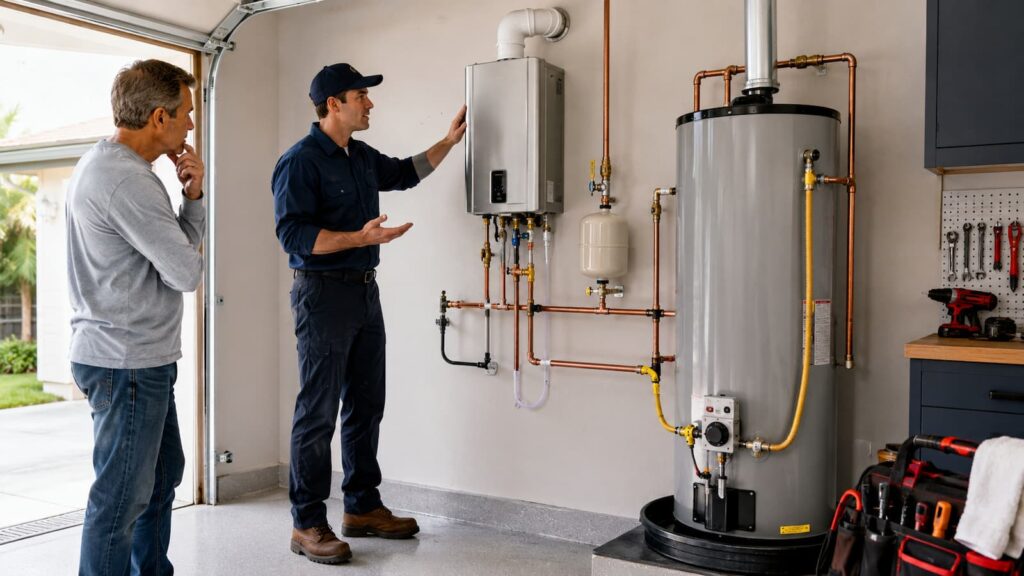
Choosing between a tankless and traditional water heater sounds simple until you start looking at the details.
At first, the comparison seems obvious. A traditional tank water heater stores hot water in a large cylinder. A tankless water heater heats water on demand. One usually costs less upfront. The other saves space and can provide continuous hot water when properly sized. One is familiar and straightforward. The other feels more modern and efficient.
But the best choice for your home is not decided by one feature. It depends on how your household actually uses hot water, how many fixtures may run at the same time, where the heater will be installed, whether your gas line or electrical panel can support the new system, how hard your water is, how long you plan to stay in the home, and whether you care more about upfront price or long-term performance.
That is why homeowners often get conflicting advice. One person says tankless is always better because it is compact and efficient. Another says traditional water heaters are simpler and cheaper to maintain. Both can be right in different homes. A tankless water heater can be an excellent upgrade when the home is a good fit. A traditional storage water heater can also be the smarter choice when budget, simplicity, installation conditions, or usage patterns point that way.
This guide compares tankless and traditional water heaters in practical homeowner terms: hot water comfort, upfront cost, efficiency, installation complexity, maintenance, lifespan, space, repair issues, water quality, household size, and replacement timing. If your current unit is already failing or you are planning an upgrade, Smart Plumbing USA provides professional water heater installation and replacement for both tank-style and tankless systems.
The basic difference: stored hot water vs on-demand hot water
A traditional water heater stores heated water in a tank. The tank may hold 30, 40, 50, 75, or more gallons depending on the model. The heater keeps that water hot so it is ready when someone opens a faucet, starts a shower, runs the dishwasher, or uses the washing machine. Once the stored hot water is used faster than the tank can recover, the water temperature drops and the household may need to wait for the tank to heat more water.
A tankless water heater does not store a large volume of hot water. Instead, it activates when hot water begins flowing through the unit. A flow sensor detects demand, then the heater uses a gas burner or electric elements to heat the water as it passes through a heat exchanger. When the hot water fixture turns off, the unit stops heating. This is why tankless water heaters are often called “on-demand” water heaters.
This difference affects almost everything else. A tank model is limited by stored volume and recovery rate. A tankless model is limited by flow rate and temperature rise. Storage tanks usually provide strong hot water delivery until the tank is depleted. Tankless units can keep heating continuously, but only within their capacity. If the home demands more hot water than the unit can produce at that moment, the water may become lukewarm or inconsistent.
In simple terms, a traditional water heater is like a hot water reserve. A tankless water heater is like a real-time hot water engine. The reserve can run out. The engine can keep going, but only if it is powerful enough for the workload.
Hot water comfort: which feels better day to day?
Comfort is where the tankless vs traditional debate gets interesting. Tankless water heaters are often marketed as providing endless hot water. That can be true, but it needs a qualifier: endless hot water within the unit’s rated capacity. If the tankless heater is properly sized and installed, it can keep producing hot water for long showers, back-to-back baths, and extended use without running out in the way a storage tank can.
A traditional water heater feels comfortable because it provides stored hot water immediately once the hot water reaches the fixture. The tank has already done the heating work. If the tank is large enough and the household demand is moderate, homeowners may never notice a shortage. But when several people shower in a row, or when laundry and dishwashing overlap with bathing, the tank can be depleted. Once that happens, the system needs recovery time.
Tankless systems solve the “running out of tank capacity” problem, but they introduce a different question: can the unit heat enough water at the required flow rate? A single shower may be easy. Two showers plus a dishwasher may push the unit harder. A large soaking tub may demand high flow. If the unit is undersized, the experience may be disappointing even though the technology itself is not the problem.
There is also a common misconception about “instant” hot water. Tankless does not always mean hot water arrives instantly at the faucet. The water still has to travel from the heater to the fixture through the pipes. If the bathroom is far from the unit, the wait can still be noticeable. Some tankless systems can be paired with recirculation features, but that needs to be designed correctly.
For comfort, tankless is often better for households that dislike running out of hot water and have the right system size. Traditional tank models are often better for homeowners who want predictable, familiar operation and do not usually exceed the tank’s capacity.
Upfront cost: traditional water heaters usually win
If the main priority is the lowest initial cost, a traditional water heater usually has the advantage. The equipment is often less expensive, and replacement can be more straightforward when the new unit is similar to the old one. If the home already has a tank-style gas or electric water heater in a code-compliant location, replacing it with a comparable model may require fewer changes to the surrounding plumbing, venting, gas, or electrical systems.
Tankless systems usually cost more upfront. The unit itself can be more expensive, and the installation may require additional work. A gas tankless heater may need a larger gas line, new venting, condensate drainage for a condensing unit, service valves, electrical outlet access, or changes to the mounting location. An electric tankless heater may require significant electrical capacity, and not every home’s panel is ready for that load.
This is one of the biggest reasons homeowners should avoid comparing only the price tags of the units. The real cost is the installed cost. A tankless water heater may look reasonable until the project requires gas line upgrades, vent changes, electrical work, or wall modifications. On the other hand, if the home is already well-suited for tankless, the installation may be more manageable.
Traditional systems are not always cheap either. A difficult location, code upgrades, new expansion tank, pan, drain improvements, venting corrections, seismic strapping where required, or replacement of old valves can add to the cost. Still, in most like-for-like replacements, a traditional water heater is usually the more budget-friendly option at the beginning.
The better question is not simply “Which one costs less?” It is “Which one makes more sense for the home over the next several years?”
Energy efficiency: tankless often has the advantage
Tankless water heaters often have an efficiency advantage because they do not keep a large tank of water hot around the clock. Traditional storage water heaters experience standby heat loss. That means energy is used to maintain water temperature even when no one is using hot water. Modern tank water heaters are better insulated than older models, but the basic storage concept still involves maintaining a reserve.
A tankless water heater heats water only when there is demand. That can reduce wasted energy, especially in homes where hot water use is spread out or moderate. High-efficiency condensing gas tankless units can also capture more heat from combustion gases than older non-condensing designs, which can improve efficiency when installed correctly.
However, efficiency savings are not the same in every home. If a household uses a lot of hot water every day, the tankless unit will run often. It may still be efficient, but the difference compared with a good high-efficiency storage water heater may be less dramatic than expected. If hot water demand is low or intermittent, tankless systems may show a clearer advantage because they avoid keeping a large tank hot during long periods of non-use.
Fuel type also matters. Gas tankless, electric tankless, gas storage, electric storage, and heat pump water heaters all operate differently. A homeowner comparing a gas tankless heater to an old gas tank is asking a different question than someone comparing electric tankless to a heat pump water heater. Utility rates, equipment efficiency, household demand, and installation conditions all affect the real-world savings.
For many homeowners, efficiency should be part of the decision, but not the only factor. A system that is efficient on paper but poorly sized, poorly installed, or neglected can deliver a disappointing experience. The best result comes from matching the technology to the home.
Space savings: tankless is the clear winner
One of the easiest advantages to understand is space. A traditional water heater needs room for the tank, safe clearances, access for service, a drain pan where required, and enough space to remove and replace the unit later. In a garage, closet, utility room, or small mechanical area, that footprint can matter.
A tankless water heater is usually wall-mounted and much more compact. This can free up floor space and create a cleaner mechanical layout. In homes where the existing tank is squeezed into a closet, blocks access, or takes up valuable garage space, tankless can be attractive simply because it changes how the area functions.
That said, tankless does not mean “install it anywhere.” The unit still needs proper clearance, service access, venting or outdoor placement, water and gas or electrical connections, condensate handling for many gas condensing units, and freeze or weather protection depending on the location. A bad tankless location can make maintenance harder and shorten equipment life.
Still, if space is a major concern, tankless usually has the advantage. For homeowners remodeling a garage, converting a utility space, or trying to create a cleaner mechanical area, the smaller footprint can be a real benefit.
Installation complexity: tankless needs more planning
A tankless installation is not just a smaller water heater swap. It is a system design decision. The plumber needs to consider hot water demand, fuel type, venting, electrical requirements, water quality, condensate drainage, service access, local code requirements, and the location of fixtures throughout the home.
Gas tankless units can have high BTU input requirements. That means the existing gas line may not be large enough, especially if the home also has a gas furnace, stove, dryer, fireplace, or other gas appliances. If the gas supply cannot keep up, the tankless unit may show ignition problems, flame loss, poor performance, or error codes under demand.
Venting is another major consideration. A gas tankless water heater may require dedicated venting material, correct slope, proper termination, combustion air, and compliance with manufacturer limits on length and elbows. Condensing units also need condensate drainage. If the installation does not account for these details, the system may never perform reliably.
Electric tankless systems have their own challenges. Whole-house electric tankless units may require substantial amperage. Some homes need panel upgrades or dedicated circuits before installation is feasible. In areas where electricity costs are high, operating cost should also be considered carefully.
Traditional water heaters are usually simpler, especially when replacing like with like. That does not mean installation is unimportant. Venting, combustion air, expansion control, earthquake strapping where required, drain pans, shutoff valves, temperature and pressure relief discharge, and code compliance still matter. But compared with tankless conversions, a standard replacement is often less complex.
If you are leaning toward tankless, the safest approach is to treat the project as a full evaluation rather than a direct swap. Smart Plumbing USA offers tankless water heater installation for homeowners who want proper sizing, installation planning, and a system that fits the home’s real hot water demand.
Maintenance: tankless needs more attention to water quality
Traditional water heaters and tankless water heaters both need maintenance, but the maintenance priorities are different.
A traditional tank water heater can collect sediment at the bottom of the tank. Over time, sediment may reduce efficiency, create rumbling or popping noises, contribute to overheating at the tank bottom, and shorten the life of the unit. Flushing the tank can help, though the effectiveness depends on age, sediment level, and whether the tank has been maintained consistently.
A tankless water heater is more sensitive to mineral scale inside the heat exchanger. Because water passes through narrow heated passages, hard water minerals can coat internal surfaces and reduce heat transfer. This can cause reduced flow, temperature swings, overheating faults, efficiency loss, and premature wear. In hard-water areas, tankless maintenance is not optional if you want the unit to perform well long term.
Tankless maintenance often involves flushing the heat exchanger with a descaling solution, cleaning the inlet filter, checking service valves, inspecting venting, and confirming proper operation. The exact interval depends on water hardness, usage, and manufacturer recommendations. Many homes benefit from annual service, and homes with very hard water may need more frequent attention.
Water quality can also influence the decision between tankless and traditional. If your home has hard water and no treatment, a tankless heater may still be a good choice, but it should be installed with maintenance in mind. Service valves, access, and a realistic flushing schedule matter. A water softener or other treatment solution may also help protect the investment.
Traditional tanks are generally more forgiving of skipped maintenance, but that does not mean neglect is harmless. Sediment, corrosion, worn anode rods, failed valves, and old connections can all lead to problems. The difference is that tankless systems often show performance symptoms more quickly when scale or flow restrictions develop.
Lifespan: tankless can last longer, but only if maintained
Tankless water heaters often have a longer expected service life than standard tank-style units, but that longer life is not automatic. It depends heavily on installation quality, water quality, maintenance, usage, and whether problems are addressed early.
A traditional storage water heater eventually faces tank corrosion risk. Once the tank itself begins leaking, repair is usually not practical. The unit must be replaced. Components like thermostats, burners, gas valves, heating elements, relief valves, and drain valves may be repairable, but a leaking tank is typically the end of the water heater’s life.
Tankless units do not have a large storage tank that corrodes in the same way. Many components are serviceable, and the system may last longer when cared for properly. However, the heat exchanger is a critical and expensive part. If it becomes damaged by scale, overheating, freezing, or poor water conditions, the repair may be costly enough that replacement becomes more practical.
This is why maintenance matters so much in lifespan comparisons. A tankless unit that is flushed regularly, protected from hard-water damage, and installed correctly can provide long-term value. A neglected tankless unit in hard water may develop expensive problems much sooner than expected.
For homeowners planning to stay in the home for many years, tankless may be more appealing because the longer potential lifespan can help offset the higher initial investment. For homeowners planning a short-term sale or working with a tight budget, a traditional tank may make more financial sense.
Repair issues: which system is easier to fix?
Traditional water heaters are familiar to most plumbers and have relatively straightforward components. Common problems include no hot water, pilot or ignition issues, failed heating elements, thermostat problems, leaking valves, sediment buildup, faulty temperature and pressure relief valves, and tank leaks. Many non-tank failures can be repaired, but a leaking tank usually means replacement.
Tankless water heaters are more diagnostic. They use sensors, control boards, fans, flow meters, burners, heat exchangers, igniters, flame rods, and safety systems that all interact. When a tankless unit shows an error code, the code helps narrow the issue, but it does not always identify the root cause by itself. Ignition failure, for example, could involve gas supply, venting, flame sensing, burner condition, wiring, or control issues.
That does not mean tankless systems are unreliable. It means repairs require more precise troubleshooting. A plumber needs to understand the brand, model, error history, installation conditions, water quality, and operating pattern. Replacing parts without diagnosis can become expensive quickly.
Traditional tanks may be easier and cheaper to repair in some cases. Tankless systems may offer more replaceable components and longer useful life, but individual repairs can be more technical. The best repair outcome for either system starts with accurate diagnosis. If your current system is producing inconsistent hot water, leaking, showing codes, or failing to recover properly, professional water heater repair can help determine whether repair or replacement is the smarter option.
Household size and usage: matching the system to real demand
The best water heater is the one that matches how the home actually uses hot water. A small home with one or two occupants may not need the same system as a larger household with multiple bathrooms and overlapping routines. A home with teenagers, frequent guests, a large tub, or simultaneous shower use has different needs than a home where hot water demand is modest and spread throughout the day.
For traditional tanks, sizing often focuses on tank capacity and recovery rate. A larger tank provides more stored hot water, while recovery rate determines how quickly the heater can heat new water after hot water is used. If the tank is too small, the household runs out. If it is oversized, the home may pay to keep more water hot than it really needs.
For tankless systems, sizing focuses on flow rate and temperature rise. The installer needs to estimate how many fixtures may run at the same time and how much heat the unit must add to the incoming water. A tankless heater that is perfect for one household may be undersized for another, even if the homes have the same square footage.
Here are a few practical examples:
- One or two people with moderate hot water use: either system can work well, but tankless may save space and reduce standby energy use.
- A family with back-to-back showers: tankless can be attractive if properly sized, while a traditional tank needs enough capacity and recovery rate.
- A home with simultaneous showers: tankless sizing becomes critical, and a small unit may disappoint.
- A home with a large soaking tub: the fill rate and total volume matter; some tankless systems may need careful sizing to fill the tub comfortably.
- A rental or resale-focused property: traditional may be simpler for cost and maintenance, while tankless may add appeal if installed properly.
The mistake is choosing based only on household size. Two households of four people can use hot water very differently. Real habits matter more than the number of bedrooms.
Traditional water heater advantages
Traditional water heaters remain popular for good reasons. They are familiar, widely available, and often the most practical choice when replacing an existing tank-style unit on a budget.
The biggest advantage is upfront affordability. In many homes, a like-for-like tank replacement costs less than converting to tankless. The installation may be simpler, the equipment cost is often lower, and fewer system modifications may be needed.
Traditional tanks also provide strong flow from stored water. They are not dependent on a minimum activation flow in the same way tankless units are. This can make them feel more forgiving with low-flow fixtures or small hot water draws. If someone needs a small amount of hot water at a bathroom sink, the tank has already heated it.
Another advantage is simplicity. Many homeowners understand how a tank works. Many plumbers service them regularly. Parts and replacement options are widely available. For a homeowner who wants a straightforward solution and does not need advanced features, a traditional water heater can be a very sensible choice.
The drawbacks are also clear. A tank takes up floor space, can run out of hot water, experiences standby heat loss, and has a tank that can eventually corrode and leak. Once the tank leaks, replacement is usually unavoidable.
Tankless water heater advantages
Tankless water heaters are appealing because they solve several common frustrations at once. They save space, reduce standby heat loss, and can provide continuous hot water when properly sized. For many homeowners, those benefits are enough to make tankless worth considering.
The space savings can be significant. A wall-mounted unit can free up room in a garage or utility area. That matters in homes where the existing tank is bulky, awkwardly placed, or in the way of storage and access.
Continuous hot water is another major advantage. A properly sized tankless system can support longer hot water use without “running out” in the way a tank does. That can be useful for families, people who take longer showers, homes with guests, or households that have been frustrated by tank depletion.
Efficiency is also part of the appeal. Because tankless systems heat water only when needed, they can reduce standby energy waste. High-efficiency condensing models can improve performance further when installed correctly.
However, tankless has trade-offs. The upfront cost is higher. Installation is more involved. Maintenance is more important, especially in hard-water areas. Hot water may still take time to reach distant fixtures. If the system is undersized, homeowners may experience lukewarm water during high demand. Tankless is excellent when the home is a good fit, but it is not automatically the best option for every situation.
When a traditional water heater is probably the better choice
A traditional water heater may be the better choice when budget is the main concern, the current tank setup works well, the household rarely runs out of hot water, and the installation area already supports a straightforward replacement.
It can also be the better option when the home’s gas, venting, or electrical system would need expensive upgrades to support tankless. If the added conversion cost is high and the household does not strongly need tankless benefits, a high-quality traditional replacement may deliver better value.
Traditional may also make sense for homeowners who prefer simple maintenance and familiar operation. If the home will be sold soon, the owner may not stay long enough to benefit from the long-term efficiency or lifespan advantages of tankless. In that case, a reliable code-compliant tank replacement may be more practical.
Another scenario is low or occasional hot water use where the existing tank already performs acceptably. Tankless may still save space and energy, but the upgrade may not feel essential unless the homeowner values those benefits enough to justify the cost.
In short, traditional is often better when you want lower upfront cost, simpler replacement, familiar operation, and dependable hot water without major system changes.
When a tankless water heater is probably the better choice
A tankless water heater may be the better choice when the household frequently runs out of hot water, wants to save space, plans to stay in the home long term, and is willing to invest in proper installation and maintenance.
Tankless is especially appealing for homes where hot water use lasts longer than a storage tank can comfortably support. If back-to-back showers are common, if guests visit often, or if the current tank struggles during morning routines, a properly sized tankless system can improve comfort.
It may also be a good choice during remodeling or major plumbing upgrades. If walls are open, utilities are being modified, or the mechanical space is being redesigned, it can be easier to address venting, gas, electrical, condensate, and layout requirements at the same time.
Tankless can also make sense when space is valuable. Removing a bulky tank from a garage, closet, or utility room may create storage space, improve access, or make the area safer and cleaner.
The best tankless candidates are homeowners who understand that the system must be sized correctly, installed correctly, and maintained regularly. If those conditions are met, tankless can be a strong long-term upgrade.
What about hard water?
Hard water deserves its own section because it can affect both types of water heaters, but it is especially important for tankless systems.
In a traditional tank, minerals can settle at the bottom as sediment. That sediment can reduce efficiency, create noise, and contribute to wear over time. In a tankless unit, minerals can form scale inside the heat exchanger. Because the internal passages are narrow and heated intensely, scale buildup can reduce flow, interfere with heat transfer, cause temperature swings, and trigger error codes.
This does not mean hard water makes tankless a bad idea. It means the system needs to be planned with water quality in mind. Service valves should be installed for flushing. Maintenance should be realistic. If the home has significant mineral buildup, water treatment may be worth considering before or during the upgrade.
For homeowners in areas where white spots, scale on fixtures, and mineral deposits are common, water quality should be part of the conversation before choosing a new water heater. A tankless heater can still be a great option, but skipping maintenance in a hard-water home is one of the fastest ways to lose the benefits.
Gas vs electric: the comparison changes by fuel type
The tankless vs traditional question changes depending on whether you are comparing gas to gas, electric to electric, or switching fuel types.
Gas tankless water heaters are common for whole-home use because they can deliver strong heating capacity when properly supplied with gas and vented correctly. However, they may require gas line evaluation, dedicated venting, condensate drainage, and combustion air planning.
Electric tankless water heaters are compact and do not require gas venting, but whole-house models can demand significant electrical capacity. Some homes need panel upgrades or multiple dedicated circuits. In homes where electrical capacity is limited, electric tankless may not be practical without major work.
Traditional gas storage water heaters are familiar and often less expensive to operate than traditional electric resistance tanks, depending on local utility rates. Traditional electric tanks may be simpler to install in some homes but can have higher operating costs than other technologies. Heat pump water heaters are another option in the broader water heater category, but they have different installation needs, space considerations, and performance characteristics.
The main takeaway is that “tankless vs traditional” is only part of the decision. Fuel type may have just as much impact on installation cost, operating cost, and suitability for the home.
Questions to ask before choosing
Before choosing a tankless or traditional water heater, it helps to answer a few practical questions. These questions usually reveal which direction makes more sense.
- Do you currently run out of hot water? If yes, tankless or a larger/faster-recovery tank may be worth considering.
- How many fixtures may use hot water at the same time? This is critical for tankless sizing.
- Is your current water heater location cramped? Tankless may help free up space.
- Is your gas line or electrical panel ready? If not, conversion costs may increase.
- Do you have hard water? Tankless systems need maintenance planning in mineral-heavy water.
- How long do you plan to stay in the home? Long-term owners may benefit more from tankless investment.
- Is the current unit failing now? If the replacement is urgent, a simpler tank replacement may be more practical.
- Do you want lowest upfront cost or better long-term performance? This often decides the direction.
- Would a recirculation system be needed? If hot water wait time matters, layout should be reviewed.
- Are you replacing like-for-like or changing the system? Conversions require more planning.
If you are unsure, a site evaluation is more useful than a generic recommendation. A plumber can look at the existing water heater, gas line, venting, electrical access, household demand, fixture layout, and maintenance concerns before recommending the best option.
A practical decision guide
If you want a simple way to think through the choice, use this framework:
- Choose traditional if you want the lowest upfront cost, a straightforward replacement, familiar operation, and your current tank-style setup generally meets your hot water needs.
- Choose tankless if you want continuous hot water within capacity, space savings, better long-term efficiency potential, and you are prepared for proper installation and maintenance.
- Be cautious with tankless if the home has hard water, limited gas supply, limited electrical capacity, poor venting options, or very high simultaneous demand unless those issues are addressed during planning.
- Be cautious with traditional if your household regularly runs out of hot water, the tank location is inconvenient, or you want to reduce standby energy use and free up space.
The right choice is the one that fits the home, not the one that sounds better in a brochure. A well-installed traditional water heater is better than a poorly planned tankless conversion. A properly sized tankless system is better than a tank that constantly runs out of hot water. Context matters.
Frequently Asked Questions
A tankless water heater is better for some homes, but not all. It can save space, reduce standby energy loss, and provide continuous hot water when properly sized. A traditional water heater is often better when upfront cost, simple replacement, and familiar operation are the main priorities.
A tankless water heater can keep heating water continuously, but only within its rated capacity. If too many fixtures run at the same time or the unit is undersized, the water may become lukewarm even though the system has not technically run out of stored hot water.
A traditional tank-style water heater is usually cheaper to install, especially when replacing a similar existing unit. Tankless installation often costs more because it may require gas line changes, venting upgrades, condensate drainage, electrical work, or other modifications.
Not always. Tankless means the unit heats water on demand, but hot water still has to travel through the pipes to the fixture. If the bathroom or kitchen is far from the heater, there may still be a wait unless the system includes a properly designed recirculation setup.
Tankless can be worth it for a small household if space savings, efficiency, and long-term value matter. However, if hot water use is modest and the existing tank setup works well, a traditional replacement may be more cost-effective.
Tankless can be a strong option for a large family, especially if the household often runs out of hot water. The key is proper sizing. A tankless unit that is too small will struggle when multiple showers, laundry, or dishwashing run at the same time.
Tankless water heaters usually need more attention to water quality and regular flushing, especially in hard-water areas. Traditional tanks also need maintenance, but tankless units are more sensitive to mineral scale inside the heat exchanger.
It depends on your home. Tankless may be a good upgrade if you want space savings, continuous hot water, and long-term efficiency potential. A traditional replacement may be better if you want lower upfront cost, quick installation, and your existing tank already meets your needs.
Final thoughts
Tankless and traditional water heaters both have real advantages. The traditional tank wins on upfront cost, familiarity, and simpler replacement. Tankless wins on space savings, continuous hot water potential, and energy efficiency when the home is a good fit. Neither option is automatically better in every situation.
The best choice depends on the house. A properly sized and well-installed tankless water heater can be a major comfort upgrade. A properly installed traditional water heater can be the most sensible and cost-effective choice for many homes. Problems usually happen when the system is chosen based on one selling point instead of the full picture.
Before deciding, look at your household’s hot water habits, your current installation, available space, gas or electrical capacity, water hardness, maintenance expectations, and long-term plans. When those details are considered together, the right answer usually becomes much clearer.