
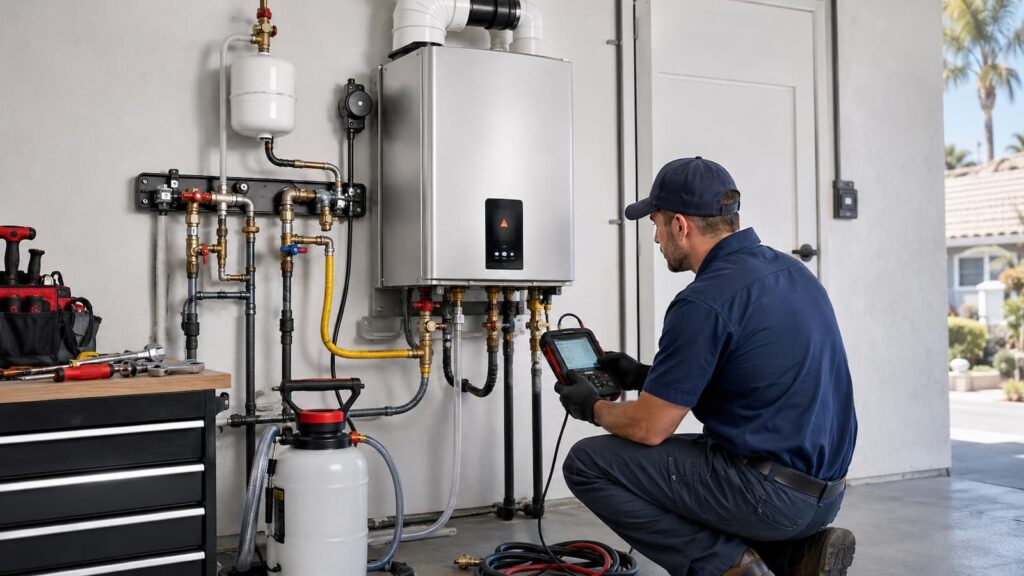
A tankless water heater can feel like a major upgrade when everything works correctly.
You turn on a shower, hot water arrives, and the system keeps producing it without the limits of a traditional storage tank. There is no large cylinder taking up space in the garage. There is less standby heat loss. The unit only heats water when there is demand. For many homes, especially homes where space matters or hot water use changes throughout the day, that can be a very practical setup.
But when a tankless water heater starts acting up, the symptoms can be confusing. One day the water is hot. The next day it is lukewarm. One shower works fine, but two fixtures running at once cause the temperature to drop. The unit flashes an error code that disappears before you can look it up. The kitchen sink gets hot water, but the bathroom does not. Or the system seems completely dead even though the rest of the house has water and power.
That confusion happens because tankless water heaters are more sensitive to flow rate, venting, combustion, water quality, gas supply, electrical controls, filters, sensors, and maintenance than many homeowners realize. A storage tank may keep a reserve of hot water available even while it is struggling. A tankless unit has to detect flow, ignite or energize, modulate heat output, monitor safety conditions, and keep water moving through a heat exchanger in real time. When one part of that process is off, the symptom may show up as no hot water, an error code, short bursts of hot and cold water, or a unit that shuts down under demand.
This guide breaks down the most common tankless water heater problems homeowners run into: no hot water, temperature swings, error codes, low flow, mineral scale, ignition trouble, venting issues, frozen or restricted lines, and sizing problems. It also explains what you can safely check before calling a plumber, what usually requires professional diagnosis, and when repair, maintenance, or replacement may make more sense. If your system already needs hands-on help, Smart Plumbing USA provides professional water heater repair in Vista, CA, including service for tankless systems that are not heating properly, showing faults, or struggling to keep up with household demand.
How a tankless water heater is supposed to work
Before troubleshooting symptoms, it helps to understand the basic sequence. A tankless water heater does not keep a large volume of hot water stored and ready. Instead, it heats water as it passes through the unit. When you open a hot water fixture, cold water flows into the heater. A flow sensor detects movement. The control board confirms that the flow is high enough to activate the unit. Then the heater begins producing heat through either a gas burner and heat exchanger or electric heating elements, depending on the model.
From there, the unit modulates its output. That means it tries to adjust the amount of heat based on how much water is flowing and what outlet temperature has been selected. If one bathroom sink is running, the heater may use a lower firing rate. If two showers and a washing machine are demanding hot water at the same time, the unit has to work much harder. A properly sized and properly maintained tankless water heater can handle that demand within its design limits. If the demand exceeds those limits, or if the system cannot safely fire, the water temperature can drop or the unit may shut down.
This is why tankless problems can appear to be intermittent. The heater may work fine at one fixture because the flow and temperature rise are manageable. It may fail when several fixtures run together because the required output is much higher. It may work in warm weather but struggle more in winter because incoming water is colder and the heater must add more heat to reach the same set temperature. It may also behave differently after years of mineral scale buildup because the heat exchanger can no longer transfer heat as efficiently.
In other words, a tankless water heater is not just “on” or “off.” It is constantly responding to conditions. That is why the details matter: how much water is flowing, how cold the incoming water is, how clean the heat exchanger is, whether filters are clogged, whether gas pressure is stable, whether venting is clear, and whether the unit was sized correctly for the home.
Problem 1: No hot water at all
No hot water is the most obvious tankless complaint, but it does not always mean the heater has failed. The first question is whether the unit is receiving everything it needs to operate: water flow, power, gas or electrical capacity, and a clear safety path for combustion or venting.
If the unit display is blank, start with power. Many gas tankless water heaters still need electricity for the control board, fan, ignition, sensors, and display. If a breaker has tripped, a GFCI outlet has reset, a service switch is off, or the unit has lost power, a gas-fired tankless heater will not run even if the gas supply is available. Electric tankless heaters are even more dependent on proper electrical supply because they use high-amperage circuits to heat the water directly.
If the display is on but no hot water is produced, the unit may not be detecting enough flow to activate. Tankless systems usually require a minimum flow rate before they fire. That minimum varies by model, but the general idea is simple: if the water demand is too low, the unit may not recognize it as a valid hot water call. This can happen at low-flow faucets, partially closed valves, fixtures with clogged aerators, showerheads with mineral buildup, or a system with a dirty inlet filter.
Gas supply can also cause a no-hot-water condition. A gas tankless water heater needs enough fuel volume and pressure to ignite and sustain combustion, especially under higher demand. If a gas valve is closed, the gas line is undersized, another appliance is competing heavily, or the regulator is not delivering stable pressure, the unit may fail to ignite or may shut down shortly after trying. This is not something homeowners should guess at or adjust on their own. Gas-related issues require proper testing and safe diagnosis.
Another possibility is that the unit is locked out by a safety condition. Tankless water heaters monitor flame, temperature, exhaust, air supply, water flow, and internal components. If the system detects unsafe operation, it may stop heating and display an error code. That code is not just a nuisance. It is the heater’s way of telling you which part of the process failed.
Safe homeowner checks include confirming that power is on, the water valves are open, the gas valve has not been accidentally turned off, the remote controller or display is active, and hot water fixtures have enough flow. If those basics look normal and the unit still will not produce hot water, the issue is usually beyond simple troubleshooting.
Problem 2: Hot water starts, then suddenly turns cold
A tankless water heater that starts hot and then turns cold is often more frustrating than one that does not work at all. The system clearly can produce hot water, but it cannot maintain it. That points to a different set of causes.
One common cause is a drop below the activation flow rate. For example, a person may turn down a shower handle slightly after the water gets too hot. That reduction may lower the hot water flow enough that the heater no longer detects adequate demand. The burner shuts off. Cold water then begins moving through the line. The user turns the handle hotter, the unit fires again, and the cycle repeats. This can feel like the heater is randomly changing temperature, but the real problem is unstable flow through the unit.
Another cause is an overloaded unit. Tankless water heaters are rated by how many gallons per minute they can heat at a specific temperature rise. Temperature rise means the difference between incoming water temperature and the desired outlet temperature. If incoming water is 55 degrees and you want 120-degree water, the unit must add 65 degrees of heat. If several fixtures are running at once, the heater may not be able to provide that much temperature rise at that flow rate. The result is lukewarm water or water that cools under heavy use.
Mineral scale can create the same symptom. Scale acts like insulation inside the heat exchanger. Instead of heat transferring efficiently into the water, the unit has to work harder. It may overheat internally, reduce output, trigger safety limits, or fail to maintain the set temperature. In hard-water areas, scale buildup is one of the most important tankless maintenance concerns because the heat exchanger passages are narrow and depend on clean water flow.
There may also be a plumbing crossover issue. A crossover happens when cold water enters the hot water side somewhere in the plumbing system, often through a failing mixing valve, single-handle faucet cartridge, shower valve, or recirculation setup. The tankless unit may be making hot water correctly, but cold water is blending into the hot side before it reaches the fixture. This can be hard to identify without testing because the heater may appear to be the problem even though the mixing is happening elsewhere.
When hot water starts strong and then fades, pay attention to the pattern. Does it happen only at one shower? Does it happen only when another fixture is running? Does it happen after a few minutes every time? Does the unit show an error code? Those details help separate fixture problems, sizing problems, maintenance problems, and heater faults.
Problem 3: Temperature swings during showers
Temperature swings are one of the most common complaints with tankless systems. The water may alternate between hot, warm, and cool, especially during showers. Sometimes the heater is blamed immediately, but the real cause can be the heater, the shower valve, the plumbing layout, the water flow, or the way the system was installed.
The first thing to understand is that a tankless water heater needs consistent flow to maintain consistent heat. If someone opens a faucet, starts the dishwasher, runs a washing machine, or flushes a toilet while a shower is in use, the hot and cold balance can change. Pressure-balanced shower valves are designed to react to pressure changes, but older or failing valves may not respond smoothly. A tankless heater also has to adjust its firing rate as flow changes. If flow fluctuates rapidly, the outlet temperature can fluctuate too.
Low-flow fixtures can make this worse. A very restrictive showerhead may save water, but if it lowers hot water demand close to the minimum activation rate, the unit can cycle on and off. This does not mean every low-flow fixture is incompatible with tankless heating. It means the fixture, valve, and heater need to work together within the unit’s operating range.
Another issue is set temperature. Many homeowners set a tankless water heater too high and then mix in a lot of cold water at the shower. This can reduce hot-side flow through the heater. In some homes, setting the heater to a reasonable safe temperature and using less cold-water mixing can create more stable operation. However, temperature settings should always be handled with scald safety in mind, especially in homes with children, older adults, or vulnerable occupants.
Scale buildup can also cause temperature instability. When the heat exchanger is coated, the unit may have trouble reading and controlling outlet temperature accurately. It may overshoot, undershoot, or reduce firing to protect itself. If temperature swings have developed gradually over time, and the unit has not been flushed or serviced regularly, maintenance should be near the top of the suspect list.
Finally, consider whether the problem happens at every fixture or only one. If all fixtures experience temperature swings, the heater, water quality, gas supply, or system design is more likely involved. If only one shower is affected, the shower cartridge or mixing valve may be the real issue.
Problem 4: Error codes on the tankless water heater
Error codes are helpful, but they can also be misleading if they are treated as a final diagnosis. A code tells you what the unit detected. It does not always tell you why it happened. For example, an ignition failure code may be caused by gas supply, a dirty flame rod, venting trouble, condensate problems, improper combustion, a control issue, or a failing component. The code narrows the search, but it does not replace proper testing.
Common tankless water heater error categories include ignition failure, flame loss, overheating, exhaust or venting problems, fan motor issues, temperature sensor faults, flow sensor problems, scale warnings, freeze protection alerts, and communication errors between the unit and controller. The exact code numbers vary by manufacturer, so homeowners should always check the model-specific manual rather than assuming a code means the same thing across all brands.
Some codes are urgent. Anything related to combustion, venting, flame failure, exhaust temperature, or gas supply should be taken seriously. A gas tankless water heater depends on safe air intake and exhaust removal. If the unit cannot vent properly or cannot confirm proper combustion, it should not be forced to keep running. Repeatedly resetting a tankless water heater without addressing the cause can turn a repairable issue into a safety concern.
Other codes may point to maintenance. Some units display service reminders or scale-related alerts after a certain number of operating hours or when performance suggests restricted flow. These warnings are especially important for homes with hard water because mineral buildup can shorten the life of the heat exchanger, reduce efficiency, and cause more frequent shutdowns.
When you see an error code, write it down or take a photo before resetting the unit. Also note what was happening when it appeared. Was someone taking a shower? Were multiple fixtures running? Was it raining or windy outside? Did the code appear after a power outage? Did it happen only in cold weather? Those details can make diagnosis much faster.
A one-time code after a temporary interruption may not always indicate a major failure, but repeated codes should not be ignored. If the same fault keeps returning, the system is telling you that something is outside normal operating conditions.
Problem 5: Low hot water flow
Low hot water flow can make a tankless system behave poorly even when the heater itself is capable of working. Because flow is what activates and regulates the unit, restrictions on the hot water side can cause weak output, delayed heating, short cycling, or inconsistent temperature.
One of the simplest causes is a clogged fixture aerator or showerhead. Mineral deposits, sediment, and debris can collect at the fixture and reduce flow. If one faucet has weak hot water but other fixtures work normally, start by checking that fixture. A partially blocked aerator can make it seem like the water heater is failing when the restriction is actually at the faucet.
If several fixtures have weak hot water, the restriction may be closer to the heater. Tankless units often have an inlet water filter or screen that catches debris before it enters the heat exchanger. If that filter clogs, the unit may receive less water than it needs. In some cases, the heater may still fire but not perform well. In others, it may fail to activate consistently.
Scale buildup inside the heat exchanger is another major cause of restricted flow. Hard water minerals can accumulate in the narrow passages where water is heated. As the passage narrows, flow drops and heat transfer suffers. This can lead to longer wait times, lower output, temperature swings, and error codes. It can also increase stress on the unit because the heater is trying to do the same job with less effective water movement.
Valves matter too. If isolation valves near the heater are not fully open, if a service valve was left partially closed after maintenance, or if an old shutoff valve is failing internally, hot water flow may be reduced. This is one reason a good tankless installation includes accessible, properly oriented service valves. They make maintenance easier and reduce the chance of accidental restrictions.
If low flow appeared suddenly after plumbing work, maintenance, a water outage, or debris in the system, a clogged filter or partially closed valve becomes more likely. If it developed slowly over months or years, scale buildup or fixture restrictions are more likely.
Problem 6: Mineral scale and hard water buildup
Scale is one of the most important tankless water heater problems because it can quietly damage performance before homeowners notice obvious symptoms. Unlike a storage tank, where sediment settles at the bottom, a tankless unit runs water through a compact heat exchanger. That heat exchanger has narrow passages and depends on efficient heat transfer. Mineral deposits interfere with both.
Hard water contains dissolved minerals, especially calcium and magnesium. When water is heated, those minerals can come out of solution and form scale on hot surfaces. Inside a tankless water heater, scale can coat the heat exchanger. The thicker the scale layer becomes, the harder it is for heat to transfer into the water. The heater may run hotter internally while delivering less stable hot water at the fixtures.
Common signs of scale-related tankless problems include reduced hot water flow, longer time to get hot water, temperature swings, rumbling or unusual operating noise, reduced efficiency, repeated overheating faults, and error codes that appear under heavier demand. In some cases, the system still works, but it feels weaker than it used to. That slow decline is why scale problems are often overlooked until maintenance is overdue.
Routine flushing is the standard maintenance step for removing mineral buildup before it becomes severe. The process usually involves isolating the heater, connecting hoses to the service ports, circulating a descaling solution through the heat exchanger, then flushing the unit with clean water. This is not the same as simply running hot water through the system. Proper service uses the tankless isolation valves and circulates solution directly through the heater.
How often a tankless water heater should be flushed depends on water hardness, usage, manufacturer recommendations, and whether the home has water treatment. In hard-water homes, annual service is commonly recommended, and some systems may benefit from more frequent attention. If hard water is already creating scale on fixtures, shower glass, faucets, or appliances, it may also be affecting the tankless heater. For homes dealing with mineral buildup, a properly selected water softener installation in Vista, CA can help protect plumbing fixtures and water-heating equipment over the long term.
The key point is that scale is not just a comfort issue. It can shorten equipment life. A tankless water heater is a high-performance appliance, and it needs clean internal water passages to perform the way it was designed.
Problem 7: The unit is too small for the home
Some tankless water heater problems are not repair problems at all. They are sizing problems. A unit can be installed correctly and still fail to meet household demand if it was not sized for the way the home actually uses hot water.
Tankless capacity is commonly discussed in gallons per minute, but that number only makes sense when paired with temperature rise. A heater that can deliver a certain flow rate at a 35-degree temperature rise will deliver less flow at a 65-degree temperature rise. That matters because incoming water temperature changes by region and season. The colder the incoming water, the harder the heater must work to reach the same outlet temperature.
Household habits matter just as much. A small household with one shower running at a time may be satisfied with a smaller unit. A larger home with multiple bathrooms, a soaking tub, a dishwasher, laundry use, and overlapping morning routines may need significantly more capacity. If the heater is undersized, the most common symptom is not total failure. It is hot water that works under light use but becomes lukewarm when demand increases.
Undersizing can also show up as user frustration. People may blame the heater because it works “sometimes,” when the real issue is that the home is asking more from the unit than it can provide. This is especially common when a traditional tank is replaced with a tankless unit without carefully calculating fixture demand, flow rates, and temperature rise.
Correct sizing is one reason tankless installation should not be treated as a simple appliance swap. Venting, gas line capacity, electrical requirements, condensate management, service access, water quality, and household demand all matter. If you are considering replacing an older water heater or upgrading to tankless, professional tankless water heater installation in Vista, CA can help ensure the unit is matched to the home rather than selected only by brand or price.
If your current tankless water heater has always struggled during simultaneous use, sizing should be part of the diagnosis. If it used to perform well and now struggles, maintenance, scale, flow restrictions, or component issues may be more likely.
Problem 8: Ignition failure or flame loss
Gas tankless water heaters rely on safe and consistent ignition. When ignition fails, the unit may try to fire, shut down, and display an error code. When flame loss occurs, the burner may ignite but fail to stay lit. These are not problems to ignore or repeatedly reset without diagnosis.
Ignition and flame problems can come from several sources. The gas valve may be closed. Gas pressure may be inadequate. The gas line may be undersized for the heater’s demand. The igniter may be dirty or failing. The flame rod may not be sensing combustion correctly. The burner may need cleaning. Venting may be restricted. The unit may not be receiving enough combustion air. There may also be a control board or wiring issue.
One important detail is that tankless water heaters often have higher instantaneous gas demand than traditional tank-style heaters. A storage tank heats water more gradually. A gas tankless unit may need a large amount of fuel quickly when multiple fixtures call for hot water. If the gas supply system was not evaluated during installation, ignition and performance problems can appear under load.
Another detail is maintenance. Dust, insects, corrosion, and combustion residue can affect burners and sensors over time. Outdoor units may face exposure-related problems. Indoor units depend heavily on proper venting and air supply. Either way, combustion components should be inspected and serviced by someone who knows the equipment and can test it safely.
If you smell gas, stop using the appliance and follow appropriate safety steps immediately. Do not attempt to relight, open the unit, or troubleshoot gas components yourself. Gas-related tankless problems require professional service.
Problem 9: Venting or air intake restrictions
Gas tankless water heaters need a safe path for combustion air and exhaust. If air intake or venting is restricted, the unit may shut down, run poorly, or display a code related to combustion, fan speed, exhaust temperature, or airflow.
Venting problems can be caused by improper installation, incorrect pipe material, wrong slope, excessive vent length, too many elbows, blocked terminations, wind effects, debris, bird nests, condensate issues, or corrosion. Condensing tankless units also produce acidic condensate that must be drained correctly. If condensate cannot drain, the unit may shut down or develop operational problems.
Outdoor tankless units avoid some venting requirements, but they still need clear air movement and protection from improper enclosure, debris, and environmental exposure. Indoor units are more dependent on correctly installed intake and exhaust piping. A small venting mistake can create repeat error codes that look like heater failure when the root cause is installation or airflow.
Homeowners can safely check whether the visible exterior termination appears blocked by leaves, debris, or obvious obstructions. However, venting design and combustion performance should be evaluated professionally. Do not modify vent pipes, remove panels, or bypass safety controls. The unit is shutting down for a reason, and that reason needs to be understood before it is reset again.
Problem 10: Delayed hot water
Many homeowners install a tankless water heater expecting instant hot water. That expectation can lead to disappointment because “tankless” does not always mean “instant at the faucet.” A tankless unit heats water on demand, but the hot water still has to travel through the pipes from the heater to the fixture.
If the heater is far from the bathroom, the first water coming out of the tap is the cooled water sitting in the hot water line. That water must be pushed out before freshly heated water arrives. This delay is a plumbing layout issue, not necessarily a heater problem.
Tankless systems may also have a slight startup delay because the unit must detect flow, begin heating, and stabilize output. That delay is usually brief, but it can add to the wait created by long pipe runs. In large homes, the distance between the water heater and fixtures can make a noticeable difference.
A recirculation system can reduce wait times, but it must be designed properly. Some tankless water heaters have built-in recirculation features. Others require compatible external pumps and controls. Poorly designed recirculation can increase energy use, create crossover problems, or interfere with tankless operation. This is another area where the system should be planned around the home rather than added casually.
If hot water takes a long time to arrive but is stable once it gets there, the heater may be working normally. If hot water takes a long time and then fluctuates, the issue may involve flow, scale, sizing, or controls.
Problem 11: The “cold water sandwich” effect
The cold water sandwich is a classic tankless complaint. It usually happens when hot water is used, stopped briefly, and then used again. A slug of cool water can appear between warm sections of water, creating an unexpected cold burst at the fixture.
Here is the basic reason it happens. When the first hot water draw ends, some hot water remains in the pipe. The tankless unit shuts down because demand has stopped. When hot water is requested again soon after, the leftover warm water may reach the fixture first, followed by cooler water that entered the line while the heater was starting back up, followed by newly heated water. That middle cool section is the “sandwich.”
Not every tankless system produces a noticeable cold water sandwich, and newer units often manage it better than older models. The severity depends on the heater, flow rate, pipe distance, recirculation setup, and user behavior. It is often more noticeable during stop-and-start showering or when hot water is turned on and off repeatedly.
If the cold burst is brief and only happens during rapid on-off use, it may be a normal tankless characteristic. If the water repeatedly turns cold during steady use, that is a different problem and should be investigated as temperature instability, flow loss, scale, or a heater shutdown.
Problem 12: The tankless heater shuts off during heavy demand
A tankless water heater that shuts down during heavy demand may be protecting itself. High demand pushes the system hardest. That is when gas supply limitations, venting restrictions, scale buildup, flow restrictions, overheating, and undersizing become most obvious.
For example, one shower may not reveal a gas supply problem. Two showers and a dishwasher might. A mildly scaled heat exchanger may still produce hot water for a bathroom sink. It may overheat or fault when asked to heat a much higher flow rate. A borderline venting issue may only trigger shutdown when the burner is firing at a higher rate and exhaust volume increases.
Heavy-demand shutdowns should be documented carefully. Note how many fixtures were running, whether the unit displayed a code, whether hot water returned after resetting, and whether the problem is getting more frequent. A pattern that appears only under load gives important diagnostic clues.
Do not simply raise the temperature setting to compensate. If the heater is already struggling, asking it to produce hotter water can increase the temperature rise and make the problem worse. The better approach is to identify whether the unit is undersized, restricted, scaled, or being limited by fuel, electrical, or venting conditions.
What homeowners can safely check before calling a plumber
Some tankless water heater checks are safe and useful for homeowners. Others should be left to a professional. The goal is not to take the unit apart. The goal is to gather clear information and rule out simple issues.
Start with the display. Is it on? Is there an error code? Does the code appear only during certain conditions? Take a photo of the code before resetting anything. If the display is blank, check whether the unit has power. Look for a tripped breaker, reset GFCI, or switched-off service outlet if accessible and safe.
Next, check whether the problem affects every fixture or only one. If one bathroom faucet has poor hot water but the kitchen works normally, the issue may be the fixture, cartridge, aerator, or local piping. If the whole house has no hot water, the heater or its supply conditions are more likely involved.
Check whether hot water flow is strong enough. Remove and clean a clogged aerator if the issue is limited to one faucet. Make sure showerheads are not heavily blocked by mineral deposits. Look near the heater to confirm that service valves appear open, but do not force old valves. A stuck or corroded valve can break and create a leak.
If the unit is gas-fired, confirm that the gas valve has not been accidentally turned off, but do not adjust gas pressure, open gas components, or attempt combustion repairs. If you smell gas, stop and follow safety procedures immediately.
Also consider recent events. Did the problem start after a water outage, power outage, plumbing repair, filter change, freezing weather, heavy wind, or maintenance visit? Did someone change the temperature setting? Did a new showerhead, washing machine, or appliance get installed? Changes like these often explain sudden performance problems.
Useful information to write down includes the brand and model, age of the unit, error code, symptoms, affected fixtures, maintenance history, water hardness concerns, and whether the problem happens under light use or heavy demand. That information can save time during diagnosis.
What usually requires professional diagnosis
Tankless water heaters are not appliances where every problem should be handled with DIY trial and error. Many issues involve gas, electricity, combustion, venting, internal sensors, heat exchangers, control boards, and manufacturer-specific diagnostic procedures.
Professional diagnosis is especially important when the unit has repeated ignition failures, flame loss, combustion or venting codes, overheating faults, frequent shutdowns, water leaks inside or below the unit, signs of corrosion, unusual noises, electrical faults, or persistent temperature problems that affect the whole house.
A plumber or qualified technician can test flow rate, inspect filters, evaluate scale buildup, check error history, confirm proper venting, verify gas supply conditions, flush the heat exchanger, inspect service valves, test temperature output, and determine whether the problem is inside the heater or elsewhere in the plumbing system. That distinction matters. Replacing parts in the heater will not fix a crossover through a shower valve. Flushing the heat exchanger will not fix an undersized gas line. Raising the temperature will not fix a restricted inlet filter.
If the unit is newer, diagnosis may also protect warranty coverage. Many manufacturers have specific maintenance requirements, installation requirements, and approved service procedures. Guessing or bypassing safety controls can create more expensive problems later.
For urgent issues such as active leaks, repeated shutdowns, no hot water during essential use, or suspected gas-related problems, it is better to get help promptly rather than keep resetting the unit. If the situation cannot wait, Smart Plumbing USA also provides emergency plumbing service in Vista, CA for problems that need fast attention.
Repair, maintenance, or replacement: how to think about the next step
Not every tankless water heater problem means the unit needs to be replaced. In many cases, maintenance or a targeted repair is enough. The right decision depends on the age of the heater, condition of the heat exchanger, maintenance history, error pattern, repair cost, parts availability, and whether the unit was properly sized and installed in the first place.
Maintenance makes sense when the symptoms point to scale, restricted filters, neglected service, or gradual performance decline. A flush, filter cleaning, inspection, and system check can restore performance if the unit is still in good condition. This is especially true when the heater has not been serviced regularly but has no major internal damage.
Repair makes sense when a specific component has failed and the rest of the system is healthy. Sensors, igniters, flame rods, fans, valves, controls, and other parts may be serviceable depending on the model. The key is confirming the actual cause rather than replacing parts based only on symptoms.
Replacement becomes more reasonable when the unit is older, the heat exchanger is damaged or heavily scaled, repair costs are high, the system was undersized from the beginning, parts are difficult to obtain, or installation defects make continued repairs inefficient. A replacement may also be the better long-term choice if household demand has changed and the current unit no longer fits the home.
If the unit has had repeated service calls, recurring error codes, ongoing temperature complaints, and poor maintenance history, it is worth stepping back and looking at the whole system. Sometimes the smarter investment is not another small repair, but correcting the underlying sizing, water quality, venting, or installation issue.
How to prevent tankless water heater problems
The best tankless water heater repairs are the ones you never need. Preventive care matters because tankless systems are compact, high-output appliances with sensitive internal components. They can last a long time, but they do not respond well to neglect, poor water quality, improper installation, or repeated operation outside their design limits.
The most important preventive step is regular flushing and service. If your home has hard water, annual flushing is often a practical baseline. In some homes, more frequent maintenance may be appropriate. During service, the inlet filter should be checked, the heat exchanger should be flushed when needed, visible connections should be inspected, and the unit should be checked for proper operation.
Water quality should not be ignored. If hard water leaves white scale on shower glass, faucets, and appliances, it can also affect the water heater. Water treatment may reduce scale formation and help protect the system. This is especially important for tankless units because scale can affect both efficiency and safety controls.
Homeowners should also avoid pushing the system beyond its capacity. If the heater was sized for two simultaneous fixtures, do not expect it to perform like a commercial boiler during multiple showers, laundry, dishwashing, and a large tub fill all at once. Understanding the unit’s real capacity helps prevent unrealistic expectations and reduces complaints that are actually demand-related.
Finally, pay attention to early symptoms. Slightly longer hot water wait times, occasional temperature dips, reduced flow, new noises, or intermittent error codes are easier to address before the unit reaches full shutdown. A tankless water heater often gives hints before it fails completely. Listening to those hints can prevent a no-hot-water emergency later.
A simple symptom guide for tankless water heater problems
If you are trying to make sense of what your tankless system is doing, the pattern of symptoms is often more useful than one isolated detail.
- No display, no operation: check power, breaker, GFCI, or service switch before assuming the heater has failed.
- Display on, but no hot water: possible low flow, closed valve, ignition issue, gas supply problem, sensor fault, or safety lockout.
- Hot water at one fixture but not another: possible fixture restriction, cartridge issue, crossover, or local plumbing problem.
- Water starts hot then turns cold: possible flow drop, overloaded unit, scale buildup, ignition loss, or temperature control issue.
- Temperature swings during shower: possible low-flow fixture, shower valve problem, scale buildup, changing demand, or unstable heater operation.
- Low hot water flow throughout the house: possible clogged inlet filter, scale buildup, partially closed valve, or restriction near the heater.
- Error code during heavy use: possible gas supply limitation, venting issue, overheating, scale, or undersized unit.
- Long wait for hot water but stable temperature after arrival: likely pipe distance or recirculation design rather than a heating failure.
- Brief cold burst after stopping and restarting hot water: possible cold water sandwich effect.
- Repeated codes after resets: professional diagnosis is recommended rather than continuing to reset the unit.
This guide is not a replacement for proper service, but it can help you describe the problem accurately. The more precise the symptom, the easier it is to find the cause.
Frequently Asked Questions
A tankless water heater may have no hot water because of lost power, low water flow, a closed valve, ignition failure, gas supply trouble, an error-code lockout, a clogged inlet filter, or a failed internal component. If basic checks do not reveal the issue, professional diagnosis is usually the safest next step.
Hot-and-cold swings can be caused by unstable flow, a low-flow showerhead, a failing shower valve, scale buildup inside the heat exchanger, an overloaded unit, or a tankless heater that is shutting down and restarting. If it happens at only one shower, the shower valve or fixture may be the issue. If it happens throughout the home, the heater or system conditions are more likely involved.
A single reset may clear a temporary interruption, but repeated resets are not a fix. Take a photo of the error code and note when it appeared. If the same code returns, especially codes related to ignition, flame loss, overheating, or venting, the unit should be inspected before it is used repeatedly.
Flushing frequency depends on water hardness, usage, and the manufacturer’s recommendations. In many hard-water homes, annual flushing is a practical baseline. Homes with very hard water or heavy hot water use may need more frequent maintenance.
Yes. Hard water can leave mineral scale inside the heat exchanger. Scale reduces heat transfer, restricts flow, causes temperature instability, increases stress on the unit, and may lead to error codes or premature failure if maintenance is ignored.
Tankless water heaters heat on demand, but hot water still has to travel from the unit to the fixture. Long pipe runs can create a delay. The heater may also have a short startup delay while it detects flow and begins heating. If the temperature is stable once hot water arrives, the delay may be a plumbing layout issue rather than a heater failure.
Yes. If the unit is undersized, it may work during light use but struggle when multiple fixtures run at the same time. Sizing depends on flow rate, incoming water temperature, desired outlet temperature, and household hot water habits.
Call a plumber if there is no hot water after basic checks, repeated error codes, ignition or flame problems, suspected gas or venting issues, active leaks, low hot water flow throughout the home, or temperature swings that do not resolve with simple fixture checks.
Final thoughts
Tankless water heater problems are frustrating because the symptoms often overlap. No hot water may come from power, gas, flow, ignition, or a safety fault. Temperature swings may come from the heater, the shower valve, scale buildup, low flow, or an undersized unit. Error codes may point toward the right system, but they still need proper interpretation.
The best way to approach the problem is to look at the pattern. Does it happen at one fixture or throughout the house? Did it start suddenly or gradually? Does it happen only during heavy demand? Is there an error code? Has the unit been flushed recently? Is hard water an issue in the home? Those answers usually tell you whether the problem is likely simple, maintenance-related, installation-related, or a true equipment fault.
A tankless water heater can be a great system, but it is not maintenance-free. It needs clean water flow, proper sizing, safe venting, stable fuel or electrical supply, and regular service. If your unit is showing repeated codes, losing hot water, swinging temperatures, or struggling to keep up, it is better to diagnose the cause early than wait for a complete no-hot-water situation.