
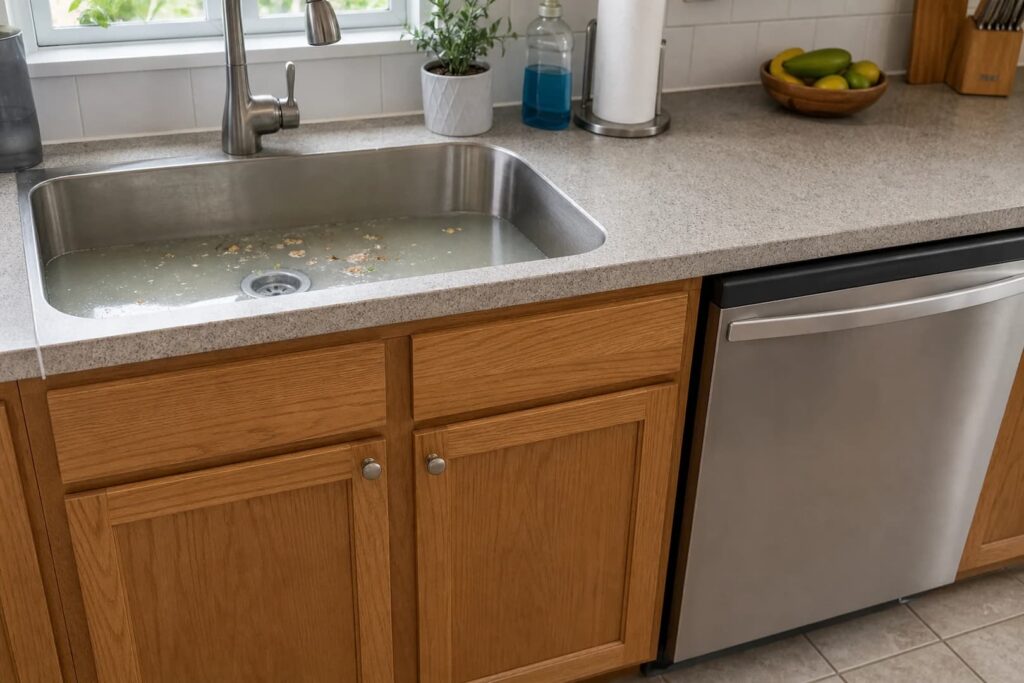
A dishwasher backing up into the kitchen sink usually means the dishwasher can pump water out, but the shared sink drain cannot carry that water away fast enough.
Most residential dishwashers do not have a completely separate drain to the sewer. A flexible hose carries discharge to a countertop air gap or high loop, then into the garbage disposal or a branch tailpiece under the sink. From there, dishwasher water uses the same P-trap and kitchen branch drain as the sink. A restriction anywhere after that connection can make cloudy water rise in the basin during the drain cycle.
Stop the dishwasher if the sink is filling. Do not run the disposal while utensils, glass, or your hands are in the backed-up water. Keep water away from under-sink outlets and cords, and do not pour chemical drain cleaner into a sink connected to a disposal or dishwasher. The cause may be a simple blocked air gap, but it may also be grease in the P-trap, a clogged disposal outlet, a new disposal with its knockout plug still installed, or a restriction deeper in the kitchen branch.
The fastest diagnosis follows the water path from the appliance to the wall, checking where normal flow stops. Smart Plumbing USA provides kitchen drain cleaning in Vista and professional garbage disposal repair and installation when the problem involves the disposal connection.
What “dishwasher backing up into the sink” can mean
Homeowners use the phrase for two related but different symptoms. In the first, the dishwasher drains and water rises in the sink. In the second, dirty sink water moves backward into the dishwasher between cycles. Both involve the shared drain path, but the likely checks are not identical.
| What happens | Likely area to check | Why |
|---|---|---|
| Sink fills only while dishwasher pumps out | Disposal outlet, P-trap, or kitchen branch | Pumped water reaches a restriction downstream |
| Water comes from the countertop air gap | Air-gap outlet hose or disposal inlet | The path after the air gap is blocked or kinked |
| New dishwasher cannot drain into a new disposal | Disposal dishwasher-inlet knockout plug | The factory plug may not have been removed |
| Dirty sink water appears inside idle dishwasher | High loop or air gap, check valve, hose routing | Backflow protection or drain routing may be inadequate |
| Both sink basins hold water even without dishwasher | P-trap or wall drain | The kitchen drain itself is clogged |
| Other rooms also back up | Shared building drain or main sewer | The problem is larger than the kitchen connection |
One symptom can involve two faults. A poorly routed hose may allow sink water to return to the dishwasher, while grease in the wall drain makes the sink slow. Fixing only the hose will not clean the branch, and clearing only the branch will not correct the backflow route.
What to do immediately
- Cancel or pause the dishwasher cycle. Use the appliance controls and allow the pump to stop.
- Do not add sink water. Turn off the faucet and avoid draining another basin into the blockage.
- Keep hands out of cloudy water near the disposal. Never reach into the disposal opening, even when the wall switch is off.
- Cut power before inspecting below the sink. Unplug the disposal or switch off the correct breaker if water is near electrical connections and you can do so without entering a wet area.
- Place a shallow pan under a minor drip. Do not loosen a trap full of chemical cleaner or hot wastewater.
- Remove standing water carefully. Scoop it into a container if needed; do not send it into another backed-up household drain.
Dishwasher discharge can be very hot. Cloudy water may also contain detergent, grease, food residue, and bacteria from the sink drain. Wear gloves and protect your eyes from splashes. Broken glass can hide below the surface, especially if a drinking glass cracked in the sink before the backup.
How dishwasher water reaches the sink drain
At the end of a wash or rinse stage, the dishwasher’s drain pump pushes water through a flexible hose. Depending on the local installation, the hose rises to a countertop air gap or forms a high loop secured near the underside of the counter. It then connects to a garbage disposal inlet or a special branch fitting above the sink trap.
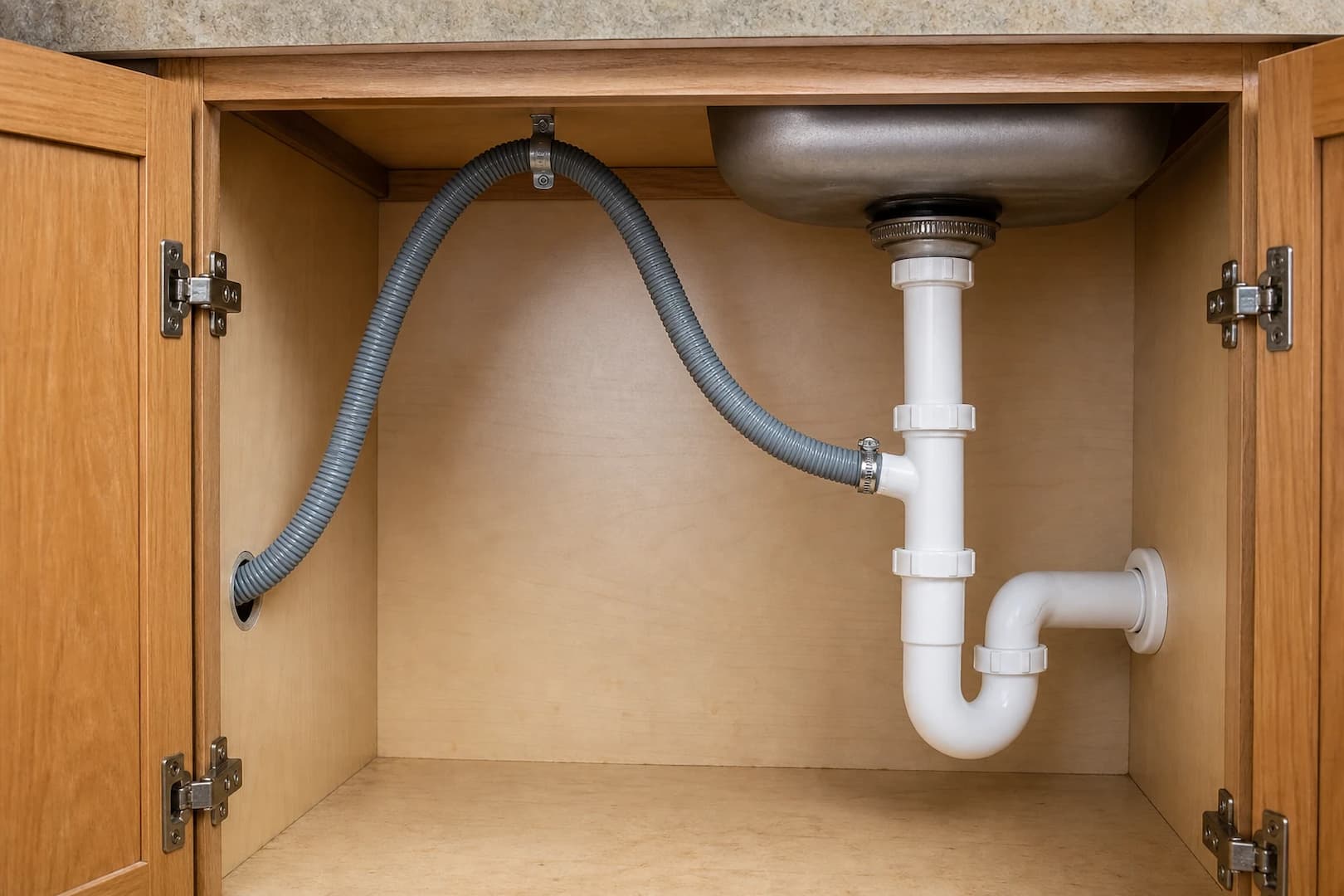
The air gap or high loop reduces the chance that sink wastewater will siphon or flow back into the dishwasher. It does not create extra drain capacity. Once water reaches the disposal or branch tailpiece, it still has to pass through the sink’s discharge piping, P-trap, trap arm, and wall drain.
The pump makes this symptom look sudden. A sink may drain acceptably under a thin faucet stream while the pipe is partly narrowed. Then the dishwasher releases a faster volume, the restricted line cannot keep up, and water rises in the basin for a minute. That is a capacity problem in the shared path, not proof that the dishwasher pump is too powerful.
Cause 1: the garbage disposal or its outlet is clogged
If the dishwasher hose connects to the disposal, discharge enters the disposal’s upper side and then leaves through the same outlet used by the sink. Food sludge, grease, fibrous scraps, coffee grounds, starch, or a jammed disposal can reduce that path. The disposal may spin normally while its outlet or downstream pipe remains clogged.
With the sink empty and power safely available, running the disposal briefly with cold water sometimes clears loose food already inside the chamber. Do not do this if the disposal hums, leaks, contains a foreign object, or sits under backed-up water with hidden glass. Never put a hand into the opening. If the unit does not sound normal, disconnect power and treat it as a separate problem.
A disposal that works but leaves both sides of a double sink full usually points downstream of the unit. The P-trap or wall drain cannot accept the combined flow. Grinding the same water repeatedly will not clear grease coating the branch.
Cause 2: the new disposal knockout plug was never removed
New garbage disposals ship with a solid plug inside the dishwasher inlet. The plug keeps the inlet sealed when no dishwasher is connected. During an installation that uses the inlet, the installer must knock out and remove that plug before attaching the hose.
The timing is the clue. If the dishwasher stopped draining immediately after a disposal replacement, while the sink and disposal otherwise drain normally, a retained knockout plug is a prime suspect. The dishwasher pump may run, the hose may swell or hold water, and little or no discharge reaches the disposal.
Correcting the issue requires disconnecting power, removing the hose, knocking the plug into the disposal, and retrieving it from the grinding chamber before use. Because this involves an appliance connection and the disposal interior, many homeowners prefer to have the installer return. Do not run the disposal with the loose plug inside.
Cause 3: the air gap is blocked
A countertop air gap is the small capped fitting near the faucet. Dishwasher water enters one passage, crosses an air break, then flows through a larger hose to the disposal or drain. Debris commonly collects in the outlet side or in the larger hose. When that path blocks, water may spill from the air-gap cap onto the sink deck.
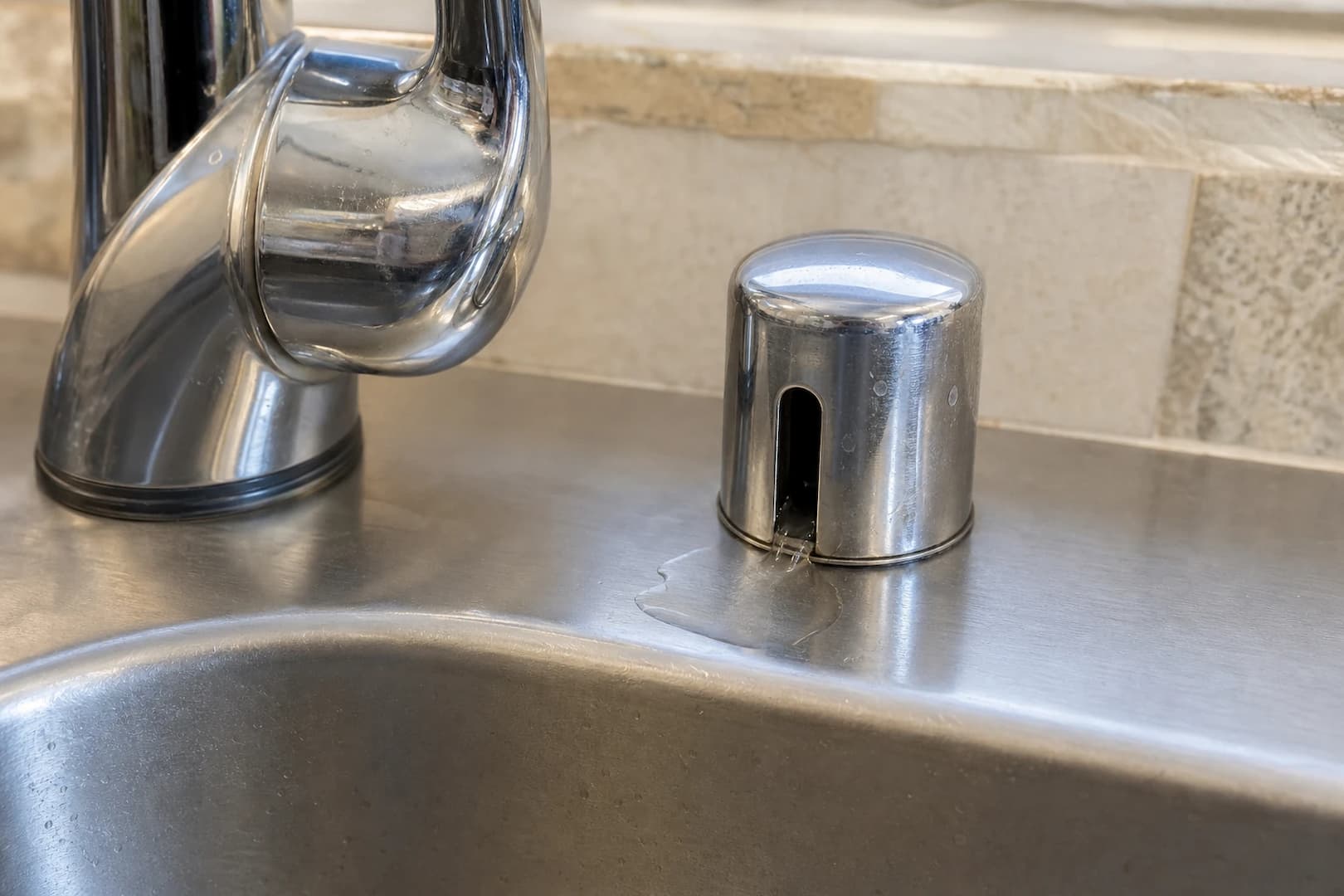
With the dishwasher off, the decorative cap usually lifts off for a visual check. Designs vary, so follow the appliance or fitting instructions. Remove visible debris gently; do not force a sharp object deep into the passages. If the top looks clear but water still exits there, the downstream hose may be kinked, clogged, or connected to a blocked disposal inlet.
An air gap that leaks continuously from the base rather than through its vents may be loose or damaged. That is a fitting leak, not merely a drain blockage, and the countertop connection should be repaired.
Cause 4: the hose is kinked, sagging, or installed without a high loop
A crushed or sharply kinked hose limits pumped flow. A hose that lies low across the cabinet can hold dirty water and make backflow more likely. Where a high-loop installation is used, the hose should rise as high as the appliance instructions and local requirements specify, stay secured, and descend without a pinch to its drain connection.
The hose should not be stretched tight against a disposal, folded behind a drawer, or routed where cabinet contents crush it. A long low sag also collects residue. Correcting the route may solve backflow or poor dishwasher drainage, but it will not clear a clogged P-trap or wall drain.
Some installations require an air gap rather than relying only on a high loop. Follow the dishwasher manufacturer’s instructions and applicable local plumbing requirements; do not remove an existing air gap simply because a loop looks neater.
Cause 5: the P-trap or kitchen branch is clogged
The P-trap is the curved section below the sink that holds water to block sewer gas. Grease, food particles, coffee grounds, and sludge can settle there or in the trap arm leading to the wall. If the sink drains slowly even when the dishwasher is off, or both basins fill together, the shared sink drain is the likely focus.
A removable slip-joint trap can sometimes be cleaned by a capable homeowner after power is disconnected and a bucket is placed below. Photograph the layout first, and expect the trap to contain dirty water. Do not loosen it if chemical cleaner is present, fittings are corroded, pipes are glued or misaligned, or the cabinet includes unsafe electrical conditions. A trap reassembled with a tilted washer or stressed joint can leak after the apparent clog is gone.
If the trap is clear and the wall pipe still holds water, the restriction is deeper in the kitchen branch. That is a better job for correctly sized drain-cleaning equipment than repeated plunging or chemicals.
Cause 6: the dishwasher filter, pump, or check valve has a problem
If the sink never receives dishwasher water, the problem may be inside the appliance. A clogged filter or sump can restrict water reaching the drain pump. Broken glass, labels, food, or a damaged impeller can affect the pump. A failed check valve can allow water to return after the pump stops.
Turn off power before removing the dishwasher filter, and follow the manual for that model. Clean only user-serviceable parts. Water standing below the filter can be normal in some designs; water covering the tub floor with an error or odor is different. If the pump hums, makes grinding noises, trips a breaker, or cannot evacuate water despite a clear hose and sink drain, appliance service may be needed rather than drain cleaning.
A safe troubleshooting order
- Stop the dishwasher and remove standing sink water safely.
- Check whether the sink drains normally without the dishwasher.
- Inspect and clean the user-serviceable dishwasher filter.
- Look for an overflowing countertop air gap.
- With power off, inspect the hose for a kink, low sag, loose clamp, or poor high-loop routing.
- Consider the disposal knockout plug if the problem began immediately after disposal replacement.
- Check the disposal and sink drain for a restriction without putting a hand into the unit.
- Call a plumber or appliance technician based on where normal flow stops.
Do not test after every step with a full wash cycle. Once the likely drain path is clear, use the dishwasher’s cancel/drain function while watching the sink and air gap. Stop immediately if the basin rises. A controlled short test limits the amount of water available for another overflow.
Why chemical drain cleaner is a poor choice here
Chemical cleaner may sit in the sink, disposal, trap, or dishwasher hose when the line cannot drain. The dishwasher pump can move or splash that solution. Anyone who later removes the P-trap or hose may be exposed. Some products can damage seals, corrode metal, or react dangerously with another cleaner.
It also cannot remove a disposal knockout plug, repair a kinked hose, correct an absent high loop, or fix a failing pump. Mechanical cleaning and direct inspection match the likely faults far better.
When to call a plumber and when to call appliance service
Call a plumber when the sink itself is slow, both basins back up, the disposal outlet or P-trap is clogged, the wall drain holds water, under-sink connections leak, or other household drains are affected. A plumber can isolate the kitchen branch, clean the line, correct the drain assembly, and verify that the dishwasher discharge has an open route.
Call appliance service when the sink and hose route are clear but the dishwasher pump does not run, grinds, reports a persistent drain error, leaks from the appliance base, or leaves water because of an internal pump or control fault. Some plumbers also handle dishwasher connections, but internal appliance diagnosis may require a technician familiar with the model.
If the problem began after an installation, contact the installer first. A retained disposal plug, pinched hose, missing clamp, or incorrect route can often be traced directly to that work. Do not accept repeated sink backups as normal break-in behavior.
How to prevent dishwasher drain backups
Scrape plates into the trash before loading. The dishwasher filter is meant to catch residue, not a meal’s worth of scraps. Clean the filter at the interval in the appliance manual and remove labels that can loosen from jars or containers.
Keep grease out of the sink and disposal. It cools inside the branch and catches food particles. Feed only small, appropriate scraps through the disposal with cold water, and pay attention when the sink starts draining more slowly after meals. Early kitchen drain cleaning is easier to contain than a dishwasher pump discharge into a full basin.
Do not store bottles or bins where they crush the dishwasher hose. Check the air-gap cap if water appears around it, and preserve the high loop or required air gap during cabinet work. After a disposal replacement, verify that the dishwasher drains before the installer leaves.
Frequently Asked Questions
The dishwasher pump is sending water into a shared sink drain that cannot carry the flow. The restriction may be in the disposal outlet, P-trap, trap arm, or kitchen branch line.
The outlet side of the air gap, the larger hose to the disposal, or the disposal inlet is blocked or kinked. Water takes the air-gap vent as its available escape path.
It is a factory plug sealing the disposal’s dishwasher inlet. When a dishwasher uses that inlet, the plug must be knocked out and removed before the hose is connected.
Only if the disposal sounds normal, does not leak, and the sink water does not hide glass or a foreign object. Never put your hand in the disposal. If both basins remain full, the clog is probably downstream.
Installation requirements vary by model and location. Preserve the air gap and hose routing specified by the manufacturer and applicable plumbing rules rather than removing one component based on a generic diagram.
Avoid it. Cleaner can remain in the disposal, trap, or dishwasher hose, damage components, and expose anyone who removes the piping. It also cannot fix a plug, hose route, or pump problem.
A missing or low high loop, blocked air gap, poor hose routing, or failed check valve can allow backflow. A clogged shared drain can increase the pressure and make the problem more likely.
Call a plumber for a slow sink, disposal or P-trap blockage, leaking drain connections, or a clogged wall drain. Call appliance service when the external drain path is clear but the pump, check valve, or controls fail.
Final thoughts
When dishwasher water rises in the kitchen sink, follow the discharge route in order: filter and pump, hose, air gap or high loop, disposal connection, P-trap, then wall drain. The exact timing often identifies the trouble spot. A problem that began after disposal replacement points strongly to the inlet or knockout plug; a sink that is always slow points farther downstream.
Stop the cycle before the basin fills, keep hands away from the disposal, and avoid chemicals. Once the restriction or routing error is corrected, a short cancel-and-drain test should send water away without raising the sink or spilling from the air gap.