
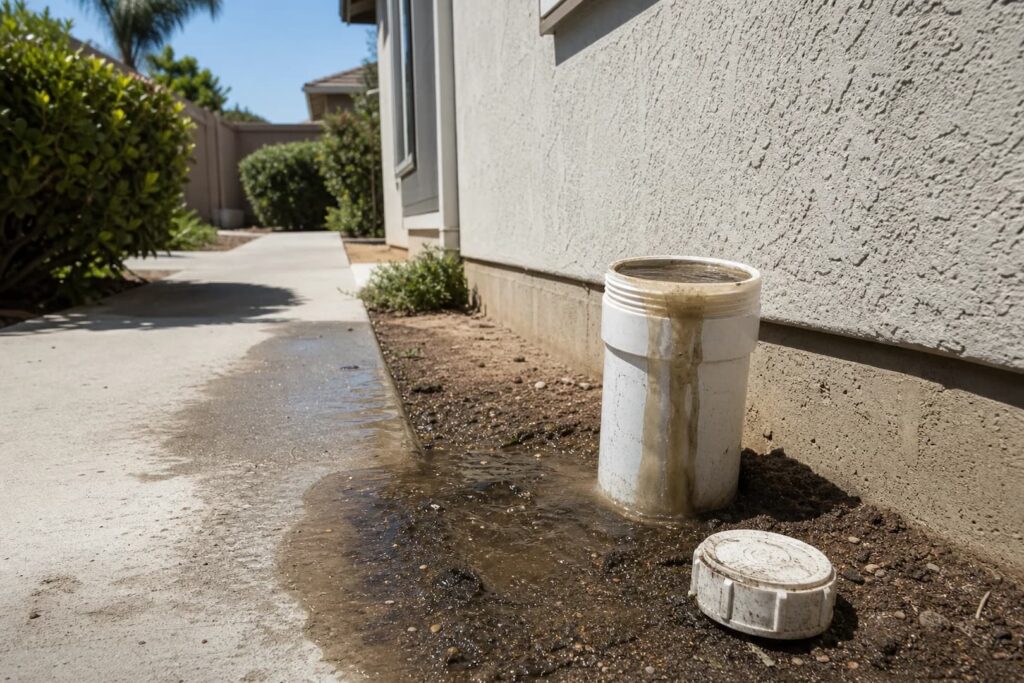
An overflowing sewer cleanout usually means wastewater cannot move past a blockage downstream of that opening. The cleanout has become the lowest available relief point, so sewage is escaping outdoors instead of continuing toward the street sewer or septic system.
That outdoor overflow is unpleasant, but it may be preventing the same water from rising through a shower, toilet, or floor drain inside the house. Do not put the cap back on to force the water down. A tight cap does not remove the obstruction; it simply redirects pressure to another opening or a weak pipe joint.
Stop all household water use immediately. Do not flush toilets, run faucets, shower, start laundry, or use the dishwasher. Keep children and pets away from the area, avoid direct contact with wastewater, and call for drain or sewer service. If sewage is actively entering the home or spreading toward neighboring property or a storm drain, explain that when you call so the situation can be prioritized correctly.
Smart Plumbing USA provides sewer line diagnostics and repair in Vista, CA. The right response may be a main-line cable, hydro jetting, camera inspection, septic service, or coordination with the local sewer utility. The location and behavior of the cleanout help decide which path makes sense.
What a sewer cleanout is supposed to do
A cleanout is an access opening connected to a drain or sewer line. Most exterior residential cleanouts use a threaded cap and may appear as one PVC or cast-iron riser, a two-way fitting, or a flush box in the ground. Plumbers use the opening to insert a cable, jetting hose, or inspection camera without removing a toilet or opening finished walls.
The cleanout is not a drain designed to spill water. Under normal conditions, wastewater passes below it in a closed pipe. When the pipe fills because flow is blocked, the water level rises into the cleanout riser. A loose, missing, damaged, or intentionally relieved cap lets that water out. A sealed cap may hold temporarily, but the backed-up water remains in the system.
Some properties have more than one cleanout. One may serve a kitchen branch, another a building drain, and a two-way exterior cleanout may provide access in both directions. Do not assume every white pipe near the house is a sewer cleanout. Irrigation, condensate, pool, and drainage components can look similar from a distance.
Immediate steps when the cleanout is overflowing
- Stop sending water down every drain. One toilet flush or washing-machine discharge can add enough volume to spread the overflow.
- Cancel automatic appliance cycles. Pause the washer and dishwasher according to their controls so they do not pump out unexpectedly.
- Create a safe perimeter. Keep people and animals off contaminated soil and pavement. Avoid tracking wastewater into the home.
- Leave the opening visible. Move clean objects away, but do not lean over the riser or try to seal it while it is full.
- Note what was running. Laundry, several showers, heavy rain, or one specific toilet can provide a useful diagnostic clue.
- Check indoors without operating fixtures. Look for standing water in the lowest tub, shower, toilet, or floor drain. Do not test-flush.
- Call for service. Report whether the overflow stops when water use stops and whether neighboring properties appear affected.
For minor containment, wear waterproof gloves, rubber boots, and eye protection. Cover any cuts. Do not use a wet/dry vacuum unless it is designed and managed for contaminated water, and never create an electrical hazard around wet pavement. A significant release deserves professional cleanup guidance as well as plumbing service.
What the cleanout level reveals about the blockage
If wastewater stands in or spills from a main cleanout, the obstruction is usually downstream of that access point. Water from the house has reached the cleanout but cannot continue. “Downstream” could mean farther across the yard, near the property connection, in a private septic component, or occasionally in the public sewer.
If the cleanout is empty while fixtures inside back up, the restriction may be upstream, between the affected fixtures and the cleanout. That can happen in a bathroom branch, kitchen branch, or building drain section that joins after another access point. It can also mean you found a cleanout for a different line.
| Cleanout condition | Indoor condition | Likely interpretation |
|---|---|---|
| Full or overflowing | Several fixtures slow or backed up | Restriction likely lies downstream of the cleanout |
| Empty | One bathroom backs up | Branch blockage may be upstream of the cleanout |
| Overflows only during heavy household use | Drains recover slowly | Partial obstruction or reduced downstream capacity |
| Overflows during rain even with little water use | Neighbors may have symptoms | Groundwater infiltration, public sewer surcharge, or a saturated septic system may need investigation |
| Cap area is wet but pipe level is low | Indoor drains normal | Past overflow, irrigation water, or a damaged cap should be distinguished |
This interpretation assumes the cleanout actually connects to the affected building sewer. Remodels, additions, and older properties can create unexpected routes. A plumber may trace the line with a camera and locator rather than relying only on visible placement.
Common reasons a sewer cleanout overflows
Paper, wipes, and accumulated solids
A large paper load can stop at a rough joint or a section already narrowed by buildup. Wipes, paper towels, hygiene products, and other non-dispersing materials are more persistent. They may travel until they meet roots, scale, an offset, or another object, then form a plug that grows with every flush.
Tree-root intrusion
Fine roots enter through defects where moisture escapes. They catch paper and expand into a dense mass. Cutting roots can reopen the line, but it does not close the failed joint. Recurring root blockage calls for camera documentation and a discussion of repair or a condition-based maintenance plan.

Grease, sludge, scale, and corrosion
Grease coats pipe walls instead of disappearing. Food particles, soap, and sediment stick to that coating. Cast iron can also develop heavy internal scale. The line loses usable diameter gradually, so the cleanout may overflow only when several fixtures run at once before it begins overflowing under lighter use.
A belly, offset, break, or collapse
A low section holds water and solids; an offset joint catches material; a crushed or collapsed pipe physically blocks the route. Cabling may pull debris from the opening, but no cleaning method can restore the original slope or alignment. Persistent standing water seen on camera after cleaning is an important clue.
A full or malfunctioning septic system
For a home on septic, the cleanout can overflow when the tank cannot accept flow, an outlet is blocked, a pump has failed, or the drainfield is saturated. Heavy rain may worsen the symptom. The EPA advises reducing water use and avoiding contact with sewage when a septic system backs up. Never enter a septic tank or lean into an open access point; toxic gases can incapacitate without warning.
A public sewer surcharge or downstream utility blockage
If multiple nearby properties have backups, the private lateral may not be the only issue. A municipal main can surcharge because of blockage, damage, equipment failure, or inflow during severe weather. Responsibility boundaries vary by location. A plumber can confirm the condition of the private line, while the sewer utility determines whether its system is affected.
Should you remove or replace the cleanout cap?
Do not remove a cap from a riser that appears full or pressurized. Wastewater can release quickly, and the cap itself may move suddenly as threads disengage. If the cap is already off, do not press it back onto an active overflow. Let the plumber approach the access with appropriate protective equipment and a containment plan.
Once the line is cleared and tested, a cracked, cross-threaded, or missing cap should be replaced with the correct type and size. The cap keeps debris, stormwater, insects, and roots out of the access. It also contains sewer gas. It should be serviceable, not buried under concrete or permanently glued shut.
A cap that repeatedly pops or leaks is not the core problem. It is revealing a line that repeatedly fills. Tightening it harder hides the symptom and may move the next overflow indoors.
How plumbers clear an overflowing sewer line
First, the plumber confirms the cleanout serves the affected line and determines the likely direction of the obstruction. Standing wastewater may need controlled relief before equipment can be set. The work area is isolated so a cable or hose does not spread contamination across a walkway.

A mechanical sewer cable can bore through paper, wipes, soft material, and some root masses. The correct cable and cutting head depend on pipe diameter, length, and condition. A small hand snake is not equivalent to a main-line machine. An undersized cable may open a narrow hole while leaving most buildup in place, and an inexperienced operator can kink or trap a cable.
Hydro jetting sends a controlled high-pressure water stream through a selected nozzle to scour grease, sludge, scale, and loose root material from the pipe wall. It is not automatically right for every pipe. Access, material, structural condition, blockage type, and the ability to manage discharged water all matter.
After flow returns, a camera can inspect joints and pipe condition. Running a camera through an opaque, completely full line often produces little useful information; clearing first usually improves visibility. The plumber may locate a defect above ground and record its distance from the access. That evidence distinguishes a clean-and-monitor situation from a repair.
How to tell whether the repair is complete
A falling cleanout level is only the beginning. The line should accept realistic household flow without filling. The plumber may run fixtures in stages, flush toilets, and watch the cleanout and lowest indoor drains. Water should move without a delayed surge, gurgle, or level rise.
If cabling opened the line but a camera shows dense remaining grease, further cleaning may be recommended. If the camera shows roots at an open joint, a sag full of standing water, or a crushed section, the cause has not disappeared just because the symptoms stopped. Ask for the observed location and condition in plain language. A useful repair recommendation should tie back to something seen or measured.
Cleaning the overflow area
Wait until the sewer is flowing and testing is complete. Photograph the release before cleanup if it caused material damage. Wear waterproof boots, gloves, and eye protection. Prevent wastewater from reaching storm drains, neighboring areas, play surfaces, or garden produce, and follow local guidance for a significant outdoor release.
Remove solids with disposable tools or materials suitable for contaminated waste. Clean hard surfaces with detergent and water, then use a compatible disinfectant according to its label. Never mix bleach with other cleaners. Contaminated soil, mulch, porous pavers, or landscaping may need more specific handling than a washable concrete path.
If anyone had direct exposure, wash skin with soap and clean water. Seek medical advice for exposure involving eyes, mouth, broken skin, or illness, especially for someone at higher risk. Plumbing service restores flow; it does not replace health or environmental guidance after a substantial sewage release.
Preventing another cleanout overflow
Flush only toilet paper and human waste. Keep grease, wipes, paper towels, dental floss, hygiene products, litter, and construction debris out of drains. Spread high-volume water use when the system has limited capacity, particularly on a septic property, but do not use conservation as a substitute for repairing a damaged line.
Pay attention to the weeks before an overflow. Slow tubs, toilet bubbles, sewer odor, and a cleanout that becomes damp under heavy use are valuable early signals. After a confirmed root or grease problem, base maintenance on the pipe condition and rate of recurrence. Blindly cabling on a fixed schedule can miss a worsening structural defect.
Keep the cleanout visible and accessible. Protect it from vehicle loads and landscaping damage. Replace a broken cap after the line is clear, and record the cleanout location for future owners or service technicians.
Frequently Asked Questions
Wastewater is reaching the cleanout but cannot continue downstream. A blockage, pipe defect, septic problem, or sewer surcharge is causing the line to fill and spill at the access opening.
Do not force a cap onto an active overflow. Sealing the opening does not clear the line and may redirect sewage into a tub, toilet, floor drain, or weak pipe joint inside the home.
A full or pressurized cleanout can release wastewater suddenly when the cap loosens. Do not lean over it or remove the cap casually. A plumber can manage the opening with protective equipment and containment.
Not necessarily. The obstruction is usually downstream of that cleanout, but it may still be in the private sewer lateral. Neighboring symptoms and a verified clear private line help determine whether the sewer utility should investigate.
A partial blockage may pass ordinary trickle flow but not the washer’s fast pump discharge. The high-volume release fills the restricted line and raises water through the cleanout.
Chemical cleaner is not a reliable answer for roots, wipes, heavy buildup, pipe damage, or a main sewer blockage. It can remain in the backed-up water and expose the technician who services the line.
Yes. Rain can contribute when groundwater enters damaged sewer pipes, a public sewer surcharges, or a septic drainfield becomes saturated. An overflow during low household use deserves investigation beyond a routine fixture clog.
Call immediately when wastewater is actively spilling, indoor fixtures are backing up, the overflow is approaching a storm drain or neighboring property, or the cleanout fills again after a temporary clearing.
Final thoughts
An overflowing sewer cleanout is a system warning, not a bad cap. Stop water use, keep people away from the spill, and leave the opening accessible without trying to seal a full line. A full cleanout usually places the restriction downstream; an empty one during an indoor backup points attention upstream or to a different branch.
Clearing restores flow. Inspection explains why the blockage formed and whether it is likely to return. That distinction matters when the cause is roots, pipe damage, or a septic or public-sewer condition rather than a one-time paper obstruction.