
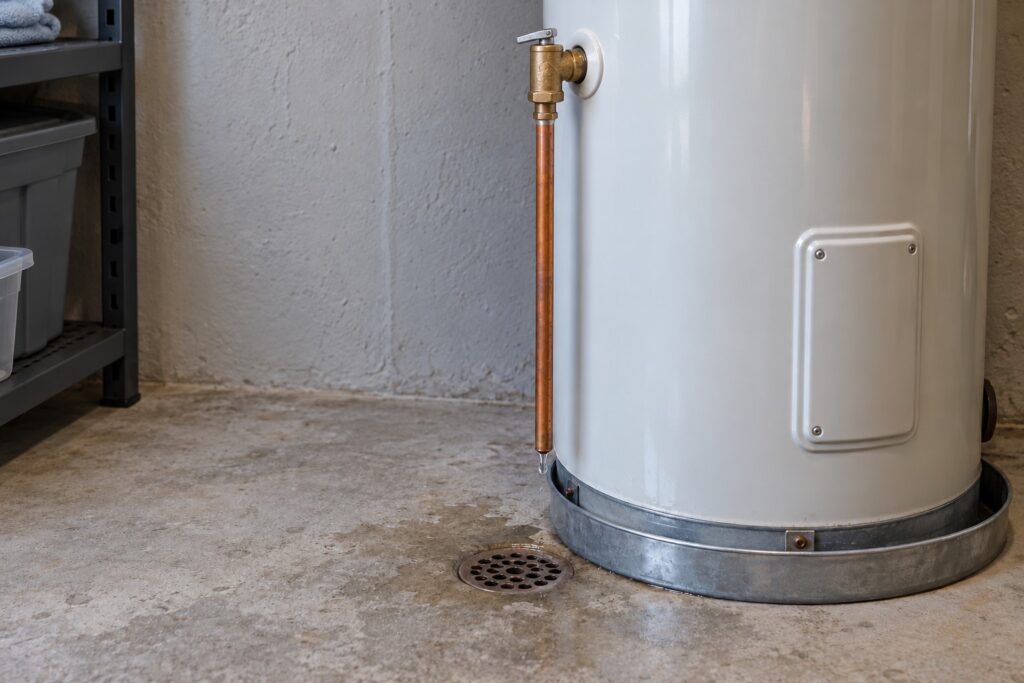
A leaking water heater pressure relief valve can be releasing excess pressure, responding to overheating, or failing to seal. Water around the valve’s threaded connection is a different problem from water coming out of its discharge pipe. The source and timing determine what needs repair; replacing the valve alone may leave the cause unchanged.
On a typical residential storage water heater, this component is a temperature-and-pressure relief valve, often called a T&P or TPR valve. It is a safety device. Recurring discharge needs attention, even when the pipe releases only a few drops.
What to do when the relief valve is leaking
Never cap, plug or install a shutoff valve in the relief outlet or discharge pipe. Do not tie the lever down, seal the opening with tape, or connect a hose that restricts flow. The outlet must remain able to release water if the heater becomes unsafe.
Stay clear of the discharge end. Steam, forceful hot-water release, unusually scalding tap water or water reaching electrical equipment calls for urgent help. Stop heating using the correct labeled control or breaker only if you can identify and reach it safely without entering water or approaching the discharge. Otherwise, leave the area and get help.
Do not open panels, drain the tank or operate the test lever to investigate an active fault.
If you smell gas or suspect a gas leak, leave immediately without operating switches or the heater’s controls. Call 911 or the gas utility from a safe location. SDG&E’s gas-leak instructions explain the evacuation precautions.
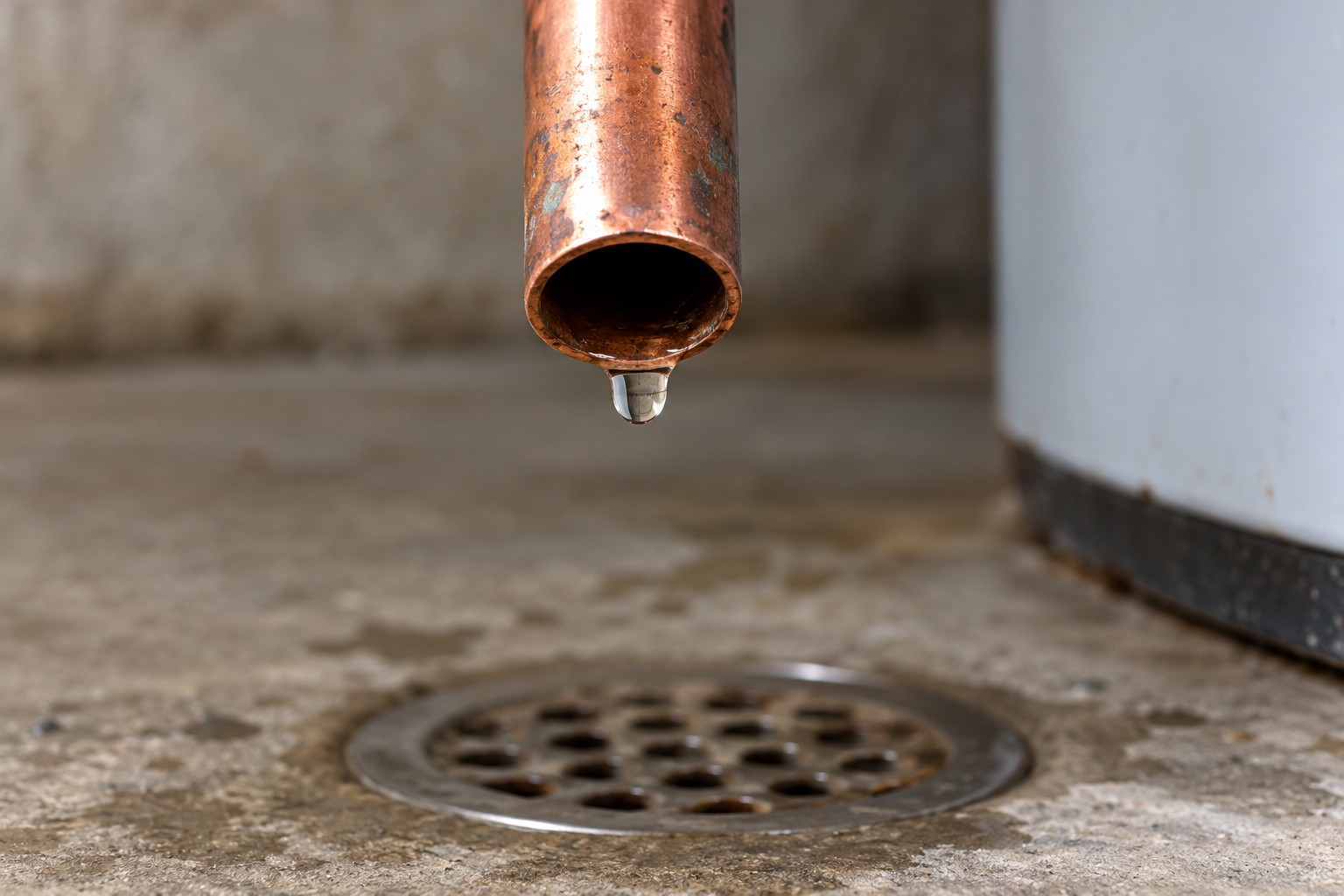
For a slow drip without those warning signs, arrange prompt plumbing service. Keep people away from the outlet and note when the dripping occurs. Do not assume that a dry pipe later means the problem has gone away. Watts describes recurring T&P discharge as a condition requiring evaluation, not routine water-heater operation.
Confirm which part is wet
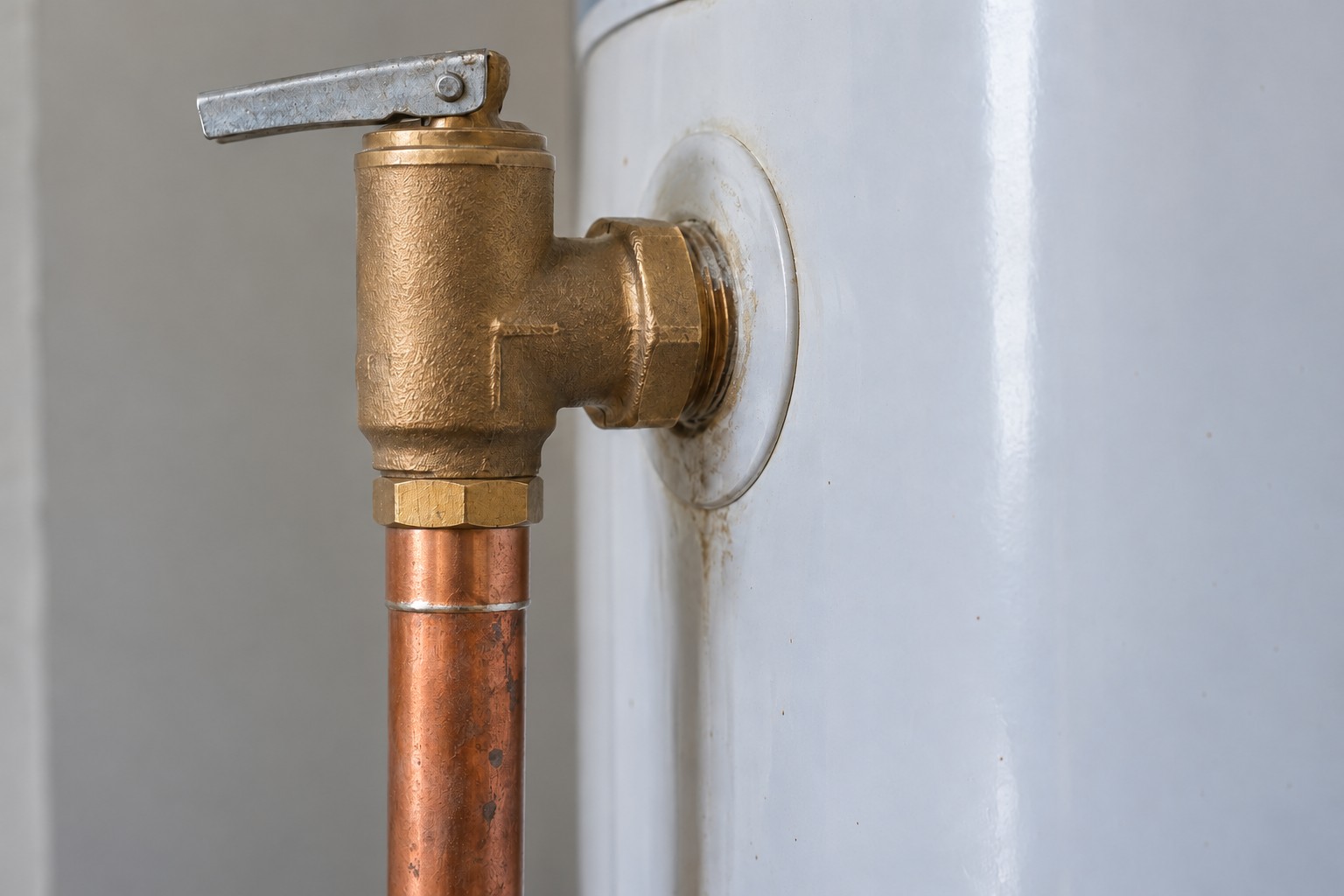
The T&P valve is usually near the top of the tank or on its upper side. It has a metal test lever and an outlet connected to a discharge pipe. The drain valve near the bottom of the tank, often with a hose connection, serves a different purpose. A pressure-reducing valve, or PRV, regulates incoming household water pressure; it is not the tank’s T&P safety valve.
From a safe distance, look for the first visible wet point: the open discharge-pipe end, the valve-to-tank threads, or the valve body and lever area. Water can also run down from a connection above. Use a flashlight without touching the valve or putting a hand under the outlet. Tell the plumber which surface becomes wet first; those locations do not all point to the same repair.
| Where and when water appears | Possible explanation | What the inspection should establish |
|---|---|---|
| Discharge pipe drips mainly during heating, after hot-water use | Pressure rising from thermal expansion | Pressure through the heating cycle and expansion-tank condition |
| Discharge continues between heating cycles | High supply pressure, a valve that cannot reseal, or another fault | Actual pressure and temperature before blaming the valve |
| Water appears around the valve-to-tank threads | A leaking threaded joint or damage at the tank fitting | The exact origin of the seepage and the fitting’s condition |
| Dripping began after someone operated the lever | The valve may not have fully reseated | Whether the valve needs replacement and why it remains open |
| Heavy hot-water discharge or steam | A potentially dangerous temperature or pressure condition | Urgent professional assessment with the area kept clear |
A.O. Smith’s relief-valve leak bulletin distinguishes a leaking threaded connection from discharge through the valve. If you cannot trace the water to either location, the guide to water leaking beneath a heater covers other sources.
Why the discharge pipe drips during heating
Water expands as it heats. After a shower, the heater warms incoming cold water and that growing volume needs room. In a closed plumbing system, a check valve or backflow device prevents it from pushing back toward the supply. Some pressure regulators also create this condition. Without adequate expansion control, pressure rises and the relief valve may open.
A drip during heating, followed by a dry outlet after the cycle or after someone uses water, fits this pattern. Pressure measurements still need to confirm it. A.O. Smith’s thermal expansion bulletin explains why the safety valve should not serve as the system’s regular expansion control.
An expansion tank can be present but ineffective
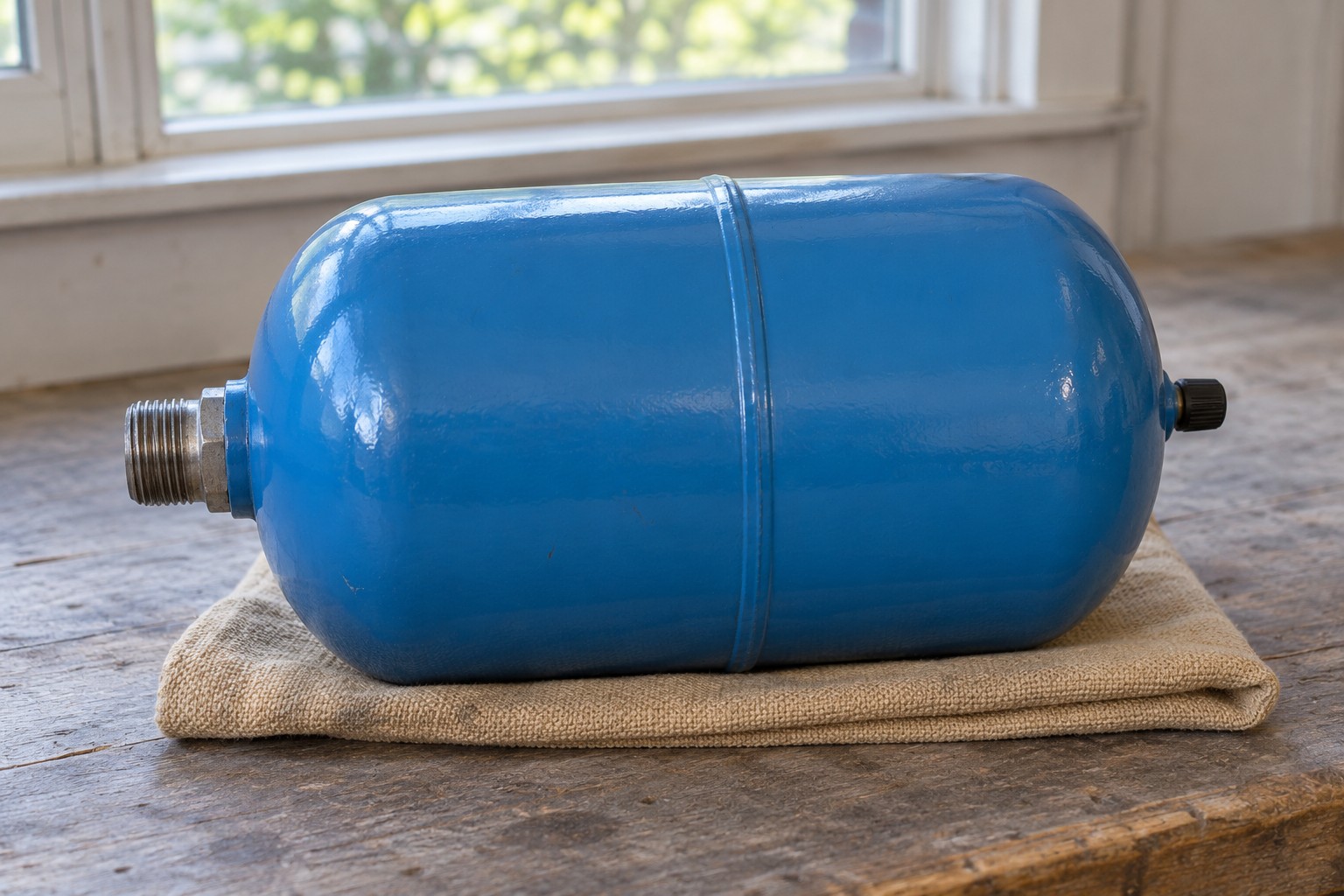
A potable-water expansion tank gives the extra water somewhere to go. Inside, a flexible diaphragm or bladder separates water from a pressurized air space. The air compresses as water enters. That capacity depends on correct sizing, installation and air charge.
A tank may lose its air charge, develop internal damage, or be too small for the installation. Its location matters too. If a check valve separates it from the heater, expanded water may not reach it. The tank’s presence on the piping does not prove that it works.
Have a plumber check it according to its manufacturer’s procedure. Do not press the air valve or add air to an old tank as an experiment. Amtrol’s expansion-tank instructions make the air charge and installation dependent on the water system; a factory setting is not a universal answer for every home.
Continuous leaking and leaks after a test or replacement
Steady dripping does not prove that the relief valve is defective. Household pressure may remain high, or the heater may have a temperature-control problem. A valve can also leak because deposits or wear prevent its internal seal from closing fully. Those possibilities need different repairs.
If the leak started after the test lever was lifted, tell the plumber exactly that. Water already inside the discharge pipe can take time to drain, but continuing fresh discharge needs attention. Do not repeatedly lift and release a symptomatic valve to try to make it stop. A.O. Smith’s water-heater maintenance instructions call for replacement when a tested valve fails to reset and continues releasing water.
A new valve that drips immediately deserves another diagnosis, not an assumption that the replacement is bad. The original pressure problem may remain. The replacement’s rating or installation may be wrong, or the water may be escaping at its threaded joint rather than through its outlet. Keep the old service invoice and the replacement part number if available.
What a plumber should test before choosing a repair
The technician needs to establish whether the valve is responding to excess pressure or temperature, or leaking even when both are within the equipment’s operating requirements. A dry outlet during a short visit cannot settle that question. Describe when the leak last occurred so the inspection can reproduce the relevant operating conditions safely.
Incoming pressure and the heating-cycle peak
A plumber can measure pressure with fixtures closed, compare it with pressure during flow, and monitor what happens as the heater recovers. A recording or maximum-reading gauge can reveal peaks that a single reading misses. The measurement point matters too, particularly where the house has a regulator or several check valves.
High incoming pressure and pressure that climbs mainly during heating are different findings. The first may call for pressure-regulator inspection or repair; the second directs attention toward expansion control. Both can occur in the same home. Adjusting a regulator without checking the heating cycle may leave the relief-valve drip unresolved.
Actual water temperature and control operation
A thermostat dial shows the selected setting, not proof of the temperature inside the tank. The technician checks actual temperature and whether the heating controls shut off correctly. A mixing valve can change the temperature delivered at a faucet, so comfortable tap water alone cannot establish that the tank is operating safely. Do not turn the thermostat up or down repeatedly to test the discharge.
The inspection should also confirm the expansion tank’s condition and usable capacity. Any air-charge measurement must follow the tank’s procedure with water pressure properly relieved; reading the air valve while the water side is pressurized can give misleading information. This is a service check, not a reason to release hot water yourself.
Replacing the valve without overlooking the cause
If the valve cannot seal reliably, replacement may be necessary even after a pressure problem is corrected. The replacement must suit the heater, not merely fit the threads. Its temperature and pressure ratings, discharge capacity, probe reach and connection details matter. The valve’s listed heat-input capacity must meet the heater’s requirements; a higher pressure setting is not a fix for repeated dripping.
Rheem’s installation guidance requires a correctly rated valve and an unrestricted discharge route. The pipe must use suitable material, drain properly and terminate safely where discharge can be observed. A plumber should correct unsafe piping as part of the work, rather than leave a sound new valve connected to a blocked or restricted outlet.
Water at the valve’s threaded joint may call for resealing or replacing a fitting. A leak from the tank’s welded connection is a different matter and may require heater replacement. Age alone does not decide the outcome. Ask the plumber to show where the leak begins and explain which part has failed.
Before finishing, the plumber should check the system under the conditions that produced the leak. That may mean observing a heating cycle and recording peak pressure. The price depends on whether the work involves a valve, expansion tank, regulator, controls or damage at the heater connection. Ask for the proposed work and cost after the inspection.
Questions about a dripping relief valve
Is a little water from the relief pipe normal?
For a typical U.S. residential storage heater, recurring T&P discharge is not something to accept as normal. The valve may be doing its safety job, but the condition making it open still needs correction. A few drops do not identify whether the cause is pressure, temperature or a valve that no longer seals.
Can I keep using hot water until the appointment?
Call for guidance based on the symptoms before continuing normal operation. Report active discharge and any unusually hot water. Steam, forceful discharge or overheating calls for urgent attention and safe shutdown, not another shower to see whether it clears. A leak that pauses is not proof that the heater is safe.
Why did it start after a new meter or regulator was installed?
A new check valve or backflow feature can change how expanded water moves through the system. Mention recent meter, regulator or water-heater work when booking service. The plumber can establish whether the plumbing is now closed and whether its expansion control matches the installation. Do not remove a check valve to stop the drip.
Relief-valve leak help in Vista and North County
Smart Plumbing USA provides water heater repair in Vista and serves North County. Call (858) 727-5522 with the heater type, where the water appears and whether the leak follows a heating cycle. Mention any recent valve replacement or pressure-regulator work so the visit can address the cause of the discharge.